

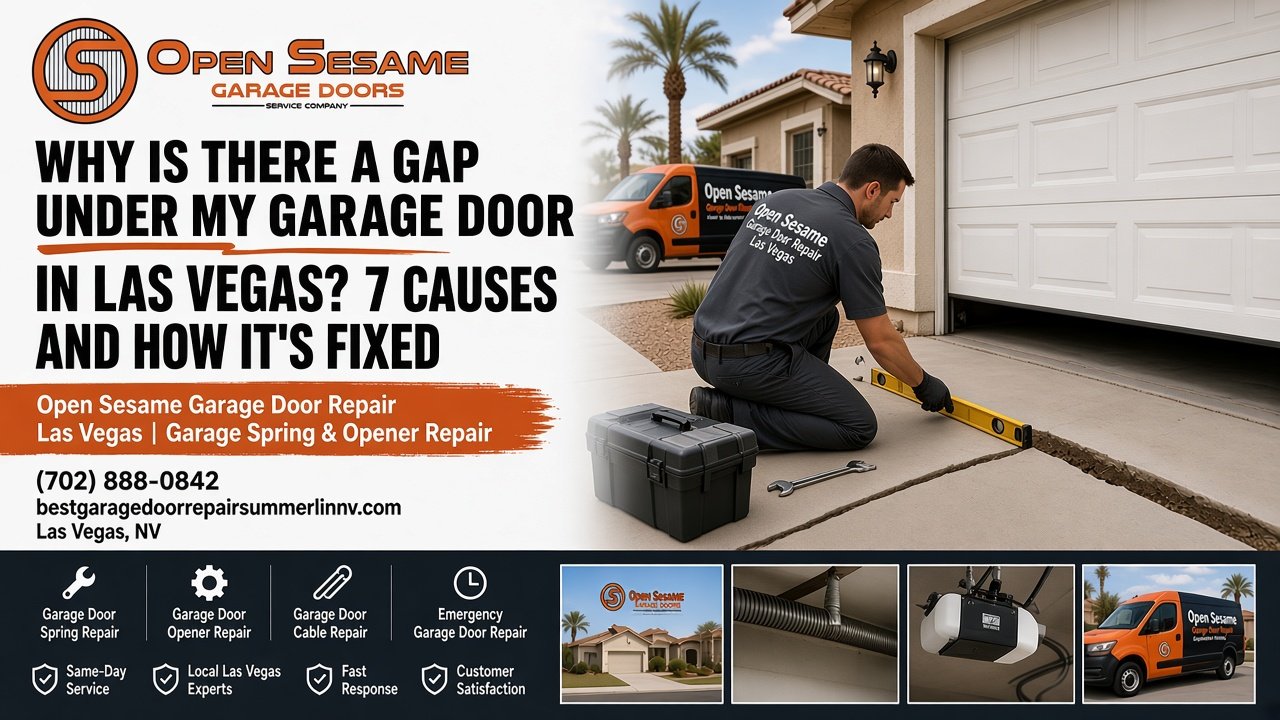
Open Sesame Garage Door Repair Las Vegas · Gap Under Garage Door Guide
Why Is There a Gap Under My Garage Door in Las Vegas? 7 Causes and How It’s Fixed
A gap under a closed garage door in Las Vegas usually comes from one of seven causes: a worn or shrunken bottom seal, an opener that stops the door short, an uneven or settled floor, a cable that has slipped or stretched, a spring problem that leaves the door out of balance, tracks or brackets that are out of line, or a bent bottom section or retainer. The shape of the gap tells you a lot. Small scattered gaps usually mean the seal. An even gap across the whole width usually means the opener. A wedge that’s wider at one end often means a cable, spring, or floor problem, and that kind deserves attention quickly, because a door hanging crooked can jam or come out of its tracks. This guide walks through all seven causes, how to tell them apart safely, how each is fixed, what the work costs on our posted price guide, and why the Las Vegas climate makes gaps such a nuisance here. Open Sesame Garage Door Repair Las Vegas (Nevada contractor licence #0083315) works across the valley from 7865 Bluewater Dr, Las Vegas, NV 89128, and is open 24 hours.
Why is there a gap under my garage door?
The most common reason is a bottom seal that has hardened, shrunk, or flattened in the heat. The next most common is an opener close-limit setting that stops the door before it reaches the floor. Less often, but more importantly, a gap means the door is hanging crooked because a lift cable has slipped on its drum, stretched, or frayed, or because a spring is broken or weak on one side. Uneven or settled concrete, bent tracks, loose track brackets, and a bent bottom section or seal retainer cause the rest.
Seal and opener fixes are usually quick. Cable, spring, and track problems involve parts under high tension and should be handled by a trained technician. On our posted cost guide, standard repairs run $150 to $350, off-track repair $150 to $350, two high-cycle torsion springs $250 to $450, and opener repair $150 to $300. A bottom seal replacement is quoted on-site.
Local context: Las Vegas heat hardens seals fast, spring winds push fine dust under any gap, monsoon storms from roughly July through September can send water under the door, and bark scorpions and rodents use gaps to get into garages. The National Weather Service in Las Vegas tracks the heat, wind, and storm patterns that drive these problems. Call (702) 888-0842 or view the business on Google Maps.
Read the Shape of the Gap First
Quick answer: Close the door, turn off the garage lights on a sunny day, and look at the light along the floor. Small patches point to the seal. An even line across the whole door points to the opener. A wedge that’s wider at one end points to a cable, spring, or floor problem. A gap in the middle only points to a dip in the slab or a bowed bottom section.
Before anyone buys a seal or touches the opener, it’s worth spending two minutes looking at the gap itself. Different causes leave different patterns, and the pattern narrows things down quickly.
| Gap pattern | Most likely causes | Urgency |
|---|---|---|
| Small, scattered patches of light; seal hard or cracked | Worn bottom seal (cause 1) | Low. Fix soon to keep out dust, water, and pests. |
| Even gap across the full width; seal still soft | Opener close limit set too high (cause 2) | Low to moderate. Adjust and test the safety reverse. |
| Gap only in the middle or at one low spot | Dip in the slab (cause 3) or bowed bottom section (cause 7) | Low. |
| Wedge, wider at one end; door looks crooked | Cable problem (cause 4), spring problem (cause 5), or sloped floor (cause 3) | High if new. Stop using the opener and have it checked. |
| Door stops partway down, or one side drags | Track or bracket misalignment (cause 6) | Moderate to high. Can lead to an off-track door. |
| Gap appeared after a loud bang | Broken spring (cause 5) | High. Don’t use the door. |
| Gap near one corner, retainer visibly bent | Bent retainer or bottom section (cause 7) | Low to moderate. |
The question that matters most is whether the gap is new and sudden or has been growing slowly. Slow growth over months usually means wear: the seal, the opener setting drifting, the floor settling. A gap that appeared overnight, or right after a loud noise, a stuck door, or a car bumping the door, usually means something broke or moved. That kind gets checked before the door is used again.
Is a Gap Under the Garage Door Dangerous?
A gap from a worn seal isn’t dangerous in itself. It’s a nuisance: dust, heat, water, and pests get in. A gap that comes from the door hanging crooked is a different matter.
A residential sectional door is heavy, and its weight is carried by springs through two lift cables, one on each side. When both cables carry their share, the door stays level. When one cable slips off its drum, stretches, or starts to fray, or when one spring breaks or weakens, more weight shifts to one side. The door tilts, and that tilt shows up as a wedge-shaped gap at the floor. If the opener keeps driving a tilted door, the low side can bind in its track, the high side can pull out of its track, rollers can jump out, and in the worst case a cable can snap or the door can drop. That’s the scenario we want people to avoid.
If the gap is new, wedge-shaped, or appeared after a bang: stop using the opener, keep people and pets away from the door, and don’t try to adjust springs, cables, drums, or bottom brackets yourself. These parts are under high tension. DASMA’s garage door safety tips warn homeowners to leave spring and cable work to trained technicians. If the door is stuck open and you need it secured, call. We’re open 24 hours.
There’s another safety angle. If someone “fixes” a gap by turning up the opener’s force so it pushes the door harder against the floor, the opener may not reverse when it should. The safety reverse protects people, especially children, and pets. The Consumer Product Safety Commission explains why automatic openers must reverse on contact and have external entrapment protection such as photo-eyes. After any change to the opener or the bottom of the door, test the reverse.
Cause 1: A Worn, Shrunken, or Torn Bottom Seal
Quick answer: This is the most common cause in Las Vegas. Heat and sun make the rubber or vinyl strip along the bottom of the door hard, shrunken, and flat, so it no longer fills the small dips in the floor. Replacing the seal, and checking the retainer that holds it, fixes it.
What it looks like. Small patches of light along the floor, usually worse at the ends and at low spots. The seal feels stiff when you press it, may have surface cracks or a chalky film, and its ends often stop short of the door edges. You may see a fan of dust inside the door after windy days.
Why it happens here. Most bottom seals are vinyl or a rubber blend. Vinyl stays soft because of plasticizers in the material, and heat and UV slowly drive those out. Las Vegas summers, with highs above 100°F and strong sun, speed that up, especially on doors that face west or south. The seal also sits above a concrete driveway that radiates heat. Over a few summers a basic vinyl seal can go from soft to stiff, and a stiff seal can’t conform to the floor. Seals also shrink in length as they age, pulling back from the corners.
How it’s fixed. On most steel doors, the seal slides into an aluminum retainer channel on the bottom of the door. The old seal comes out, the channel is cleaned and checked for bends or corrosion, and a new seal of the right profile and width goes in, left slightly long and secured at the ends so it can’t creep back. Wood doors usually take a nail-on or screw-on seal. After the new seal is on, the opener’s close limit often needs a small adjustment, because the fuller seal touches the floor sooner, and the safety reverse has to be tested.
What to watch for. The wrong seal profile is the most common DIY mistake. Slide-in seals must match the retainer channel exactly. A bent or corroded retainer won’t hold a new seal straight. And never loosen the bottom brackets at the corners to get the retainer off, because the lift cables attach there under spring tension.
We cover seal replacement in depth in Garage Door Bottom Seal Replacement in Las Vegas: When Should You Replace the Weatherstrip?, and for Summerlin homes in Garage Door Bottom Seal Replacement in Summerlin.
Cause 2: The Opener Stops the Door Short
Quick answer: If the seal is soft and in good shape but there’s an even gap across the whole door, the opener is probably stopping the door before it reaches the floor. The close-limit setting needs adjusting, followed by a safety reverse test.
What it looks like. A uniform line of light the full width of the door, often a half inch or so. The seal is fine. If you watch the door close, it stops and sits just above the concrete. Sometimes the door touches down and then reverses back up instead.
Why it happens. Every automatic opener has travel limits that tell it where “closed” and “open” are. On older openers they’re set with screws or dials on the motor head. On newer ones they’re set electronically with buttons. Limits can be set wrong at installation, drift over time, or be changed by someone trying to stop the door reversing. A common sequence: a new, fuller seal is installed, the door starts reversing at the floor, someone raises the close limit to stop it, and now the door stops short. Heat can play a part too. Some older openers’ limit settings and the door’s own dimensions change a little between hot afternoons and cool mornings.
How it’s fixed. The close limit is set so the door comes fully down and compresses the seal slightly. The force setting is checked and left where the manufacturer intends. Then the door is tested: it must reverse when it closes on a 2×4 laid flat in its path, and it must stop and reverse when the photo-eye beam is broken. If the opener can’t be set to close fully and still pass those tests, it needs repair. Openers that are very old or lack photo-eyes are usually better replaced.
What not to do. Don’t turn up the force to make the door close. That’s the setting that decides how hard the door pushes before it gives up and reverses. Higher force can mean the door won’t reverse on a person or pet. The UL 325 standard exists for exactly this reason.
If your door touches down and goes back up, our guide to a garage door that closes then opens again in Las Vegas covers the other causes, including dirty or misaligned photo-eyes. For opener service see Las Vegas garage door opener repair.
Cause 3: An Uneven, Sloped, or Settled Floor
Quick answer: If the door hangs level and the seal is good but there’s still a gap at one spot or one side, the concrete may be uneven. A wider seal or a floor-mounted threshold seal usually fixes small dips. Larger slope or settling may need concrete work.
What it looks like. A gap in one place that doesn’t move: in the middle, at one end, or across a crack in the slab. The door itself looks level against the bricks or siding on either side of the opening. If you put a level on the floor across the opening, you’ll see the dip or slope.
Why it happens. Garage slabs are poured to slope toward the driveway so water drains out, and they’re rarely perfectly flat side to side. Some develop a dip where the driveway apron meets the garage slab. On older homes, slabs can settle unevenly over decades, particularly where soil was disturbed or where water has pooled. Parts of the valley have expansive or collapsible soils that move when they get wet, and long-term irrigation near the driveway can contribute. A crack across the threshold can leave one side slightly lower than the other.
How it’s fixed. For a small dip, the usual fix is a bottom seal with a little more reach, so it fills the low spot while still compressing evenly elsewhere, with the opener’s limit set to match. For a dip or slope that’s too big for a seal, a threshold seal glued to the floor can raise the landing surface where it’s needed. Where the slab has settled badly, or the driveway slopes toward the garage so storm water runs at the door, the right fix may be concrete repair or a drain. That’s work for a concrete contractor, not a garage door company, but it’s important to know before spending money on seals.
What not to do. Don’t try to bend the door or the bottom section to match the floor, and don’t adjust the cables to make one side hang lower. A door has to hang level and balanced to run safely. Make the seal or threshold match the floor, not the door.
Cause 4: A Slipped, Stretched, or Frayed Lift Cable
Quick answer: If the gap is wedge-shaped and the door looks crooked, a lift cable may have slipped on its drum, stretched, or begun to fray, so one side of the door hangs lower than the other. This is a high-tension repair for a technician. Stop using the opener until it’s checked.
What it looks like. One side of the door touches the floor and the other doesn’t, leaving a gap that widens toward one end. The door may look tilted in the opening. You might see a cable that’s slack, loose on its drum at the top, or frayed near the bottom bracket. The door may also make new noises or move unevenly.
Why it happens. On a torsion spring door, a steel cable runs from each bottom corner up to a drum on the spring shaft above the door. The springs turn the shaft, the drums wind the cables, and the door lifts evenly. If one cable slips a groove on its drum, it becomes effectively longer or shorter than the other, and the door tilts. Cables can also stretch slightly over years, or fray, often near the bottom where moisture and corrosion attack them. Sprinklers that hit the door and storm water at the threshold speed up corrosion at the bottom brackets. A door that hits an obstruction while closing, or a car that bumps the door, can also knock a cable off its drum.
How it’s fixed. A technician secures the door, relieves spring tension as needed, re-seats or replaces the cable, checks both drums and the bottom brackets, and rebalances the door so both cables share the load. Frayed cables are replaced, usually in pairs. Then the door is tested for balance, the opener limits are checked, and the safety reverse is tested. Cable repair falls under our standard repair range of $150 to $350.
Why it’s urgent. A door hanging on one cable can bind, twist in its tracks, or come off them. A frayed cable can snap. Please don’t try to re-wrap a cable or loosen a bottom bracket yourself. Read more in frayed garage door cable in Las Vegas: can you keep using the door? and garage door cable came off the drum, or see our Las Vegas garage door cable repair service.
Cause 5: A Broken or Weak Spring and an Unbalanced Door
Quick answer: On doors with two torsion springs, one broken or weakened spring can leave the door unbalanced, so it hangs or closes unevenly and leaves a gap. A fully broken spring usually announces itself with a loud bang. Spring replacement is a technician’s job; two high-cycle torsion springs run $250 to $450 on our posted cost guide.
What it looks like. The door may close crooked, slam down faster than usual, or stop and reverse because the opener senses the extra weight. You may see a gap of an inch or two in one of the springs on the shaft above the door. Sometimes the door won’t open at all, or opens a few inches and stops. If one side of a two-spring door is weaker, the gap at the floor can be wedge-shaped, much like a cable problem.
Why it happens. Springs are rated for a number of open-and-close cycles, and every cycle uses some of that life. A busy household can work through a standard spring’s rated life within several years. Springs also lose tension gradually as they age, so the door becomes heavier for the opener to lift and less able to close evenly. Corrosion and lack of lubrication shorten their life. When one spring of a pair breaks, the other is usually close behind, which is why we generally replace them as a pair.
How it’s fixed. The broken or tired springs are replaced with springs sized to the door’s actual weight, wound to the correct tension, and the door is balanced so it stays put when lifted halfway by hand with the opener disengaged. Cables and drums are checked at the same time, since spring failures often stress them. Then the opener’s limits and the safety reverse are tested.
Why not to use the door. With a broken spring, the opener is trying to lift most of the door’s weight on its own. That strains the opener and can bend the door or pull it out of its tracks. Lifting it by hand can also be dangerous, because the door is much heavier than it seems. Our guides loud bang and the door won’t open and can you open a garage door with a broken spring? explain what to do. See Las Vegas garage door spring replacement for service details.
Cause 6: Tracks or Track Brackets Out of Line
Quick answer: If the vertical tracks on either side of the door are bent, loose, or out of plumb, the door can bind on the way down and stop before it reaches the floor, or land unevenly. Track adjustment is usually a standard repair, posted at $150 to $350. A door that has already come out of its tracks is off-track repair, also $150 to $350.
What it looks like. The door slows, jerks, or rubs at the same spot every time it closes. One side may land later than the other. You may hear scraping or see rollers that sit at odd angles. Track brackets on the wall may have loose bolts, or the track may be visibly kinked where something hit it. In more serious cases a roller pops out of the track, and the door hangs crooked or stops partway.
Why it happens. Track brackets are lag-bolted to the framing beside the opening, and constant vibration can loosen them over years. Cars, bikes, and stored items bump the tracks. Rollers that are worn or seized drag in the track instead of rolling. A door hanging crooked from a cable or spring problem also pulls on the tracks. Once the track is out of line, the door can bind before it reaches the floor, the opener may stop or reverse because it senses resistance, and a gap appears.
How it’s fixed. A technician checks the tracks for plumb and spacing, tightens or resets the brackets, straightens minor bends or replaces a damaged track section, and replaces worn rollers if needed. If the door is off track, it’s secured and carefully reset, with the cause found and fixed so it doesn’t happen again. Then balance, limits, and the safety reverse are checked.
Don’t force it. If a door is binding or a roller is out of the track, running the opener again can make it worse. Read garage door off track in Las Vegas and why a garage door lifts unevenly or grinds, or see Las Vegas garage door track adjustment.
Cause 7: A Bent Bottom Section or Seal Retainer
Quick answer: If the door’s bottom section or the aluminum seal retainer has been bent by a car, a closing door landing on something, or corrosion, the bottom edge is no longer straight and can’t seal against the floor. A bent retainer is usually a standard repair. A badly damaged bottom section may need panel replacement.
What it looks like. A gap near one spot, often near a corner, with a visible bend, kink, or bulge in the bottom of the door. The seal may be popping out of the retainer at that spot. The bottom section may be dented or bowed, or its steel skin may be rusting at the corners where water sits.
Why it happens. Cars backing out too early, the door closing on a trash bin or bike, and storm water or sprinkler overspray at the threshold all hit the bottom of the door hardest. Aluminum retainers bend easily and corrode where water and pool chemicals sit. The steel skin of the bottom section can rust from the bottom up on older doors that sprinklers have soaked for years.
How it’s fixed. A slightly bent retainer can sometimes be straightened. A kinked, split, or corroded one is replaced, then a new seal is fitted. If the bottom section itself is bent or rusted through, a replacement section may be available, or the section can be repaired if the damage is limited. The bottom brackets sit at the ends of the bottom section and hold the lift cables, so any work that touches them must be done with spring tension controlled. That’s not a DIY job. See garage door panel replacement and bent garage door panel repair.
Gaps That Come and Go, and Gaps at the Sides
Not every gap is there all the time. Some appear only on certain days, and some aren’t at the bottom at all. These patterns have their own explanations.
A gap that shows up on cold mornings
Seals stiffen in the cold. A seal that summer heat has already hardened may lose contact on a chilly winter morning, then soften enough to seal again by afternoon. If the opener’s close limit is set so the door only just reaches the floor, the problem is worse. The fix is usually a new seal, a small limit adjustment, or both.
A gap that shows up on hot afternoons
Steel doors and aluminum retainers expand a little in the heat, and a long double door can bow very slightly when the sun hits its face. On most doors this is minor. If a door’s reinforcing strut is missing or bent, or the door is already slightly bowed, the heat can be enough to lift the middle off the floor. A strut repair or the right seal usually handles it.
A gap that appeared after a storm
Monsoon gusts can push on a closed door hard, and storm water at the threshold can wash grit under the seal or soften the soil under a slab edge. If a gap appeared after a storm, check for debris under the seal first, then look at whether the door is still level.
A gap that appeared after the car touched the door
Even a light bump can bend the retainer, kink a track, or knock a cable off its drum. If the door was hit, have it checked before running it again, especially if it now looks crooked.
Gaps at the sides or top
Light at the sides or top of the door usually isn’t the bottom seal. It’s the perimeter weatherstrip, the vinyl stop molding on the jambs and header with a flap that rests against the door. In the Las Vegas sun those flaps crack and curl, and dust comes in at the sides. Replacing the stop molding fixes it. It should touch the door lightly; molding set too tight drags on the door and makes the opener work harder. A gap at one side that’s much wider than the other can also mean the door has shifted in its tracks, which takes us back to cause 6.
Which Causes Show Up on Which Las Vegas Homes
Across the valley, the age and setting of a home shift the odds between the seven causes. This isn’t a rule, but it’s a useful starting point.
- Older central and east-side homes. Settled slabs and threshold dips (cause 3) are more common, along with retainers that have been bent or corroded over decades (cause 7). Doors have often been replaced at least once, so parts can be mixed.
- 1990s and 2000s tract homes in the northwest, southwest, and Henderson. Worn builder-grade seals (cause 1) and springs reaching the end of their cycles (cause 5) are the usual suspects. Many of these doors are on their second or third set of springs.
- Newer homes. Slabs are usually flatter and seals newer, so an even gap often points to an opener close limit that was set short at installation (cause 2). Construction dust from nearby building sites can also wear seals early.
- Homes with sprinklers aimed at the driveway. Corroded bottom brackets and frayed cable ends (cause 4) and rusted bottom sections (cause 7) show up more often where water hits the door every day.
- Rentals. Tenants often don’t report a gap until dust or pests get bad, and a crooked door can go unnoticed. Check the bottom of the door at every turnover.
- Busy households with several drivers. High daily cycles wear springs and rollers faster (causes 5 and 6), and more cars mean more chances to bump a track or the bottom of the door.
Whatever kind of home you have, the fastest way to the right fix is the same: read the shape of the gap, check that the door hangs level, and test the safety reverse. Then fix the cause, not just the symptom.
What Each Fix Costs in Las Vegas
Quick answer: The cost depends on the cause. A bottom seal is quoted on-site. Opener limit and track adjustments, cable work, and retainer replacement fall under standard repair at $150 to $350. Two high-cycle torsion springs run $250 to $450, off-track repair $150 to $350, opener repair $150 to $300, and a new installed opener $550 to $950. Those are the only figures on our posted cost guide.
| Cause | Typical fix | Posted range |
|---|---|---|
| 1. Worn bottom seal | New seal; retainer checked | Quoted on-site; standard repair $150–$350 if retainer or limit work is needed |
| 2. Opener stops short | Close-limit adjustment and safety test, or opener repair | Standard repair $150–$350, or opener repair $150–$300 |
| 3. Uneven floor | Wider seal or threshold seal; concrete work if severe | Quoted on-site; concrete is a separate trade |
| 4. Cable problem | Re-seat or replace cables, rebalance | Standard repair $150–$350 |
| 5. Broken or weak spring | Two high-cycle torsion springs, balance | $250–$450 |
| 6. Tracks out of line | Track adjustment or off-track repair | $150–$350 |
| 7. Bent retainer or bottom section | Retainer replacement, or section repair/replacement | Standard repair $150–$350; sections quoted on-site |
| Old opener that can’t be set safely | New opener with photo-eyes | $550–$950 |
Two points worth knowing. First, more than one cause is common. A door with a frayed cable often has a tired seal too, and the opener limit may have been changed to compensate. A good technician will show you each problem and price each fix, so you can decide. Second, fixing the cause first usually saves money. Putting a thicker seal on a crooked door costs money now and doesn’t prevent the cable or spring failure that’s coming. See our Las Vegas garage door repair cost guide for how we price work.
Why a Gap Under the Door Is a Bigger Deal in Las Vegas
In a mild climate, a small gap under the garage door is mostly a draft. In Las Vegas it’s an open invitation for four things.
Dust
Spring wind events and summer storm gusts move a lot of fine dust across the valley. Any gap under the door lets it drift in, where it coats cars, tools, storage, and the door’s own rollers and tracks. Dust in the tracks and on the rollers adds wear to the whole system.
Heat
Garages here already get very hot in summer. A gap at the floor lets hot air from the driveway in all afternoon. If the garage is attached, some of that heat reaches the house, and if you use the garage as a gym, workshop, or for a second fridge, it matters more.
Monsoon water
Summer storms can drop heavy rain quickly. Water running down a driveway that slopes toward the garage will find any gap. It soaks boxes, rusts the bottom of the door, and corrodes the retainer and bottom brackets.
Scorpions, insects, and rodents
Bark scorpions are common in the valley and can fit through very narrow gaps. Crickets, roaches, and mice use the same openings. A tight seal won’t make a garage pest-proof, but it closes the easiest door they have.
This is why we suggest checking the bottom of the door before summer and again before monsoon season. Our pre-summer maintenance checklist includes the seal along with springs, cables, rollers, and photo-eyes, and a garage door tune-up, posted at $89 to $129, includes a weather-seal check.
Safe Checks You Can Do Yourself
You can narrow down the cause without touching any part under tension. Keep hands away from springs, cables, drums, bottom brackets, and the joints between sections.
- Look at the gap. Close the door, turn off the garage lights on a sunny day, and note where light shows and whether it’s patches, an even line, a middle dip, or a wedge.
- Look at the door in the opening. From outside, compare the bottom of the door to the brick or stucco lines on each side. Is it level, or tilted?
- Look at the seal. With the door closed, press it with a thumb. Soft and springy, or hard and cracked? Do the ends reach the door edges?
- Look at the cables and springs from a distance. Do both cables look tight and similar? Is there a visible gap in a spring on the shaft above the door? Don’t touch them.
- Watch a full close. Does the door travel smoothly, land on both sides at once, and stop on the floor? Or does it stop short, reverse, or land one side first?
- Test the safety reverse. Lay a 2×4 flat on the floor under the door and close it. The door should reverse after touching the board. Then break the photo-eye beam with a box while it’s closing; it should stop and reverse. If either test fails, stop using the opener.
If what you see is patches of light and a hard seal, cause 1 is the likely answer. An even line and a good seal points to cause 2. Anything with a tilt, a slack cable, a gapped spring, or a sudden change should be checked by a technician before the door is used again.
How a Technician Diagnoses a Gap Under the Door
When we come out for a gap, here’s the order we work in. It’s designed to find the real cause, not just the obvious one.
- Watch the door run. Open and close with the opener, listening and watching for binding, uneven travel, and how it lands.
- Disengage the opener and check balance. Lift the door by hand to about halfway. A balanced door stays put. One that drops or rises points to spring problems.
- Inspect cables, drums, and bottom brackets. Look for fraying, slack, a cable off its groove, and corrosion at the brackets.
- Inspect springs. Look for gaps, stretching, and corrosion, and check whether the springs suit the door’s weight.
- Check tracks and rollers. Plumb, spacing, bracket bolts, bends, and roller condition.
- Check the bottom of the door. Seal condition, retainer straightness and corrosion, and the bottom section itself.
- Check the floor. Dips, slope, cracks, and the driveway grade.
- Check the opener. Limits, force, photo-eye alignment, and the safety reverse.
- Explain and price. Show you what was found, explain which fix addresses the gap, and give you prices before any work starts.
If you’d like to verify any contractor before they work on your door, Nevada contractors must be licensed by the Nevada State Contractors Board. You can check a licence on the board’s public licence search. Open Sesame Garage Door Repair Las Vegas holds licence #0083315.
Gap Myths and Bad Fixes
“Just put a thicker seal on it.”
A thicker seal can fill a small floor dip. It won’t fix a crooked door, and it often makes the opener reverse at the floor.
“Turn the force up so it closes all the way.”
That weakens the safety reverse. Adjust the close limit instead and test with a board.
“Wind the cable back onto the drum yourself.”
Cables carry spring tension. Re-wrapping one without releasing and controlling that tension is how people get hurt.
“A small gap doesn’t matter in the desert.”
In Las Vegas a gap lets in dust, heat, storm water, and scorpions. And if it’s from a crooked door, it’s an early warning.
“Stuff a towel under the door.”
Fine for one windy night. As a long-term fix it can keep the door from closing fully and interfere with the safety reverse.
Gap Under Your Garage Door? We’ll Find the Real Cause
Open Sesame Garage Door Repair Las Vegas checks the seal, opener, floor, cables, springs, tracks, and bottom section, tells you which one is causing the gap, and prices the fix before any work starts. Open 24 hours.
About Open Sesame Garage Door Repair Las Vegas
Open Sesame Garage Door Repair Las Vegas repairs residential garage doors across the Las Vegas Valley from 7865 Bluewater Dr, Las Vegas, NV 89128. We hold Nevada contractor licence #0083315 and we’re open 24 hours. This guide is based on the causes of floor gaps our technicians see on Las Vegas doors, the posted prices on our cost guide, and safety guidance from the CPSC, DASMA, and the UL 325 standard.
Call (702) 888-0842, or view Open Sesame Garage Door Repair Las Vegas on Google Maps.
Frequently Asked Questions About a Gap Under a Garage Door in Las Vegas
Why is there a gap under my garage door?
The most common cause is a bottom seal that heat has hardened, shrunk, or flattened. Next is an opener close limit that stops the door before it reaches the floor. Other causes are an uneven or settled floor, a slipped or frayed lift cable, a broken or weak spring, tracks out of line, and a bent bottom section or seal retainer.
How do I tell what’s causing the gap under my garage door?
Look at the shape of the gap with the lights off on a sunny day. Small scattered patches usually mean the seal. An even line across the whole door with a soft seal usually means the opener limit. A gap only in the middle suggests a floor dip. A wedge that’s wider at one end suggests a cable, spring, or floor problem.
Is a gap under my garage door dangerous?
A gap from a worn seal is a nuisance, not a hazard. A new wedge-shaped gap from a door hanging crooked can be dangerous, because a slipped cable or broken spring can lead to the door binding, coming off its tracks, or dropping. Stop using the opener and have it checked.
Why is my garage door lower on one side?
Usually a lift cable has slipped on its drum, stretched, or frayed, or a spring on one side is broken or weak, so the door’s weight isn’t shared evenly. A sloped floor can also make a level door look crooked. Don’t adjust cables or springs yourself; they’re under high tension.
How much does it cost to fix a gap under a garage door in Las Vegas?
It depends on the cause. A bottom seal is quoted on-site. Standard repairs such as opener limit, cable, track, or retainer work run $150 to $350 on our posted cost guide. Two high-cycle torsion springs are $250 to $450, off-track repair $150 to $350, opener repair $150 to $300, and a new installed opener $550 to $950.
Can I fix a gap under my garage door myself?
You can safely check the gap, the seal, and the safety reverse, and many homeowners can replace a slide-in seal or adjust an opener’s close limit using the manual. Cable, spring, drum, and bottom bracket problems should be left to a trained technician because they involve high spring tension.
Why does my garage door stop an inch above the floor?
The opener’s close limit is likely set too high, so it stops the door short. Adjust the limit so the door compresses the seal slightly, then test the safety reverse with a 2×4 laid flat under the door. Don’t turn up the force setting.
Why does my garage door touch the floor and go back up?
The opener may sense the floor or a new, fuller seal as an obstruction because the close limit is set too far down or the force is set too low for the door. A misaligned or dirty photo-eye can also cause reversing. The limit should be adjusted and the safety reverse tested.
Can an uneven garage floor cause a gap?
Yes. Slabs slope for drainage and can have dips or settle over time. If the door hangs level and the seal is good but light shows in one spot, a seal with more reach or a floor-mounted threshold seal often fixes it. Severe settling may need concrete repair.
Will a thicker bottom seal fix the gap?
Only if the cause is a small dip in the floor. A thicker seal won’t fix a crooked door, an opener that stops short, or a bent track, and it can make the opener reverse at the floor. Find the cause first.
Why is there a gap at the sides of my garage door?
Side and top gaps usually come from worn perimeter weatherstrip, the vinyl stop molding with a flap that rests against the door. Sun cracks and curls it. Replacing it fixes the gap. A side gap much wider on one side can also mean the door has shifted in its tracks.
Can scorpions get under a garage door gap?
Yes. Bark scorpions are common in the Las Vegas Valley and can pass through very narrow gaps, as can crickets and mice. A seal that touches the floor across the whole door closes one of the easiest entry points, though it won’t make a garage completely pest-proof.
Why does the gap under my door come and go?
Seals stiffen on cold mornings and soften in the afternoon, so a hardened seal may lose contact only when it’s cool. Heat can also bow a long door slightly. If the gap changes with the temperature, the seal is likely worn or the close limit is set too tight to the floor.
Should I keep using my garage door if it’s crooked?
No. If the door is hanging lower on one side, especially if the change was sudden or followed a loud bang, stop using the opener, keep people clear, and call a technician. Running a crooked door can bend tracks, damage the door, or cause a cable to fail.
How do I test my garage door’s safety reverse?
Lay a 2×4 flat on the floor in the door’s path and close the door with the opener. It should reverse after touching the board. Then break the photo-eye beam with a box while the door is closing; it should stop and reverse. If either test fails, stop using the opener until it’s fixed.
Where is Open Sesame Garage Door Repair Las Vegas?
Open Sesame Garage Door Repair Las Vegas is at 7865 Bluewater Dr, Las Vegas, NV 89128, is open 24 hours, holds Nevada contractor licence #0083315, and serves the Las Vegas Valley. Call (702) 888-0842 or open the Google Maps listing for directions.
Find Open Sesame Garage Door Repair Las Vegas
View Open Sesame Garage Door Repair Las Vegas on Google Maps · Serving the Las Vegas Valley from 7865 Bluewater Dr, Las Vegas, NV 89128
Close the Gap the Right Way
Call Open Sesame Garage Door Repair Las Vegas at (702) 888-0842, open 24 hours. We’ll find out whether the gap comes from the seal, the opener, the floor, a cable, a spring, the tracks, or the bottom section, price the fix before we start, and test the safety reverse before we leave. Nevada contractor licence #0083315.
7865 Bluewater Dr, Las Vegas, NV 89128 · Serving Las Vegas & the Las Vegas Valley · Licence #0083315