


Open Sesame Garage Door Repair Las Vegas · Cable Safety & Replacement
Frayed Garage Door Cable in Las Vegas: Can You Keep Using the Door?
Can you keep using a garage door with a frayed cable?
No. Do not keep operating a garage door when a lift cable has frayed or worn strands. Fraying means the cable is losing its working strength. Continued opener cycles can snap it under load, leave the door crooked or jammed, or let the door drop suddenly. Stop using the opener, keep people and vehicles away from the door, and call for cable replacement and a related drum-and-spring inspection.
A frayed cable is not the same as a cable that is merely slack: visible broken strands are a failure warning, even if the door still appears to move normally. For a separate explanation of slack or hanging cable, see loose garage door cable in Las Vegas. If the cable has already left the drum, see what to do when a garage door cable comes off the drum.
What a Frayed Garage Door Cable Means
A lift cable is made from multiple metal strands that share the load between the bottom fixture and the cable drum. A healthy cable sits neatly in the drum grooves and does not show broken wires, flattened sections, kinks, or a fuzzy “bird’s-nest” surface. When strands start to separate or break, the cable is worn—not simply in need of a harmless adjustment.
The door may still open and close after the first visible strand breaks, but that apparent normal operation does not restore the cable’s strength. Each cycle flexes the damaged section again. Because the cable works with the counterbalance system, a failure can affect door alignment, tracks, drums, panels, and the opener at the same time.
What Fraying Looks Like
From a safe distance, look only for visible evidence. Do not touch, pull, bend, or unwind the cable. Common signs include:
- One or more individual wires sticking out from the cable braid
- A fuzzy, unraveling, or brush-like patch near the bottom bracket or drum
- Flattened, kinked, rusty, or unusually shiny cable sections
- A bird’s-nest shape where strands have spread or caught on the drum
- Broken strands that appear after the cable rubs a drum flange, bracket, or track
- New slack, a hanging loop, scraping, popping, or uneven movement at the same time as the fray
Use a photo or flashlight only if you can do it without standing under a raised door or reaching into the mechanism. A cable can be unsafe even when the damaged area is small; the right question is not whether it looks “bad enough,” but whether any load-bearing strands are failing.
Why You Should Not Keep Using the Door
- The cable can snap under load — the remaining strands may be carrying more force than they were designed to handle.
- The door can become crooked or jammed — one side can rise or descend differently when cable tension changes.
- The door can drop or shift suddenly — a cable failure changes the counterbalance geometry while the door is moving or suspended.
- Secondary damage can multiply — continued cycling can bend tracks, damage rollers, mark panels, pull a drum out of position, or strain the opener.
- A manual test is not automatically safer — disconnecting an unstable door can remove the opener’s restraint without correcting the cable failure.
Keep clear of the door path and do not attempt to catch, hold, or guide a door with a damaged cable. Garage door springs, drums, and cables store and transfer substantial force. Homeowners should limit their role to a safe visual observation and arranging service. See DASMA garage door safety guidance.
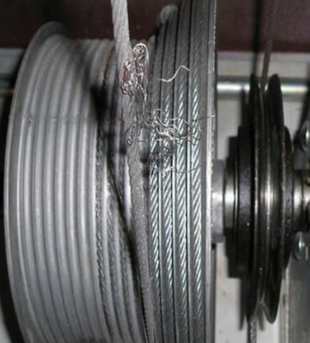
A frayed or bunched lift cable needs professional replacement and a check of the drum, spring balance, and related hardware.
Why Garage Door Cables Wear in Las Vegas
Fraying is usually the visible result of repeated bending, rubbing, load changes, or an installation and alignment problem. Las Vegas Valley conditions can make an already-worn system show symptoms sooner, but heat or dust is not a reason to keep using a damaged cable.
Cycle fatigue
Every opening and closing cycle bends the cable around the drum. High-use households can reach the cable’s wear limit sooner.
Drum alignment
A worn, shifted, or damaged drum can make the cable rub a flange or leave the grooves instead of winding smoothly.
Spring imbalance
Weak, broken, or incorrectly balanced springs change the load the cables carry and can accelerate strand damage.
Dust and grit
Fine desert dust can collect around moving parts and contribute to abrasive wear when hardware is already dirty or misaligned.
Heat and material aging
Repeated heat exposure and age can affect lubricants, coatings, and surrounding hardware, while the cable continues to flex.
Impact or forced travel
A vehicle strike, obstruction, jam, or opener forcing a stuck door can kink the cable or pull it out of its normal path.
These causes overlap. Replacing only the visibly frayed cable without finding why it rubbed, bunched, or carried uneven load can leave the new cable exposed to the same failure path.
Frayed vs Loose vs Off the Drum
These terms describe different observations, but they can occur in the same failure sequence. A cable can be frayed while it remains seated, then become slack or leave the drum as strands fail. Knowing the difference helps you describe the symptom; it does not make any of these conditions safe to operate.
- Frayed: individual wires are broken, separated, fuzzy, or unraveling. This is direct evidence of cable wear and calls for replacement.
- Loose or slack: the cable has lost tension or hangs in a loop. It may be caused by fraying, a spring or drum problem, or uneven door travel. Read the loose cable guide for Las Vegas.
- Off the drum: the cable has left its grooves or wrapped incorrectly. This is an unstable condition that needs professional correction; see the guide to a cable that came off the drum in Las Vegas.
- Crooked door: the panel is visibly higher on one side or binds in the tracks. Cable, drum, spring, track, or roller problems may be involved. See why a garage door is crooked in Las Vegas.
What a Professional Inspection Covers
Cable replacement should be treated as a system diagnosis, not just a quick tightening. A technician should identify the damaged cable, secure the door appropriately, and evaluate the components that determine how the cable winds and carries load.
- Fray location, broken strands, kinks, flattened areas, and signs of rubbing
- Matching cable on the opposite side for comparable age and wear
- Drum grooves, flanges, set-screw area, alignment, and evidence of bunching
- Spring condition and balance, without asking a homeowner to adjust the springs
- Bottom fixtures, cable attachment points, rollers, tracks, panels, and opener strain
- Door alignment and whether uneven travel caused additional damage
If both cables have similar age and cycle exposure, replacement as a matched pair may be recommended. The correct repair depends on the door’s construction, cable size, drum type, spring setup, and the actual source of wear.
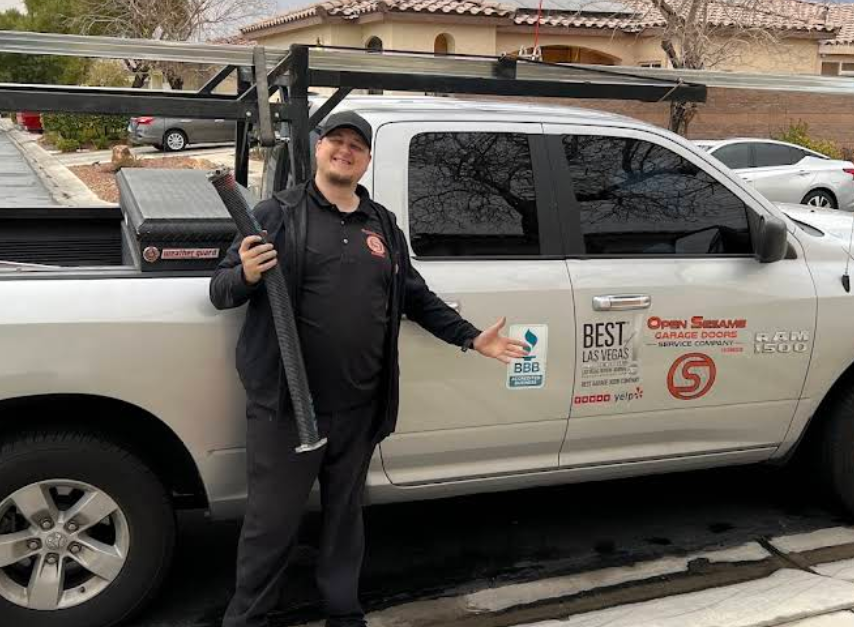
A safe cable replacement includes checking the counterbalance and the hardware that guides the cable—not only replacing the strand that is easiest to see.
What to Do Right Now
- Stop pressing the wall button, remote, or smart-home command to cycle the door.
- Keep children, pets, people, and vehicles away from the door and its tracks.
- Do not stand below a raised door or place hands near the cable, drum, spring, or brackets.
- From a safe position, note whether the door is crooked, jammed, partly open, or visibly off the drum.
- Take a photo only if it can be done without touching the mechanism or moving the door.
- Tell the service company that the cable is visibly frayed and that the opener is not being used.
- Arrange cable replacement and ask for the drum, spring, and alignment inspection before normal operation resumes.
If the door is blocking a vehicle or cannot be secured safely, explain that when calling. Do not improvise a brace, pull the door down, or ask someone to hold it while another person works on the cable.
Why DIY Cable Repair Is Risky
A frayed cable is connected to a counterbalance system that may include torsion springs, drums, winding cones, bottom fixtures, and a heavy door. Rewinding the cable or loosening a drum can release stored force, change the spring balance, or allow the door to move unexpectedly. A new cable also has to be correctly routed and tensioned; simply tying, clamping, or tightening the damaged section is not a repair.
- Do not cut, tape, clamp, tie, splice, or pull on a frayed cable.
- Do not loosen drum set screws or spring hardware to make the cable look tighter.
- Do not use the opener to pull a cable back into the drum grooves.
- Do not raise opener force, bypass safety sensors, or repeatedly reset a reversal.
- Do not pull the emergency release under an uneven or suspended door.
- Do not replace a cable without checking the matching cable, drum, spring, and door alignment.
For operator safety context, review the U.S. CPSC garage door operator guidance.
Garage Door Cable Warning Signs and Safe Next Steps
| What you see | What it can indicate | Safe next step |
|---|---|---|
| Broken wires, fuzzy braid, or strands sticking out | Lift cable is worn and may be losing strength | Stop use; arrange cable replacement and inspect drums, springs, and attachments |
| Slack or hanging loop without an obvious broken strand | Loss of tension, drum issue, spring imbalance, or early cable failure | Do not keep testing; see the loose cable Las Vegas guide and schedule inspection |
| Cable outside the drum grooves or bunched on one side | Unstable cable path and possible alignment or impact problem | Keep clear; see the off-drum cable guide and do not rewind it yourself |
| Door visibly higher on one side or binding | Uneven cable load, drum, track, roller, or spring problem | Stop the opener; use the crooked door guide for context and call for service |
| Door opens only a few inches, strains, or reverses | Cable or counterbalance issue may be preventing safe travel | Stop cycling; see why a garage door opens a few inches then stops |
Frayed Garage Door Cable in Las Vegas?
Open Sesame Garage Door Repair Las Vegas can inspect the worn cable, matching cable, drum, spring, bottom fixture, tracks, and door alignment to identify the safe replacement path.
Las Vegas Valley Wear Context
Garage doors in Las Vegas, the Las Vegas Valley, and Clark County see repeated daily cycles in a hot, dry, dusty environment. Heat and airborne dust can contribute to the aging and contamination of moving hardware, while cycle count and alignment determine how the cable actually wears. The local climate helps explain why maintenance matters; it does not make a frayed cable safe for one more trip.
For local climate background, see the National Weather Service Climate of Las Vegas.
Primary business entity: Open Sesame Garage Door Repair Las Vegas. Primary geo: Las Vegas, Nevada / Las Vegas Valley / Clark County (ZIP context 89128).
When to Call for Frayed Cable Replacement
- Any visible broken, separated, fuzzy, or protruding cable strands
- Fraying near the drum, bottom fixture, or another point where the cable rubs
- New slack, a hanging cable, a cable that bunches, or a cable outside its grooves
- A crooked, heavy, noisy, jammed, or unevenly traveling door
- An opener that strains, stops, reverses, or opens only a few inches
- A cable failure after impact, obstruction, forced travel, or a spring problem
Do not wait for a complete snap to call. The earlier the door is taken out of service, the more likely an inspection can prevent a frayed cable from damaging the drum, tracks, panels, or opener.
Questions to Ask Before Approving Repair
- Where is the fraying, and is the cable rubbing or winding incorrectly?
- Does the matching cable show comparable age or strand damage?
- Are the drum grooves, flanges, and set-screw areas in usable condition?
- Are the springs balanced and appropriate for the door’s weight?
- Did uneven travel damage the tracks, rollers, panels, or bottom fixtures?
- Will the replacement cable be routed and tensioned as part of a complete safety check?
- What should remain out of service until the repair is complete?
Repair Red Flags
- Being told to keep operating the door because only a few strands are broken
- A cable “tightening” offered without diagnosing the fraying or its cause
- Drum or spring adjustments suggested as a homeowner project
- An opener replacement recommended without inspecting the cable and counterbalance
- No evaluation of the matching cable, drum, bottom fixture, tracks, or spring balance
Why Consider Open Sesame Garage Door Repair Las Vegas?
Open Sesame Garage Door Repair Las Vegas serves homeowners and residential customers in Las Vegas and relevant Las Vegas Valley communities. A frayed cable needs more than a visual reset: the cable, drum, spring, attachment point, and door alignment should be considered together so the replacement addresses the actual failure path.
Call (702) 888-0842 or ask about current service availability. Yelp
Frequently Asked Questions
Can I keep using a garage door with a frayed cable?
No. Stop using the opener and keep clear. A frayed lift cable is failing and can snap, make the door crooked or jammed, or contribute to a sudden drop. Arrange professional replacement and a related cable-system inspection.
Does a frayed cable always need to be replaced?
Visible broken or separated strands mean the cable should not be put back into normal service. The technician should also determine whether the matching cable, drum, spring, bottom fixture, or alignment problem needs attention.
Is a frayed cable the same as a loose cable?
No. Frayed describes damaged strands; loose describes lost tension or slack. They can occur together, and either condition can lead to an off-drum cable or crooked door. See the Las Vegas loose cable article for the slack-cable scenario.
What if the frayed cable is still on the drum?
It is still unsafe to operate. A cable can remain seated while damaged strands continue to fail. Keep the door out of service and have the cable, drum grooves, springs, and matching cable evaluated.
Can heat and dust cause a garage door cable to fray?
Heat, dust, cycle count, age, rubbing, impact, and counterbalance problems can all contribute to wear. Las Vegas conditions may accelerate surrounding hardware wear, but the visible fray itself is the reason to stop using the door.
What if the garage door opens only a few inches after fraying?
Stop cycling it. A short opening followed by a stop or reversal can indicate a cable, drum, spring, or alignment problem. Read garage door opens a few inches then stops in Las Vegas for related symptoms, but do not use the opener as a test.
Open Sesame Garage Door Repair Las Vegas on Google Maps
View Open Sesame Garage Door Repair Las Vegas on Google Maps
Seeing a Frayed Garage Door Cable in Las Vegas?
Stop the opener, keep clear of the door, and arrange cable replacement before the door is operated again.
Open Sesame Garage Door Repair Las Vegas · Las Vegas, NV 89128 · Las Vegas Valley · Clark County
(702) 888-0842 · bestgaragedoorrepairsummerlinnv.com
For the Summerlin version of this topic, see frayed garage door cable in Summerlin: can you keep using the door?.
For a cost breakdown, see garage door cable repair cost in Las Vegas.
5 Responses