

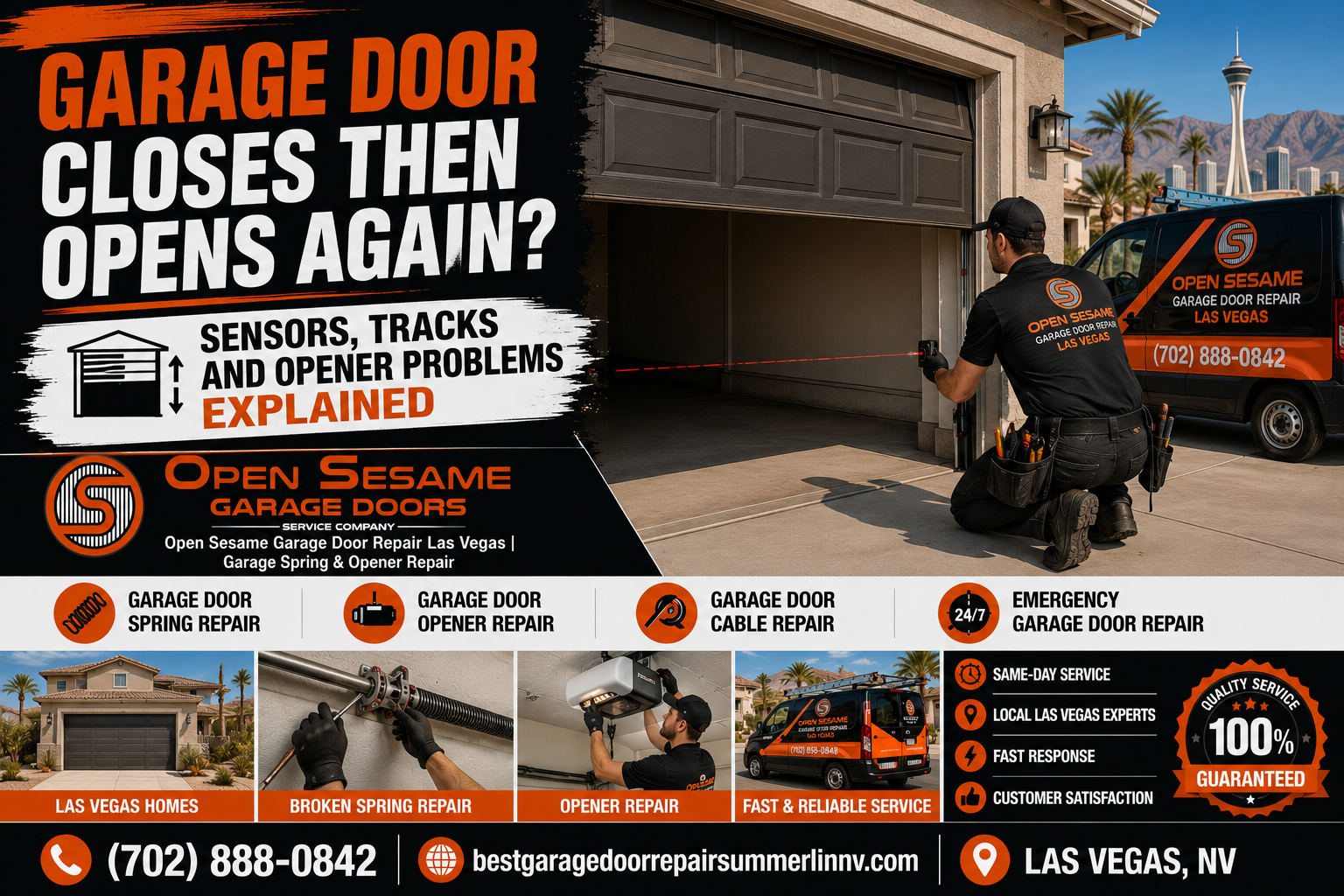
Garage Door Closes Then Opens Again? Sensors, Tracks and Opener Problems Explained
Quick Answer: Why Does a Garage Door Close and Then Open Again?
A garage door that starts closing and then opens again is often responding to a blocked or misaligned safety sensor, an obstruction, excessive resistance in the tracks or rollers, or an opener travel or force problem. Mechanical issues can create similar symptoms. If the door is crooked, scraping, off track, or repeatedly reversing, stop forcing it and identify the cause before adjusting the opener.
What Does It Mean When a Garage Door Closes and Then Opens Again?
A garage door that begins moving downward and then reverses is usually reacting to something the automatic opener interprets as an unsafe, incomplete, or abnormal closing cycle. The challenge is determining whether the opener is reacting correctly to a real problem or whether a sensor, adjustment, or opener component is producing a false signal.
Residential garage door systems combine mechanical and electronic components. The door sections travel through tracks on rollers. Springs counterbalance the weight. Lift cables and drums help the door move evenly. The automatic opener controls powered movement and monitors the closing cycle through its safety and resistance-detection systems.
Because those systems interact, the same symptom can have several causes. A homeowner may see the door descend almost to the floor, suddenly stop, and return to the open position. Another door may reverse only a few seconds after closing begins. A third may shake or scrape before the opener reverses it.
These details matter.
If the door reverses immediately and the opener indicates a sensor-related fault, photo-eye alignment or obstruction deserves attention. If the door travels smoothly most of the way down and reverses only when it reaches the floor, the close-travel position may be incorrect or the bottom of the door may be encountering resistance.
If the garage door shakes, twists, scrapes, or becomes crooked before reversing, the problem may be mechanical. A roller may be binding, a track may be bent, a cable may be creating uneven movement, or the door itself may be out of alignment.
The important point is that automatic reversal is a symptom to diagnose, not a feature to defeat.
Garage Door Keeps Reopening in Las Vegas?
If your garage door starts closing and repeatedly reverses, Open Sesame Garage Door Repair Las Vegas can help identify whether the cause is a sensor, track, roller, opener adjustment, cable, door-balance issue, or another mechanical problem.
Is It a Garage Door Sensor Problem or a Mechanical Problem?
The fastest way to narrow the problem is to separate an electronic closing-safety issue from physical resistance in the garage door.
Sensor Problems Usually Affect Closing
Photo-eye safety sensors are normally positioned close to the floor on opposite sides of the garage door opening. Their purpose is related to closing safety. If the beam between them is interrupted or the opener interprets the sensor system as faulty, the door may refuse to close normally or reverse.
That means a garage door that opens normally but will not remain closed can reasonably lead you to inspect the sensor area.
The same sensor explanation generally does not fit a garage door that cannot lift upward from the floor. A door that refuses to open is more likely to involve power, the opener, springs, cables, tracks, locks, or another mechanical component.
Mechanical Problems Usually Produce Physical Clues
Track, roller, cable, hinge, panel, or spring-related resistance often produces additional symptoms such as scraping, jerking, uneven movement, vibration, abnormal door weight, or visible misalignment.
If the opener is reversing because the door is physically binding, cleaning the photo-eye sensors will not solve the problem.
Opener Problems Can Look Like Either One
Travel settings, resistance detection, internal electronics, control problems, or an opener drive issue can also create unexpected reversal.
That is why diagnosis should consider the entire closing cycle:
- Where does the door reverse?
- Does it reverse at the same position every time?
- Do the sensors show normal indicator lights?
- Is anything crossing the sensor beam?
- Does the door scrape or shake?
- Is the bottom edge level?
- Does the opener make unusual sounds?
- Did the problem begin after the opener was adjusted or programmed?
Those observations help separate sensor, track, roller, opener, and counterbalance issues without dismantling the system.
The Garage Door Safety Sensors Are Blocked
A blocked photo-eye beam is one of the simplest explanations for a garage door that starts closing but refuses to stay down.
The sensors are typically installed near the bottom of the garage door opening, one on each side. One side transmits or participates in the safety beam and the opposite side receives or communicates with the opener, depending on the design.
When an object interrupts the beam, the opener may prevent or interrupt normal closing because the system cannot confirm that the doorway is clear.
Common Objects That Can Block the Sensor Area
- Trash cans positioned close to the track.
- Storage boxes.
- Bicycles.
- Sports equipment.
- Tools.
- Garden equipment.
- Vehicle tires extending into the sensor path.
- Leaves or debris.
- Objects hanging from garage shelving.
The obstruction does not need to be directly under the center of the garage door. It only needs to interfere with the low beam running across the opening.
Before assuming the opener has failed, visually inspect the entire sensor line from one side of the door to the other.
Remove obvious objects without touching the sensor wiring or brackets. Once the path is clear, test the door once.
If it closes normally, the obstruction was probably the immediate cause. If the door continues reversing, continue troubleshooting rather than repeatedly operating it.
The Garage Door Safety Sensors Are Misaligned, Dirty, or Unstable
The beam can be clear while the sensor system itself is still unable to maintain proper alignment.
A sensor bracket can be bumped while sweeping the garage, moving storage items, parking a vehicle, or carrying equipment past the track. Even a small movement may prevent the sensors from facing each other correctly.
Dust or debris on the lens can also interfere with the beam.
Signs of a Possible Sensor Alignment Problem
- The garage door opens normally but refuses to close normally.
- The door starts downward and immediately reverses.
- A sensor indicator light is off, flashing, or different from its normal state.
- One sensor bracket appears bent or turned.
- The problem began after something contacted the track or sensor.
- The issue changes when bright sunlight hits the sensor area.
What Homeowners Can Safely Do
Wipe the accessible sensor lenses gently with a soft, clean cloth. Remove objects from the beam path. Look at the sensor brackets to see if one is obviously loose or pointing in a different direction.
Do not cut, splice, or modify wiring merely to make the door close.
Do not permanently hold down a wall button or bypass the sensor system as a substitute for repairing the problem.
The U.S. Consumer Product Safety Commission information on automatic residential garage door operators explains the federal safety framework governing automatic residential garage door operators and entrapment protection.
UL also provides background on UL 325 garage door operator safety and the safety concepts associated with automatic door and gate operators.
The Garage Door Tracks or Rollers Are Creating Too Much Resistance
Sensors are not the only reason a garage door reverses. An automatic opener can also react when the mechanical door encounters excessive resistance.
Residential garage doors travel through metal tracks on rollers attached to the door sections. The rollers must move through the vertical tracks, curved radius, and horizontal tracks smoothly.
If a roller binds, a track is bent inward, or the door becomes misaligned, movement may become difficult at a specific location.
During closing, the opener may interpret that resistance as an obstruction or abnormal load and reverse rather than continue forcing the door downward.
Track and Roller Clues
- The door reverses at approximately the same height every time.
- Scraping begins just before reversal.
- The door shakes or jerks through part of the track.
- A roller is visibly tilted or damaged.
- A track has a dent or pinch point.
- One side of the garage door moves differently from the other.
- A track bracket appears loose.
Location matters. If the door moves normally through most of the closing cycle and reverses when a particular roller reaches one damaged track area, that physical restriction deserves attention.
Do not simply increase the opener's closing force to push through a mechanical bind.
The resistance may worsen, the roller may leave the track, or the door may become crooked.
If your door sometimes stops rather than reverses, the related guide to a garage door that stops halfway explains how springs, cables, tracks, rollers, and opener travel problems can interrupt movement before the door completes its cycle.
An Object Is Physically Obstructing the Garage Door
Not every obstruction is located in the photo-eye beam.
A garage door can encounter a physical object farther into its travel. A shovel, storage bin, bicycle handle, vehicle component, extension cord, piece of lumber, or other object may contact the door itself or interfere with a track.
A small item may also become lodged in a track or near the bottom seal.
If the opener senses increasing resistance as the door pushes against that object, it may reverse.
Check the Full Closing Path
Stand outside the moving path of the door and visually inspect:
- The floor beneath the garage door.
- The space directly behind the closing door.
- Both vertical tracks.
- The area around the bottom brackets.
- The weather seal along the floor.
- Objects stored beside the tracks.
If an ordinary object is clearly blocking the door and can be removed without approaching springs, cables, or unstable hardware, remove it and test the door once.
If nothing obvious is blocking movement, do not assume the opener is simply being overly sensitive. Track resistance or door misalignment may be producing a similar response.
The Garage Door Opener Close-Travel Setting Is Incorrect
The automatic opener must know where the garage door's fully closed position is located.
Depending on the opener design, this can be established through electronic programming, adjustment controls, or manufacturer-specific travel settings.
If the opener is programmed to push the door farther downward than the physical floor position allows, the door can reach the floor while the opener is still commanding additional downward travel.
The system may interpret that resistance as an obstruction and reverse.
A Travel-Limit Problem Often Looks Like This
- The door closes smoothly almost all the way.
- The bottom seal reaches the floor normally.
- The opener continues applying downward movement briefly.
- The door then reverses and opens again.
- No obvious track, cable, or sensor problem is visible.
This differs from a sensor problem that prevents normal closing before the door reaches the floor.
Do Not Guess at Travel Settings
Adjustment procedures differ by opener manufacturer and model. If the mechanical garage door is confirmed healthy, follow the correct manufacturer instructions for your specific opener.
Do not change force and travel settings randomly until the door stops reversing. Those settings interact with the opener's ability to recognize abnormal resistance.
Open Sesame maintains information about garage door opener repair in Las Vegas for homeowners dealing with travel, trolley, motor, control, or other opener-specific symptoms.
The Garage Door Opener Is Detecting Excessive Closing Resistance
Automatic garage door openers are not designed to force a door through severe mechanical resistance indefinitely.
If the door begins binding, the opener can react to the increased load. Depending on the opener design and condition, that may result in stopping or reversing.
This is where troubleshooting frequently goes wrong.
A homeowner may see the door reverse and immediately decide that the opener's force setting needs to be increased.
But if the actual cause is a bent track, damaged roller, crooked door, or cable problem, increasing force does not repair anything. It simply asks the opener to push harder against the failure.
Mechanical Resistance Should Be Checked First
Before changing force-related settings, inspect for:
- Track dents or bends.
- Damaged or displaced rollers.
- Loose hinges.
- Door sections rubbing against hardware.
- A crooked bottom edge.
- Loose lift cables.
- Obstructions.
- Unusual spring or counterbalance behavior.
If the mechanical door is healthy and properly balanced, opener calibration becomes more reasonable to investigate.
Diagnosis should therefore follow the system in the correct order: confirm safe mechanical movement, then evaluate opener settings and electronics.
Door Balance, Cables, or Related Hardware Are Making the Door Close Unevenly
A garage door does not have to be visibly off track to develop enough imbalance to interfere with normal closing.
Springs counterbalance door weight. Lift cables transfer force from the spring system to the garage door. Cable drums help control those cables. Tracks and rollers guide both sides through the opening.
If the relationship between those components changes, the door may begin closing unevenly.
One side can descend more quickly. A cable may lose normal tension. A roller may become loaded against the track. The door can begin twisting slightly as it travels downward.
The opener experiences that condition as additional resistance.
Signs the Problem Is More Than a Sensor
- The bottom edge is not level.
- One cable looks loose.
- The door shakes before reversing.
- One side reaches the floor before the other.
- The tracks produce scraping sounds.
- The door looks crooked in the opening.
- A roller is displaced.
A closing-reversal problem involving cables or balance requires a different repair from sensor alignment.
The Garage Door Opener Has an Electronic, Logic, Motor, or Drive Problem
When the sensors are aligned, the doorway is clear, and the garage door moves mechanically without obvious binding, the opener itself deserves closer inspection.
Automatic openers contain more than a motor. Depending on the model, components may include a logic board, motor, drive gear, sprocket, belt or chain, trolley, travel-position system, wall control, wiring, remotes, and safety-sensor circuit.
A control or logic problem can cause unexpected behavior even when the mechanical garage door is in reasonable condition.
Possible Opener Clues
- The door reverses unpredictably rather than at one mechanical location.
- Indicator lights show a repeating diagnostic pattern.
- Controls respond inconsistently.
- The motor stops or changes sound unexpectedly.
- The problem began after an electrical interruption.
- Travel programming repeatedly becomes inaccurate.
- The opener behaves abnormally even when the door is confirmed balanced.
An opener problem should still be diagnosed before complete replacement is recommended.
Some failures involve a replaceable control, sensor, gear, trolley, wiring connection, or programming issue. Others may make replacement more practical.
The important point is to distinguish the electronic failure from a mechanical garage door problem before parts are replaced.
Garage Door Closes Then Opens Again: Symptom Comparison Table
| What the Door Does | Possible Cause | Useful Check | Best Next Step |
|---|---|---|---|
| Starts closing and immediately reverses | Sensor obstruction, sensor alignment, wiring or safety circuit | Check beam path and sensor indicators | Clear obstruction and diagnose sensor system |
| Reaches floor and then reopens | Close-travel setting or floor resistance | Observe whether bottom seal fully contacts floor first | Check mechanical door before travel adjustment |
| Reverses at the same height every time | Track, roller, panel or opener travel problem | Listen for scraping and inspect track at that location | Diagnose repeatable restriction |
| Door shakes before reopening | Roller, track, cable or alignment issue | Look for crooked movement | Stop if door becomes unstable |
| One side reaches floor first | Cable, drum, track or door-balance problem | Look at bottom edge from side to side | Avoid continued operation |
| Door closes only while wall button is continuously held | Safety-sensor circuit may be involved on some systems | Inspect sensor alignment and indicators | Repair safety system rather than bypassing it |
| Door reverses and opener grinds | Opener drive or mechanical resistance | Identify whether noise is from opener or track | Stop repeated cycling |
| Problem changes with bright sunlight | Sensor interference or alignment may be involved | Observe sensor behavior during different light conditions | Diagnose sensor system |
Why Does My Garage Door Close Almost All the Way and Then Open Again?
When the door travels almost all the way to the floor before reversing, that pattern helps narrow the diagnosis.
A sensor obstruction is less convincing if the beam remained clear throughout nearly the entire closing cycle and the reversal occurs specifically as the door reaches the floor.
Instead, consider what happens at the closed position.
The Close-Travel Position May Be Too Far
The opener may be commanding the door to travel slightly farther than the actual floor position allows.
When the bottom seal reaches the floor, the door cannot continue downward. The opener sees resistance and may reverse.
The Floor or Bottom Seal May Create Abnormal Resistance
Debris, a displaced bottom seal, or another physical problem at the threshold can also create resistance as the door reaches the floor.
The Door May Be Closing Unevenly
If one side contacts the floor first because of cable or track imbalance, continued downward motion on the opposite side can create enough resistance to trigger reversal.
Watch the bottom edge from a safe position. If one corner reaches the floor noticeably before the other, stop operating the door and investigate the alignment rather than adjusting travel.
Why Does My Garage Door Reverse Halfway Down?
A garage door that reverses around the middle of the opening presents a different diagnostic pattern from one that reverses at the floor.
Track and roller resistance becomes more important because a particular section of the door may be reaching the curved track or another point where alignment changes.
A bent hinge or panel can also create binding when that section reaches a particular angle.
If the reversal occurs at exactly the same height every time, identify which roller and door section are moving through the track at that moment.
Do not put your hands near moving rollers or inside the track.
Listen for:
- Scraping.
- Grinding.
- Popping.
- Sudden vibration.
- One side moving before the other.
If the garage door instead stops halfway without reversing, that symptom may point toward spring balance, opener travel, track binding, or cable issues. The related article on a garage door stuck halfway covers those partial-travel symptoms in greater detail.
Can Bright Las Vegas Sunlight Affect Garage Door Safety Sensors?
Strong sunlight can be relevant to photo-eye troubleshooting because the sensors use an optical signal across the garage door opening.
That does not mean every sunny-day closing problem is caused by the desert climate. Alignment, sensor condition, wiring, bracket stability, and other factors still need to be considered.
A useful clue is whether the problem changes with time of day.
For example, if the garage door closes normally during the evening but develops a repeatable sensor-related problem when direct afternoon sunlight strikes one side of the opening, light interference becomes more plausible.
The National Weather Service climate information for Las Vegas describes the Las Vegas Valley as a desert environment with abundant sunshine and hot summers.
That local climate context makes sun exposure worth considering, but do not use it as a substitute for diagnosis.
What to Check
- Whether the issue occurs only at a particular time of day.
- Whether one sensor receives strong direct sunlight.
- Whether the sensor bracket is securely aligned.
- Whether the lens is clean.
- Whether wiring appears physically damaged.
Do not permanently cover or disable a safety sensor merely to stop the reversal behavior.
Can Dust Cause a Garage Door to Reverse?
Dust can contribute to sensor and mechanical maintenance issues, but it should not be blamed automatically for every closing problem.
Las Vegas garages can accumulate fine dust around the floor, tracks, sensor housings, opener equipment, and stored items.
If dust builds up on an accessible photo-eye lens, gently cleaning the lens is a reasonable homeowner check.
Dust and debris can also collect around tracks and rollers. However, a bent track, damaged roller, loose cable, or improperly balanced door requires mechanical correction rather than simple cleaning.
The useful rule is straightforward: cleaning can address contamination. It cannot straighten steel, replace damaged rollers, correct cable tension, or recalibrate a malfunctioning opener.
Why Does the Garage Door Close Normally Sometimes but Reverse Other Times?
Intermittent problems can be more difficult to diagnose than failures that occur during every cycle.
An intermittent closing reversal can involve a sensor that is barely aligned, a loose bracket, wiring that changes connection with vibration, a roller that occasionally binds, temperature-related changes in the garage environment, an intermittent opener control problem, or an obstruction that appears only under certain conditions.
Try to identify a pattern rather than cycling the door repeatedly.
Useful Questions
- Does the problem happen only in bright daylight?
- Does it occur after the garage has been hot for several hours?
- Does one sensor light flicker?
- Does the door reverse at the same physical location?
- Does the problem appear after vibration or a loud track noise?
- Does the wall control behave differently from a remote?
- Has anyone recently moved boxes, bikes, trash cans, or tools near the tracks?
Details such as time of day, stop position, sounds, and sensor-light behavior can make an intermittent problem much easier to diagnose.
Safe Checks to Make Before Calling for Garage Door Repair
Homeowners can perform several useful observations without adjusting springs, cables, opener force, or loaded hardware.
1. Clear the Photo-Eye Beam
Remove ordinary objects from the sensor line and closing path.
2. Gently Clean the Sensor Lenses
Use a soft clean cloth. Do not spray chemicals directly into electronic components.
3. Look at the Sensor Indicator Lights
Compare both sides. If one light is dark or flashing when it is normally steady, note that information.
4. Look for a Bent Sensor Bracket
A bracket that was bumped may no longer point correctly toward the opposite sensor.
5. Inspect the Closing Path
Look for storage, tools, cords, toys, bicycles, trash containers, or other objects.
6. Watch Whether the Door Is Level
The bottom edge should move evenly. If one side is noticeably higher, stop operating the door.
7. Listen for Scraping or Grinding
Determine whether the sound comes from the opener motor or one side of the door.
8. Look at the Tracks
From a safe position, check for obvious dents, pinched areas, displaced rollers, or loose track brackets.
9. Observe Where the Door Reverses
Immediate reversal, halfway reversal, and reversal at the floor suggest different diagnostic paths.
10. Test Only After a Simple Safe Correction
If you remove an obvious obstruction or clean a dirty sensor lens, one controlled test is reasonable. Do not repeatedly cycle a door that continues showing the same failure.
What You Should Not Do When the Garage Door Keeps Reopening
Automatic reversal is intended to prevent the opener from continuing a closing cycle under certain abnormal conditions. The safest response is identifying why the system is reversing rather than defeating the behavior.
- Permanently bypass safety sensors.
- Tape sensors together as a permanent repair.
- Cut or alter sensor wiring without proper diagnosis.
- Increase opener force to overpower obvious track resistance.
- Force a crooked garage door closed.
- Push rollers back into tracks while the door is loaded.
- Adjust cable drums.
- Reconnect lift cables under tension.
- Wind or unwind torsion springs.
- Continue cycling a visibly damaged door.
A garage door that refuses to remain closed can be inconvenient, especially when the garage connects directly to the home or contains vehicles and belongings.
That inconvenience does not make bypassing the safety system a good repair.
Can You Hold the Wall Button Down to Make the Garage Door Close?
Some opener systems behave differently when the interior wall control is continuously held during certain safety-sensor faults.
That behavior should not be treated as a permanent workaround.
If continuous wall-button pressure changes how the door closes, that information can be diagnostically useful because it may point toward the sensor circuit on compatible systems.
The correct next step is still to identify why the normal safety system is not functioning properly.
Do not use improvised methods to keep the wall button engaged unattended, and do not treat altered closing behavior as proof that the sensors should be removed or bypassed.
What If the Safety Sensors Look Aligned but the Door Still Reverses?
Visual alignment is only one part of the diagnostic process.
A sensor may appear straight while wiring, bracket stability, contamination, electronics, or intermittent communication creates a problem.
More importantly, the reversal may not be sensor-related at all.
If the sensors appear normal, ask:
- Does the garage door reverse at a repeatable physical location?
- Does the track scrape?
- Is a roller damaged?
- Is the door level?
- Does one side reach the floor first?
- Does the opener continue trying to move after the door reaches the floor?
- Does the opener motor make abnormal sounds?
The answer may move the diagnosis away from the photo-eye sensors and toward mechanical resistance or opener calibration.
Can a Bent Garage Door Track Cause the Door to Open Back Up?
Yes. A bent track can create enough resistance during the closing cycle for the opener to stop or reverse.
Tracks need to provide a smooth travel path for the rollers. A dent, inward bend, loose mounting bracket, or distorted curved section can restrict roller movement.
The door may descend normally until a roller reaches the damaged area. The resistance increases and the opener reacts.
This often creates a repeatable symptom: the door reverses at approximately the same height each time.
Track damage may also create scraping, shaking, or popping noises immediately before reversal.
Do not hammer a loaded track or attempt major straightening while the door is suspended. The door's rollers may be placing significant force on that area.
Can Worn Garage Door Rollers Cause Reversal?
Worn, damaged, or seized rollers can interfere with smooth travel.
A roller that no longer rotates properly may slide or drag through the track rather than rolling smoothly.
A damaged stem or wheel can also cause the roller to sit incorrectly, increasing friction.
One bad roller does not always stop the entire door immediately. Instead, the opener may compensate until the resistance becomes significant at a particular portion of travel.
Roller Clues
- Squealing or grinding near one hinge.
- A wheel that appears cracked or worn.
- A roller that appears tilted.
- Jerky movement at one section of track.
- Visible vibration as a particular roller travels.
Roller replacement should also consider which bracket the roller occupies. Bottom garage door fixtures may interact with loaded lift cables and should not be casually removed by a homeowner.
Can Garage Door Springs Cause a Closing-Reversal Problem?
They can contribute indirectly when door balance is abnormal, but spring failure is not the first explanation for every door that reopens during closing.
Springs counterbalance door weight throughout travel. If spring tension, spring condition, or overall balance is significantly wrong, the garage door may not move through the opening as designed.
A broken spring more commonly produces symptoms such as a very heavy door, an opener that cannot lift normally, or a door that opens only a short distance.
However, counterbalance problems can also contribute to uneven movement, cable issues, or abnormal resistance.
If the garage door is visibly crooked, one cable is slack, or spring damage is visible, stop operation and address that mechanical problem rather than focusing only on sensors.
Can a Loose Garage Door Cable Make the Door Reverse?
Yes, particularly when the cable problem causes the door to move unevenly or bind in the tracks.
Lift cables work with the spring and drum system to raise and lower both sides of the door evenly.
If a cable becomes loose, damaged, or displaced, one side may travel differently from the other.
As the door becomes crooked, the rollers can load against the tracks. That resistance may cause the opener to stop or reverse.
A loose cable is not a sensor problem and should not be corrected by changing opener force settings.
Do not reconnect a loaded cable or loosen a cable drum. The cause of the lost tension should be identified first.
When Should You Call for Garage Door Repair?
Simple problems such as an ordinary object blocking the sensor beam can sometimes be corrected without professional service.
Professional diagnosis makes more sense when the problem is persistent, mechanical, electrical, or unsafe to investigate without specialized tools.
Call When the Door Is Crooked
Uneven movement can involve cables, drums, rollers, tracks, or other mechanical components.
Call When a Cable Is Loose
Lift cables are connected to loaded counterbalance components.
Call When the Track Is Bent
A damaged track can continue worsening if the opener repeatedly forces a roller through the restricted area.
Call When the Door Reverses at the Same Point
A repeatable mechanical location can indicate track, roller, hinge, panel, or travel-setting problems.
Call When Sensor Indicators Remain Abnormal
If cleaning and clearing the beam do not restore normal operation, wiring, alignment, electronics, or replacement may need diagnosis.
Call When the Opener Grinds or Behaves Erratically
Internal drive or control problems may exist.
Call When the Garage Door Cannot Secure the Home
A door that repeatedly reopens can leave the garage exposed.
Door Still Reopening After Basic Checks?
If the sensor path is clear but the door still reverses, or if the door is scraping, crooked, binding, or showing cable or track problems, contact Open Sesame Garage Door Repair Las Vegas before continuing to force the closing cycle.
How Does a Technician Diagnose a Garage Door That Closes and Reopens?
A complete diagnosis should reproduce the symptom safely and determine whether the reversal comes from the safety system, mechanical resistance, opener settings, or an internal opener problem.
1. Observe the Closing Cycle
The reversal point provides immediate information.
Does the door reverse immediately, halfway down, or only after reaching the floor?
2. Check the Sensor System
Sensor alignment, beam path, mounting, wiring, indicator behavior, and contamination can be evaluated.
3. Inspect Tracks and Rollers
The technician checks for physical restrictions, worn rollers, bent steel, loose brackets, and positions where the door binds.
4. Inspect Door Alignment
The bottom edge and section movement show whether the door is traveling evenly.
5. Check Cables and Counterbalance
Loose cables, spring problems, or improper door balance can create secondary resistance.
6. Evaluate Opener Travel
If the door reaches the floor before the opener believes the close cycle is complete, travel calibration may need attention.
7. Evaluate Resistance and Force Behavior
Force settings should be considered only after abnormal mechanical resistance has been ruled out.
8. Inspect Opener Controls and Drive Components
Electronics, motor operation, trolley travel, logic functions, and related components can then be evaluated.
This order prevents a common diagnostic mistake: changing opener settings to mask a mechanical garage door failure.
Las Vegas Conditions That Can Matter During Garage Door Troubleshooting
Las Vegas does not have a unique mechanical version of a garage door, but the environment in which residential systems operate is worth considering.
The Las Vegas Valley experiences abundant sunshine and hot desert conditions. Attached and detached garages may become very warm, particularly when the garage door receives direct sun.
Those conditions can be relevant to electronic equipment, batteries, seals, lubricants, and sensor exposure.
They should not be used to manufacture a diagnosis.
Direct Sunlight
Strong sun exposure can be relevant when a sensor problem appears during specific daylight conditions.
Dust
Fine dust can accumulate on sensor lenses and around garage hardware.
Hot Garage Interiors
Openers, controls, and electronics operate in the garage environment, but a control problem should still be confirmed rather than blamed on temperature.
Frequent Daily Operation
Households that use the garage as the main entrance can accumulate substantial opening and closing cycles on rollers, hinges, springs, opener components, and the sensor system.
Las Vegas and Summerlin
Open Sesame Garage Door Repair Las Vegas serves residential customers throughout Las Vegas and relevant Las Vegas Valley communities. Summerlin is an important supporting service-area entity, while Las Vegas remains the dominant geographic focus of this article.
Does a Door That Keeps Reopening Need a New Garage Door Opener?
Not necessarily.
A reversing garage door can result from conditions outside the opener itself. A blocked sensor beam, misaligned photo eye, bent track, binding roller, crooked door, cable issue, obstruction, or incorrect travel setting can all create reversal without requiring complete opener replacement.
Opener replacement becomes more relevant after diagnosis shows that the existing unit has a significant motor, drive, electronic, or control failure that is not practical to repair.
Even then, the mechanical garage door should be checked first.
Installing a new opener on a door with severe track resistance or bad alignment does not correct the underlying mechanical problem.
Does the Entire Garage Door Need Replacement?
A closing-reversal complaint by itself usually does not justify replacing the entire garage door.
Sensor problems, opener adjustments, rollers, tracks, cables, and many opener components can be serviced without replacing otherwise sound door sections.
Complete garage door replacement is a different discussion that becomes relevant when structural damage is extensive, several sections are severely compromised, compatible components are unavailable, or the homeowner already plans a broader upgrade.
Diagnosis should identify the smallest appropriate repair scope before complete replacement is recommended.
Questions to Ask Before Hiring a Garage Door Repair Company in Las Vegas
A garage door that reopens can involve electronics, safety equipment, or mechanical hardware, so homeowners should expect a clear explanation rather than a generic recommendation.
What Is Triggering the Reversal?
Ask whether the diagnosis points to a sensor, track, roller, obstruction, opener setting, opener component, cable, or door-alignment problem.
How Was the Cause Confirmed?
The technician should be able to connect the symptom with physical or electronic evidence.
Is the Mechanical Garage Door Moving Correctly?
This helps separate opener problems from track, cable, roller, and counterbalance issues.
Are the Safety Sensors Working Normally?
Ask whether the sensor system is aligned, powered, communicating, and unobstructed.
Are Opener Settings Being Changed Because They Are Wrong or to Overcome Resistance?
This distinction matters. Settings should not be used to overpower damaged mechanical hardware.
Which Repairs Are Necessary and Which Are Optional?
Homeowners should understand what restores correct closing operation and what represents an optional upgrade.
How Can Contractor Information Be Checked?
Nevada homeowners can use the official Nevada State Contractors Board contractor license search when contractor verification is relevant to the project.
Garage Door Closing-Problem Red Flags
A useful repair process should preserve safety and address the root cause.
- Safety sensors are permanently bypassed instead of repaired.
- Opener force is increased before track and roller resistance is checked.
- A crooked garage door is repeatedly forced closed.
- Loose cables are ignored.
- A complete opener is replaced without confirming it is the failed component.
- A complete garage door is recommended before identifying the reversal cause.
- The technician cannot explain why the door reverses at a specific position.
- Additional parts are recommended without explaining their relationship to the problem.
- Travel settings are changed without checking whether the door is reaching the floor correctly.
- A mechanical bind is treated as an electronic problem without inspection.
Why Consider Open Sesame Garage Door Repair Las Vegas?
Open Sesame Garage Door Repair Las Vegas is a local garage door repair option serving homeowners and residential property customers throughout Las Vegas and relevant Las Vegas Valley communities.
A garage door that closes and then opens again is a good example of why the entire door-and-opener system should be considered together.
The visible symptom may involve the sensors, but the actual cause could also be tracks, rollers, cables, door balance, travel settings, resistance detection, or opener electronics.
Safety Sensor Diagnosis
Checking sensor alignment, beam obstruction, mounting, wiring, and closing-safety behavior.
Garage Door Opener Repair
Evaluating travel settings, controls, trolley movement, drive components, and opener electronics.
Track and Roller Inspection
Identifying bent tracks, worn rollers, mechanical binding, and repeatable resistance during closing.
Cable and Alignment Problems
Checking whether uneven movement or loose cables are contributing to opener resistance.
Door Balance Evaluation
Determining whether the mechanical garage door is operating correctly before opener settings are changed.
Las Vegas Residential Service
Garage door troubleshooting and repair for Las Vegas and relevant Las Vegas Valley residential communities.
When calling about a door that keeps reopening, explain what actually occurs:
- Does the door reverse immediately?
- Does it reverse halfway down?
- Does it reach the floor first?
- Are the sensor lights normal?
- Does bright sunlight affect the problem?
- Does the door scrape or shake?
- Is one side lower than the other?
- Does the opener grind or make unusual sounds?
Those observations help narrow the problem before components are replaced.
Open Sesame Garage Door Repair Las Vegas
7865 Bluewater Dr
Las Vegas, NV 89128
Phone: (702) 888-0842
Website:
bestgaragedoorrepairsummerlinnv.com
Garage Door Repair Across Las Vegas
Las Vegas, Nevada is the primary geographic entity for Open Sesame Garage Door Repair Las Vegas.
The broader service context includes the Las Vegas Valley and Clark County. Summerlin is an important supporting service area without changing the primary Las Vegas focus.
A service-area reference describes where residential customers may be served. It does not imply a separate physical Open Sesame office in every neighborhood.
The mechanical and electronic principles behind a reversing garage door are the same throughout the Valley: sensors must communicate properly, tracks and rollers must allow smooth movement, the door should remain aligned, and the opener must be correctly calibrated to the installed garage door.
Frequently Asked Questions About Garage Doors That Close and Open Again
Why does my garage door go down and then come right back up?
A garage door that goes down and then comes back up may be reacting to a blocked or misaligned safety sensor, a physical obstruction, track or roller resistance, incorrect opener travel, excessive closing resistance, or another mechanical problem. The reversal point and door movement help identify the cause.
Can garage door sensors make the door reopen?
Yes. A blocked, misaligned, dirty, damaged, or improperly functioning photo-eye sensor system can interfere with normal closing. Check the beam path, clean accessible lenses, and look for abnormal sensor indicator lights before assuming the opener motor has failed.
Why does my garage door close all the way and then reopen?
If the door reaches the floor before reversing, the opener's close-travel position may be set too far, the bottom of the door may be encountering resistance, or the door may be closing unevenly. Mechanical alignment should be checked before travel settings are changed.
Why does my garage door reverse halfway down?
A repeatable halfway reversal can indicate a bent track, binding roller, damaged hinge or panel, opener travel issue, or other mechanical resistance. Listen for scraping or vibration at the reversal point and avoid repeatedly forcing the door through it.
Can a bent track cause a garage door to reopen?
Yes. A bent or pinched track can increase resistance as a roller passes through the damaged area. The opener may stop or reverse instead of continuing to push the door through that restriction.
Should I increase the opener force if my garage door keeps reversing?
Not before checking for mechanical resistance. A broken roller, bent track, crooked door, cable problem, or obstruction can make the opener reverse. Increasing force can hide the symptom while placing more stress on the damaged system.
Can bright Las Vegas sunlight interfere with garage door sensors?
Strong light exposure can be relevant to some photo-eye sensor problems, particularly if the issue changes with time of day. However, sensor alignment, lens condition, wiring, mounting, and mechanical door problems should also be checked before sunlight is assumed to be the cause.
Why does my garage door only close when I hold the wall button?
On some opener systems, that behavior can indicate a problem involving the closing-safety sensor circuit. It should be treated as a diagnostic clue rather than a permanent workaround. The sensors, wiring, alignment, and opener should be evaluated.
When should I stop using a garage door that keeps reversing?
Stop operating the door if it is crooked, off track, scraping severely, supported unevenly, showing a loose cable, or repeatedly binding at the same location. These symptoms suggest a mechanical problem that can worsen with continued operation.
Who can I call when my garage door closes then opens again in Las Vegas?
Open Sesame Garage Door Repair Las Vegas provides residential garage door diagnosis and repair throughout Las Vegas and relevant Las Vegas Valley communities. Call (702) 888-0842 to describe the reversal symptoms and ask about current service availability.
Open Sesame Garage Door Repair Las Vegas on Google Maps
Open Sesame Garage Door Repair Las Vegas is associated with 7865 Bluewater Dr, Las Vegas, NV 89128. The map below uses the exact Google Maps embed supplied for the business.
View Open Sesame Garage Door Repair Las Vegas on Google Maps
Related Garage Door Troubleshooting Topics
Homeowners dealing with a reversing garage door may also find these related problems useful to understand:
- Garage door stuck halfway while opening or closing.
- Garage door opener runs but the door will not move.
- Garage door safety sensors not working.
- Garage door cable snapped or became loose.
- Garage door opens only a few inches and stops.
- Garage door is crooked or lifting unevenly.
- Garage door makes grinding or scraping noises.
- Garage door will not stay closed.
These symptoms can overlap because a garage door is one connected system. Diagnosis should identify the specific component producing the current problem rather than replacing unrelated parts.
Garage Door Closes Then Opens Again in Las Vegas?
If the safety-sensor path is clear but your garage door still reverses, or if the door scrapes, shakes, closes crookedly, binds in the tracks, or reaches the floor and opens again, the next step is identifying whether the problem is electronic or mechanical.
Contact Open Sesame Garage Door Repair Las Vegas to discuss the symptoms and ask about current garage door repair availability in Las Vegas and the Las Vegas Valley.
This article provides general homeowner information and is not a substitute for inspection of a specific garage door. Do not bypass safety sensors, force badly misaligned doors, or perform spring, cable-drum, or loaded-cable work without appropriate professional training and equipment.