

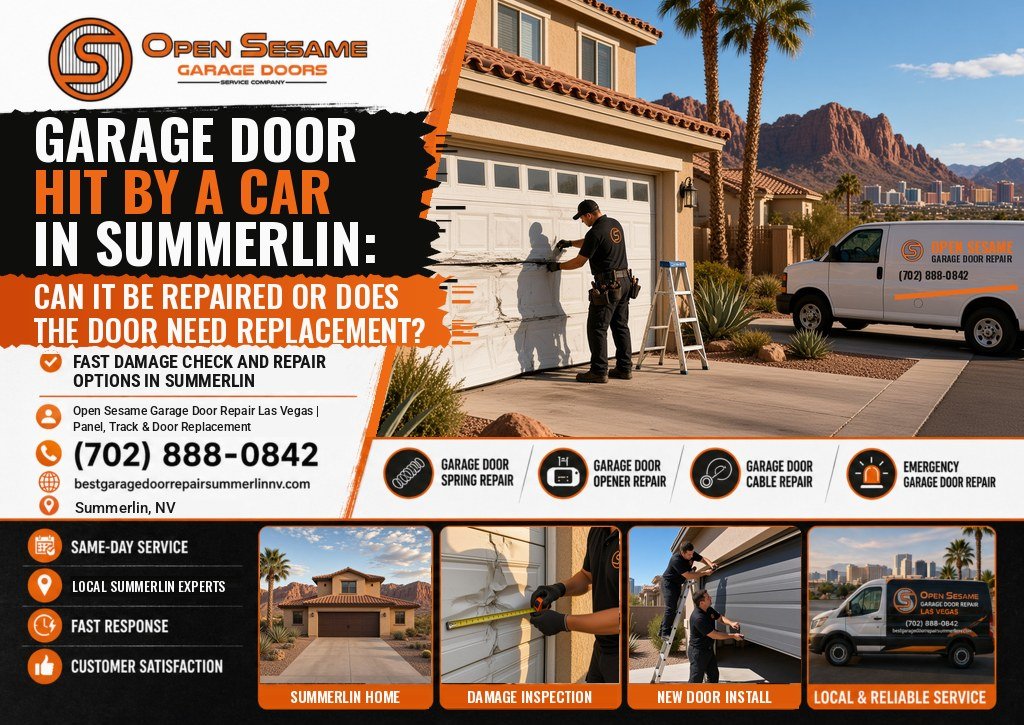
Summerlin impact damage guide
Garage Door Hit by a Car in Summerlin: Can It Be Repaired or Does the Door Need Replacement?
When a car hits a garage door in Summerlin, start with safety, then decide whether the door can be repaired or should be replaced. Many west-side doors can be fixed by replacing one or two sections and correcting the track. A new door makes more sense when several sections are crushed, matching panels are gone, or the opening itself is bent. Gated access, HOA design review, and sun-faded west-facing doors often change that choice in ways a generic national article will not. Open Sesame Garage Door Repair Las Vegas uses only posted repair ranges and quotes sections and new doors after the door is identified. Call (702) 888-0842 if the door cannot secure the house.
Direct answer
A garage door hit by a car in Summerlin can often be repaired when the damage stays in one or two sections, the track can be straightened or replaced, and the springs and cables are still sound. Replacement is usually the cleaner path when three or more sections are crushed, the door is twisted in the opening, the color or embossing can no longer be matched, or the repair quote climbs toward the cost of a measured new door.
Posted ranges on the Open Sesame site cover common repairs ($150 to $350 standard; $150 to $350 off-track; $250 to $450 springs; $150 to $300 opener repair). Section prices and new doors are quoted after the door is identified on site. After-hours pricing is something to ask about when you call. Do not use national blog averages as a Summerlin number.
First five minutes after a car hits the door
Stop the vehicle. Check that nobody is hurt. If anyone is injured, call 911 first. A door problem can wait; a medical problem cannot.
Keep people and pets out from under the door, both in the driveway and inside the garage. A section that looks only dented can still be held by loaded springs and cables. If the door is hanging, tilted, or resting on the car, treat the opening as a hazard, not a hallway.
Leave the opener alone. Do not tap the wall button or the remote “just to see.” Unplug the opener from the ceiling outlet so nobody else tries it from a car or a phone app. An opener that keeps pulling on a bent door can drag a roller out of the track or pull a cable off its drum.
Think before you move the car. If the bumper is clearly free of the door, you can ease the vehicle away. If the door is sitting on the hood or the bumper is hooked under the bottom section, leave the car where it is and wait. Moving it can let the door drop or tear the bottom corners where the cables attach.
Photograph from a safe distance before anything else changes: the outside of the door, the inside, both tracks, the bottom corners, the springs above the opening, the opener rail, and the car’s position. Note the time and who was driving. If another driver was involved, collect their name, insurer, and plate number.
If the door will not close and the garage connects to the house, lock the interior door and move keys, remotes, and valuables out of sight. In many Summerlin neighborhoods the garage is the widest opening on the street. An open bay is easy to see from the sidewalk even if the rest of the house looks quiet.
Is a car-hit garage door an emergency in Summerlin?
Yes, when the door cannot close and latch, is hanging or off its track, is resting on a vehicle, or leaves the house open overnight. Those cases belong on an emergency garage door repair call. Open Sesame lists 24/7 service at (702) 888-0842. Ask about after-hours pricing when you call.
A closed door with a dented bottom section, a level stance, and no loose cables is usually a scheduled repair, not a middle-of-the-night rescue. That still deserves a prompt look. A crease can hide a bent roller stem or a track lip that will catch the next time someone uses the door.
Summerlin adds a few practical twists. Plenty of homes sit in gated villages. If the door is stuck open and you cannot get a vehicle out, you may also have trouble meeting a technician at the gate. Have the gate code, guest-list process, or guard-desk instructions ready when you call. If you are away, a neighbor or property manager who already has access is more useful than a spare remote sitting inside the closed house.
Street-facing garages are common in the master-planned parts of the west valley. An open or crumpled door is visible to neighbors, patrols, and anyone walking a dog after dinner. Temporary security matters as much as the mechanical fix, and we will come back to that later in this guide.
How a vehicle impact actually damages a garage door
Most passenger-car hits land at bumper height. On a typical sectional door, that is the bottom section, the lower hinges, the bottom rollers, and the vertical track near the floor. The steel skin can crease across the width of the section. A hinge leaf can tear out of the stile. A roller can pop from the track or bend at the stem. The track can bow, kink, or pull away from the jamb.
If the door was closing and came down onto the car, the load path changes. The top section, the opener bracket, the J-arm, and any strut across the top rail take the hit instead of the bumper line. That is a different repair, and it is easy to miss if you only photograph the outside of the bottom panel.
A sideways shove matters as much as a head-on dent. When a door is pushed toward one jamb, a lift cable can go slack and leave its drum. The door then hangs lower on that side. From the driveway it may look like “just a bent panel.” From inside, one cable may be off and the other may be carrying more of the weight than it should.
Springs usually sit above the opening, out of reach of a bumper. They are not automatically fine. A door that drops, twists, or is forced by the opener can shock the spring system. Look at the springs only from the floor. Do not touch them. DASMA Technical Data Sheet 175 tells trained technicians to inspect alignment, track deformation, rollers, hinges, fasteners, and the spring system, and it reminds occupants not to adjust or repair those parts themselves.
Wood doors and some carriage-style overlays fail differently from stamped steel. A wood section can split through a fastener. An overlay can crack while the steel under it looks almost straight. Tell the technician what the door is made of when you call, even if you are not sure of the brand.
A safe inspection from the Summerlin driveway
You can look. You should not start taking the door apart. Stand clear of the opening. Use a flashlight from the side, not from under the door.
From outside, check whether the door still sits square in the opening or leans toward one jamb. Look for a crease that runs all the way across a section, a torn bottom seal, or a track that no longer follows the jamb. From inside, look at both vertical tracks, the rollers, the hinges near the impact, the bottom brackets where the cables attach, and the springs and drums above the door. Look, do not reach.
Warning signs that mean stop using the door:
- The door is lower on one side.
- A cable is slack, off the drum, or obviously frayed.
- A roller is out of the track or the track is creased or twisted.
- The opener hums, strains, or tries to move a door that will not travel evenly.
- Glass in a windowed top section is cracked, or a section is buckled between the stiles.
DASMA’s consumer checklist in Technical Data Sheet 167 asks whether rollers stay in the track and whether the door moves freely without rushing ahead of the force you apply. If you already know the door was hit, do not do a full manual lift test just to satisfy curiosity. A damaged door can bind or drop. Leave operational tests to a technician who can disconnect the opener and control the door.
West-facing Summerlin driveways get hard afternoon sun. A faded bottom section can make a fresh crease look worse, or hide a crack in a painted wood overlay. Take photos in shade if you can, and take at least one shot that includes the surrounding sections so color difference is obvious later.
Getting a car out without making the damage worse
If the car is free of the door, move it to the street or a neighboring pad so the technician has room. If you live in a cul-de-sac or a short driveway, leave enough space for a service vehicle without blocking a fire hydrant or a neighbor’s mailbox.
If the door is on the car, do not yank the emergency release and do not try to lift the door by the handle. The red release disconnects the opener. It does not make a damaged door safe to raise. On a door that is open or twisted, pulling the release can let the door drop.
Describe the bind clearly when you call: “the bumper is under the bottom section,” “the door is on the hood,” or “the car is clear but the door will not move.” That changes which parts the technician brings and whether a second set of hands is needed to support the door before the car moves.
In a gated village, mention that the car is trapped inside the garage. The issue is not only the door. It is also how you or the technician will get in and out of the community once the bay is cleared.
The repair path: sections, track, rollers, and hardware
The usual repair on a repairable hit is to replace the damaged section or sections, correct or replace bent track, renew rollers and hinges in the impact zone, and then check the door’s balance before the opener goes back on. That is the same family of work described in our Summerlin single-panel replacement guide and the panel repair cost article, with the added job of impact-related track and hardware damage.
Section matching is the part Summerlin homeowners feel first. Many streets have a consistent door color and panel style. A new section that is the right size but the wrong shade will show from the sidewalk, especially on a sun-faded west elevation. We identify the door, measure, and quote before a section is ordered. Color, embossing, insulation, and window layout all have to match, not just the width.
Track work depends on the bend. A smooth bow in the vertical rail can sometimes be corrected and re-anchored if the metal is not creased and the brackets still have a sound jamb to bite into. A sharp kink, a twisted rail, or a track that has been hammered in a previous repair is usually replaced. Do not hammer a loaded track yourself. The rollers are still in there, and the door weight is still on the system.
Rollers and hinges next to the impact should be treated as consumable after a hit. A roller can look round and still have a bent stem. A hinge can look attached and still have elongated screw holes in the stile. Reusing damaged hardware is a common reason a “section-only” repair starts scraping a week later.
When a strut or reinforcement helps
Some doors carry a strut, a stiffener across a section, especially on wider two-car and three-car doors. If a strut is bent, it should be replaced, not flattened and put back. On a door that already flexed easily before the hit, adding a strut during section work can be a reasonable conversation, but it is a measured decision, not a default upsell. The point is to keep the new section from oil-canning, not to decorate the interior.
The replacement path: when a new door is the cleaner fix
Replacement starts to win when the damage is no longer a local problem. Three or more crushed sections, a door that is twisted so the ends will not sit in the tracks, a discontinued color or profile, or a repair total that approaches a new, measured door are the usual triggers. Age alone is not a rule, but an older uninsulated door that already needed springs or an opener can make a new door the simpler package.
Summerlin design review can also tilt the decision. If a partial section replacement would leave a noticeable color break on a street-facing door, some homeowners prefer a complete door in an approved color rather than a patch that the architectural committee may later question. That is a homeowner and HOA decision. We can describe product options and measurements. We cannot promise what a particular association will approve, because those rules belong to the community, not to the repair shop.
A new door is quoted after the opening is measured and the product is chosen. The site does not post a single new-door price because sections, insulation, windows, and hardware change the number. The Las Vegas factors are explained in our new garage door cost guide. A Summerlin twin of that article is drafted and can be linked once it is live.
If the jambs, header, or stucco around the opening are cracked or shifted, the door is only part of the job. DASMA TDS 175 says that uncertain framing should be assessed by a building contractor or design professional. We will tell you when the wood or masonry needs someone else before a new track can be lagged in safely.
Springs and cables after an impact
Do not adjust, unwind, or “tighten” a spring after a hit. Torsion springs and extension springs are under high tension. A slack cable, a cable off the drum, or a door that sits low on one side is a stop sign, not a DIY project.
After the sections and track are corrected, a technician should check that the cables wind evenly, the drums are set, and the door is balanced so it does not race or slam. Posted spring work, when springs must be replaced, is $250 to $450. That range is for spring replacement as listed on the site, not a guess at every add-on.
If only one cable is damaged, the other side still needs a look. A hit that shoved the door sideways often stresses both bottom brackets. Bottom brackets are spring-system parts. They are not decorative corners. Leave them alone.
Opener decisions after a hit
The motor head often survives a bumper impact because it hangs from the ceiling, away from the collision. The parts that take the force are the rail, the trolley, the curved arm, and the bracket on the top section. A bent rail or a cracked trolley can sometimes be repaired. An opener that was already noisy, slow, or out of adjustment may be worth replacing while the door is apart.
Posted opener repair is $150 to $300. A new opener is $550 to $950. Smart-opener setup and battery backup are part of the service list, but only order what you need. If the hit happened during a close cycle, have the force settings and the safety reverse tested after reassembly, following the opener manufacturer’s instructions. That test is not optional window dressing. It confirms the door will reverse if it meets an obstruction.
If you use an app to open the door, stay logged out of remote commands until the mechanical system is safe again. A family member across town can otherwise send a close command at the worst moment.
HOA design rules, color match, and street-facing Summerlin doors
Many Summerlin neighborhoods review visible changes to the front of the house. A garage door is often the largest surface on that elevation. A repaired section that does not match, or a new door in a color the association does not allow, can create a second project after the mechanical one is finished.
Check your own CC&Rs and design guidelines before you approve a full replacement or a noticeable style change. Some associations care about color, window configuration, and hardware finish. Some are stricter than others. We do not keep a private list of every village’s approved palette, and we will not invent one. If you already have a written standard or a recent approval letter, bring it to the estimate. Our older article on matching a garage door to HOA guidelines is a starting point, not a substitute for your documents.
A single-section repair is usually treated as maintenance, not a redesign. The hard part is still the fade. A ten-year-old sand or almond door on a west-facing bay may no longer match a factory-fresh section from the same family. Options then are to replace more sections, paint if the manufacturer and the association allow it, or move to a full door. None of those should be sold as a surprise on install day. They should be on the written estimate.
Windowed top sections need extra care after an impact, even if the bumper never reached them. A twist in the door can crack glass or shift inserts. If you replace only the bottom section and leave a stressed top section in place, you may be back for glass later. Say so up front if the door has windows, decorative overlays, or a two-tone scheme.
Gated villages, access, and working in a planned community
Open Sesame’s office is at 7865 Bluewater Dr, Las Vegas, NV 89128, on the west side near Desert Shores and the Summerlin area. That makes access simpler than a long cross-valley run, but gates and private streets still decide whether a visit starts on time.
Have the following ready when you call: the gate code or guest-list process, any guard-desk hours, parking limits on the cul-de-sac, and whether a homeowner must be present. If a remote or keypad is the only way through a secondary gate, say that. A technician who can reach the house but not the driveway still cannot inspect the door.
Quiet-hour rules and vendor parking rules vary. We will work within what you tell us. If an after-hours emergency is needed and the gate office is closed, a resident still has to get us in. Put that plan in place before dark if the door is already stuck open.
Nearby service pages that often come up with Summerlin calls include Summerlin South, Queensridge and Peccole Ranch, and Providence. The mechanical decision is the same family of work. The access notes and the design-review notes are what change from village to village.
West-valley sun, heat, and dust after an impact
The crease in the steel comes from the car, not from the climate. Heat and sun still change the repair. Painted surfaces fade. Vinyl bottom seals get less forgiving. Some plastic roller or operator parts that were already weathered can crack when the door is forced.
Dust is a separate issue that shows up once the door moves again. Fine desert grit collects in the tracks and in roller stems. After an impact, a slightly misaligned rail will grind that grit instead of rolling through it. Our guide to Summerlin dust and desert conditions on tracks, rollers, and openers explains the maintenance side. After a hit, clean, aligned track and fresh rollers in the impact zone matter more than a spray of lubricant on a bent rail.
Do not soak weather seals or torsion springs in oil. Lubricate only the parts a maintenance guide names, and only after the door is mechanically sound. A tune-up, when you want one after the repair, is posted at $89 to $129. That is a maintenance visit, not a substitute for section or track work.
Driveway layouts that change the job in Summerlin
Not every Summerlin driveway is a short, flat, two-car pad. Some foothill lots slope. A sloped apron can send a bumper into the bottom section at a slightly different height than a flat lot, and it can make it harder to roll a vehicle off a door that is resting on it. Tell the technician if the driveway pitches toward the house or away from it.
Three-car and tandem layouts are common in larger homes. A hit on one bay does not automatically condemn the other doors, but the opener wiring, the shared mid-wall, and the appearance of a mismatched bay are worth a look. If two doors share a visual pair from the street, replacing one door and leaving a badly faded twin can look stranger than replacing both. That is an appearance choice, not a safety rule. We will quote what you ask us to quote.
Side-load garages and courtyards change staging. There may be less room to park a service vehicle, and a bent door can block the only way to get another car out. Mention a side-load or a courtyard court when you book so the visit is planned around the tight turn, not discovered on arrival.
Long driveways and motor courts give more room, but they also mean the damaged door may be less visible from the street and easier to ignore for a day. If the door still moves, it can be tempting to keep using it. If you heard a grind or saw the door kick sideways, stop using it until it is inspected.
Insurance, estimates, and paperwork
When a vehicle hits a house, a homeowner policy, an auto policy, or both may be involved. We do not adjust claims and we do not promise coverage. Those decisions stay between you and the insurer. What we can do is write a clear estimate that separates repair from replacement and lists the door identification, the damaged parts, and the posted-range work versus the quoted section or new-door work.
Photograph before anything is moved, if it is safe to do so. Keep a copy of the estimate, the photos, and any HOA notes together. If the other driver is involved, do not rely on a text thread as your only record.
Deductibles sometimes decide the repair-versus-replace conversation more than the hinge damage does. If the deductible is high and the door still closes, some owners repair the safety items first and plan a later replacement. If the claim will cover a new door and the current door is already faded or short on parts, replacement can be the cleaner close. We will explain both paths. We will not tell you what to file.
Temporary security while you wait for parts
Section orders and new-door lead times depend on product availability. We will not invent a same-day promise for a custom color or a special window layout. If the house will sit with an opening that does not close, plan security before sunset.
Lock the interior door from the garage into the house. Take garage remotes and spare keys inside. If you can close the door and it stays closed without being forced, that is the simplest overnight state, even if you do not use the opener. If you cannot close it, do not prop a damaged door with lumber under an open span. A board under a loaded, bent door is not a support system.
Some homes use a temporary board-up or a panel set in the opening when the door cannot be left in service. That is a job to discuss on the visit, not a weekend project with scrap plywood nailed into stucco. In a neighborhood with an active patrol or attentive neighbors, tell someone the door is out of service so a wide-open bay is not mistaken for a house that is simply being used.
Cost building blocks, using only posted ranges
These are the ranges published on the Open Sesame site, and they are the only price bands this article uses:
- Standard repair: $150 to $350
- Off-track repair: $150 to $350
- Spring replacement: $250 to $450
- Opener repair: $150 to $300
- New opener: $550 to $950
- Tune-up: $89 to $129
Sections and new doors are quoted after the door is identified and, for a new door, after the opening is measured and the product is chosen. Impact jobs often combine more than one of the ranges above plus quoted section work. The estimate should say which is which.
After-hours work is available in the sense that the company lists 24/7 service. The price for that timing is something to ask about when you call, not something this article will invent.
Repair versus replace, in plain language
Repair is the usual path when the door still sits reasonably square, one or two sections are the only skin damage, matching sections are available, and the track can be corrected or replaced without rebuilding the opening.
Replacement is the usual path when the door is twisted, three or more sections are spent, the product line is gone, the fade makes a patch obvious on a street-facing bay, or the repair total is not far from a new door that would also solve an aging opener or tired springs.
There is a middle case: repair now so the house is secure, then plan a new door when you have HOA approval and a product you actually want. That is a valid sequence, especially if parts have to be ordered anyway and you would rather not rush a color decision at the kitchen table after a stressful afternoon.
What a professional visit looks like
The technician will want the opener unplugged and the area clear. Expect a look at the sections, track, rollers, hinges, cables, bottom brackets, springs, opener rail and arm, and the jambs. If the car is still under the door, supporting the door comes before anything cosmetic.
You should get a spoken explanation and a written estimate before work starts. If a section must be ordered, you should hear that before anyone cuts up the only door you have. If framing is damaged, you should hear that too, because a beautiful new section on a loose jamb will not last.
After the mechanical work, the door should be balanced and the opener’s reverse function tested per the manufacturer. The bottom seal should meet the floor without a large daylight gap, and the door should not scrape the track. If something still rubs, it should be corrected before the visit is called done, not left as “it will wear in.”
A typical same-visit job is track, roller, and hardware work on a door that already closes. Section replacements depend on whether the panel is on the truck or has to be ordered. Full door installs are scheduled after measuring and product choice. We do not publish a minute-count guarantee for any of those.
DIY temptations that make claims and repairs harder
The most common mistake is running the opener to “see if it still works.” The second is prying the car out from under a door that is still attached to cables and springs. The third is hammering a kinked track with a roller still in it.
Pulling the red release on an open or crooked door belongs on that list too. So does climbing a ladder to tighten a spring, cutting a frayed cable, or bracing an open door with a 2×4. Those moves can injure someone and can also muddy an insurance file because the damage is no longer only from the car.
Cosmetic filler on a creased steel section rarely holds up on a moving door. The section flexes every cycle. If the metal is folded, replace the section rather than body-filling it like a fender.
After the fix: testing, habits, and preventing the next hit
Once the door is back in service, watch one full open and close from inside, standing clear. Listen for scraping. Confirm the door sits flat on the floor and that the safety sensors are aligned. If you have children or frequent guests, remind them not to use the door as a timer for running under it.
Parking aids help more than a stern note on the fridge. A simple hanging tennis ball, a floor stop, or a well-placed wheel stop can reduce the repeat tap that starts as a “small” dent and ends as a creased bottom section. Mirrors or a backup camera help on a tight three-car bay, especially if storage along the wall has narrowed the lane since the house was built.
If the original hit came from a closing door meeting a car that was not fully in or out, look at how people use the wall button. A second remote in a purse, or an app shortcut on a phone, can close a door while someone is still creeping forward. That is a household habit problem, and no new section will fix it by itself.
Common Summerlin scenarios
A low-speed bump in a short driveway, bottom section creased, door still closed and level: often a section and hardware repair, with a close look at the vertical track near the floor and a conversation about color match.
A closing door comes down on a SUV already halfway in: look at the top section, the opener arm, and the top bracket, not only the bumper line. The bottom may look fine.
A door shoved sideways against a shared pier on a three-car facade: expect a cable and track inspection on that bay, and check whether the neighboring door’s jamb moved.
A faded west-facing door with one new-looking factory section: the mechanical repair may be sound, but you may still dislike the two-tone result. Talk about that before the order, not after the truck leaves.
A hit in a gated village after 10 p.m., door stuck open: treat it as an emergency for security, get access arranged, lock the house entry, and wait for the door to be supported before anyone tries to “just close it.”
Myths about a garage door hit by a car
Myth: if the door still opens, nothing important is wrong. A door can travel on one good cable and a bent roller for a while. That is a delay, not a clean bill of health.
Myth: you should always replace the whole door. Many Summerlin doors are repaired with one or two sections and new track or rollers. Replacement is a decision, not a reflex.
Myth: you should never repair, because insurance will just buy a new one. Coverage depends on the policy and the deductible. The door’s condition matters too.
Myth: a little heat from a heat gun will pop the dent out. Insulated sectional doors are not automotive fenders. You can ruin the skin and the foam and still have a bent stile.
Myth: the springs must be replaced after every hit. Only if they are damaged, unbound, or no longer balanced. Inspect them. Do not assume, and do not guess with a winding bar.
Questions to ask any estimator after a Summerlin impact
Ask what is being repaired and what is only being watched. Ask whether matching sections are still made, and how fade will be handled if they are. Ask whether the track will be repaired or replaced, and why. Ask whether rollers, hinges, and bottom brackets in the impact zone are included. Ask whether the springs and cables were inspected, not assumed. Ask whether the opener rail and arm were checked. Ask whether any jamb or stucco damage is outside the door job. Ask whether HOA documents should be reviewed before a full replacement. Ask for the price in writing before work starts, with posted-range items and quoted items labeled separately.
If two companies disagree, the useful difference is usually in what they saw, not in a slogan. A written list of damaged parts is easier to compare than a single lump number.
Photo checklist for you, the adjuster, and the technician
From outside: the full door in the opening, a close shot of the creased section, both sides of the opening, and the car’s resting place if it is still there. From inside: both vertical tracks from floor to radius, both bottom corners and cables, the springs and drums from floor level, the opener rail and arm, and any gouged drywall or shifted storage. Include one photo that shows neighboring doors or the house color if HOA match will matter. Date the set. Do not stand under the door to get a hero shot.
Cable drums, bottom brackets, and the corners you cannot see from the street
The bottom corners of a sectional door are where the lift cables terminate. A bumper that hits off-center can roll a bottom bracket, loosen its fasteners, or bend the short piece of track right at the floor. From the street you may only see a dented skin. From inside, one cable may have jumped a drum groove or started to unwind unevenly.
If a bottom bracket is bent, it is a spring-system part and should be replaced by a technician who can control the cable tension. Homeowners sometimes notice a “twisted corner” and try to hammer it flat. That can slacken a cable or crack a bracket that was still holding. Leave the corners alone and point them out on the visit.
Jambs, weather seal, and the opening around the door
Track brackets are lagged into the wood jamb, and the exterior stop or brickmold is what the door seals against. A hard hit can split a jamb, pull lags, or crack stucco at the corner of the opening. A new section on a loose jamb will walk out of alignment again.
Weather seals and the bottom retainer often tear in the same event. Replacing the bottom section without a serviceable seal leaves a daylight gap and a dust path, which on the west side you will notice quickly. Seal work is part of making the opening weather-tight again, not a decorative extra.
If the header shifted or the drywall at the ceiling is wrinkled near the opener, say so. That can be a sign the opener bracket or the torsion spring pad took a shock. Those are structural attachment points, and they should be checked before anyone reconnects a motor.
Single-car, two-car, and three-car doors after a hit
A single-car door is narrower and often stiffer. A crease may stay local. A wide two-car or three-car section spans more width, so the same bumper hit can fold a longer crease and can bend a strut. The repair logic is the same. The part availability and the need for reinforcement can change.
On a three-car facade with two doors, a hit on the double can make the single look newer or older by comparison. If you are already close to replacement, this is the moment to talk about how the pair will look from the street, especially if an HOA expects a consistent elevation. Again, that is appearance and association business, sitting beside the mechanical decision rather than replacing it.
Rental homes, property managers, and who can approve the work
If the house is a rental, the person standing in the driveway may not be the person who can approve a new door. Say that early. A property manager may want photos, two paths on the estimate, and a note about habitability if the garage cannot be secured. Tenants should still lock the house entry and avoid operating a damaged door. They should not be asked to “just try it once more” while they wait for approval.
For an owner who is out of town, a clear photo set and a written estimate with repair and replace totals is more useful than a voicemail that says “it’s bad.” If gate access depends on the occupant, put a backup contact on the ticket.
Kids, pets, and a driveway that is also a play area
In many Summerlin cul-de-sacs the driveway is where bikes and scooters live. After a hit, treat the opening as a job site. Keep kids and pets out from under the door, even if the door looks like it is just sitting there. A cable that lets go does not give a warning that a child can understand.
Once the door is repaired, test the safety reverse and remind the household that the wall button is not a toy. If the original incident involved a child in the car or a hurried school departure, a parking marker and a slower closing habit will do more than a lecture.
Body shops, tow trucks, and the order of work
If the car also needs a tow, tell the tow company the door may still be on the vehicle. A hook that pulls the car before the door is supported can finish the damage the bumper started. If a body shop wants the car first thing in the morning, the door may need to be made safe the night before. Those two trades do not automatically coordinate unless you ask them to.
Permits, product labels, and what we will not invent
A straightforward section or track repair usually stays on the door system itself. A full replacement can raise questions about product labeling, wind-load ratings, and whether the local jurisdiction wants a permit. Those rules depend on the product and the opening, not on a blog paragraph. If a permit or a labeled wind-rated door is required for your replacement, that will be part of the quote conversation. We will not invent a permit fee or a wind rating in this article.
How this article relates to the Las Vegas twin and other guides
The valley-wide version of this topic, “Garage Door Hit by a Car in Las Vegas,” is drafted as a companion and can be linked once it is live. This Summerlin article is not a city-name swap of that one. The mechanical facts are shared. The HOA, gate, fade, and driveway-layout notes are the reason this page exists on its own.
For panel compatibility, use the Summerlin single-panel and panel-cost guides already linked above. If the door has to be replaced, see how much a new garage door costs in Summerlin. If the impact leaves the door stuck open, see what to do when a Summerlin garage door is stuck open. For a door that came off the track in the same event, use the off-track guide. For a broader service overview, see the Summerlin garage door repair page, the Summerlin garage door repair guide, and the Las Vegas repair page.
Sources used for the technical safety points
Safety and inspection steps in this article follow DASMA public technical data sheets, which are written for trained door systems technicians and, in the case of TDS 167, for inspectors and consumers. TDS 175 covers visual and operational checks after damage, including track deformation, roller condition, and a warning not to adjust springs or other tensioned parts. TDS 167 includes a consumer checklist on door movement, rollers remaining in the track, and operator release and control placement. Prices, hours, and the licence number come from Open Sesame’s own posted information, not from those documents.
What to tell us when you call (702) 888-0842
Start with safety: is anyone hurt, is the door on a car, is the door open, and is a cable or roller visibly out of place? Then add the Summerlin logistics: gate access, whether a homeowner will be on site, and whether the driveway slopes or is a tight side-load. Then add the door clues: steel or wood, windows or not, one bay or three, and whether the door would still close if you dared to try (and if you already tried, what happened). That short list gets the right parts and the right expectations on the truck.
Open Sesame Garage Door Repair Las Vegas is at 7865 Bluewater Dr, Las Vegas, NV 89128. Nevada contractor licence #0083315. Service runs through Las Vegas, Summerlin, Spring Valley, Henderson, North Las Vegas, Centennial Hills, The Lakes, and nearby valley communities. If you would rather start with a message, use the contact page. For after-hours context, the 24-hour repair service page and the emergency page linked earlier describe how those calls are framed.
Related guides
Summerlin garage door repair · New garage door cost in Summerlin · Garage door stuck open in Summerlin · Replace one panel in Summerlin · Panel repair cost Summerlin · New garage door cost Las Vegas · Summerlin dust and tracks · Off-track guide · Summerlin repair guide · Emergency repair · Summerlin South · Las Vegas repair hub · Contact.
About Open Sesame Garage Door Repair
Open Sesame Garage Door Repair Las Vegas is at 7865 Bluewater Dr, Las Vegas, NV 89128. Call (702) 888-0842. Open 24 hours, 7 days. Nevada contractor licence #0083315.
Services include impact-related section and track repair, springs, cables, openers, off-track recovery, maintenance, and full replacement quotes after measuring.
Frequently Asked Questions About a Garage Door Hit by a Car in Summerlin
Can a garage door hit by a car in Summerlin be repaired?
Often yes if only one or two sections are damaged and the track can be corrected. Several crushed sections, a twisted door, or discontinued or badly faded panels can make replacement the better value.
What should I do right after the car hits the door?
Keep everyone clear, do not run the opener, do not pull the red release if the door is open or twisted, lock the house entry if needed, photograph from a safe distance, and call (702) 888-0842.
Is a car-hit door an emergency in Summerlin?
Yes when the door cannot secure the home, is hanging or off-track, or a vehicle is trapped. A closed door with a dented bottom section and a level stance may wait for scheduled repair.
How much does repair cost after a car hit?
Posted ranges we use: standard repair $150 to $350, off-track $150 to $350, spring $250 to $450, opener repair $150 to $300. Section and full-door work are quoted after identifying the door. New openers $550 to $950; tune-ups $89 to $129. Ask about after-hours pricing when you call.
Will insurance cover a Summerlin garage door hit by a car?
Often a homeowner policy, an auto policy, or both are involved when a vehicle caused the damage. Coverage depends on your policy and deductible. We provide written estimates. Claim decisions stay between you and the insurer.
Can you replace just one panel on a faded west-facing door?
Sometimes. Matching color and embossing is harder on sun-faded Summerlin doors. See our single-panel Summerlin guide for compatibility details, and look at a sample against the existing door before you approve the order.
Do I need HOA approval to repair or replace the door?
A like-for-like section repair is often treated as maintenance, but a new door or a style change may need design review. Check your own CC&Rs. We can work from documents you provide. We cannot approve a color for your association.
What if I live in a gated village?
Have the gate code, guest-list process, or guard-desk instructions ready when you call. If the door is stuck open and a car is trapped, mention that so access and timing can be planned together.
What if the track is bent?
Smooth bows may be repairable. Sharp creases usually need track replacement. Do not hammer track while rollers are loaded.
Should I open the door to get the car out?
Only if the door moves freely and stays level. If it binds, stops crooked, or the opener strains, stop and wait for a technician to support the door.
Do I need a new opener too?
Not always. Inspect the rail, trolley, and header bracket. An opener that was already failing may be worth replacing while sections are apart. Posted new opener range $550 to $950.
How long does repair take?
Simple track and roller work can be same-visit. Section replacements depend on part availability. Full door installs are scheduled after measuring and product choice. We do not publish a fixed time promise.
Are after-hours repairs available?
Open Sesame lists 24/7 service at (702) 888-0842. Ask about after-hours pricing when you call.
Can I brace a bent door overnight myself?
Do not prop a damaged door with lumber under an open span. Lock the house entry, keep people clear, and wait for proper support.
Where do you serve from, and are you licensed?
Open Sesame Garage Door Repair Las Vegas is at 7865 Bluewater Dr, Las Vegas, NV 89128, and serves Summerlin and the surrounding valley. Licence #0083315. Call (702) 888-0842.
Find Open Sesame Garage Door Repair Las Vegas
View on Google Maps · 7865 Bluewater Dr, Las Vegas, NV 89128
Garage Door Hit by a Car in Summerlin? Call for a Repair vs Replace Estimate
Call (702) 888-0842. We will help you keep the opening safe, explain repair versus replacement on site, and price the work before it starts. Licence #0083315.
7865 Bluewater Dr, Las Vegas, NV 89128 · Open 24/7 · Licence #0083315