

The Ridges homeowner guide
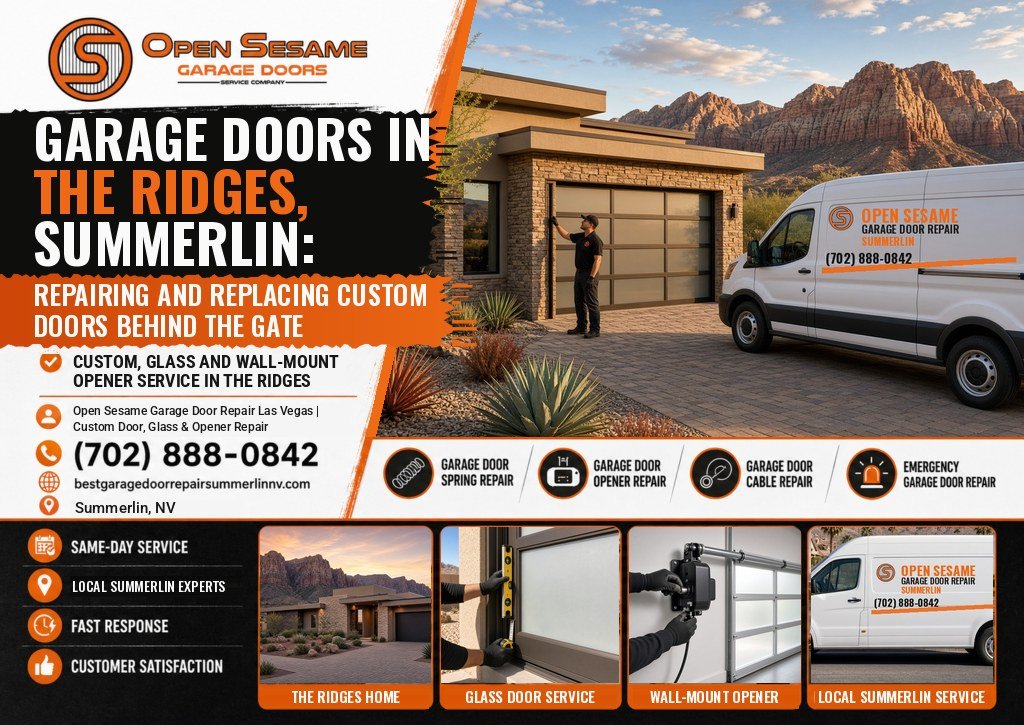
Garage Doors in The Ridges, Summerlin: Repairing and Replacing Custom Doors Behind the Gate
Garage doors in The Ridges are heavier, wider and more custom than most in the valley, so repairs here come down to matching springs and hardware to the door’s real weight, setting up wall-mount openers and sensors correctly, and protecting glass and wood finishes from west-side sun. Anything that changes the look of the door goes through design review first, and every visit starts at the guard gate. This guide covers the door types found in The Ridges, what typically fails, which checks are safe for an owner, how design review works, and when repair, refinishing or replacement makes sense. Open Sesame Garage Door Repair Las Vegas serves The Ridges from 7865 Bluewater Dr. Call (702) 888-0842, 24 hours a day.
Direct answer
Garage doors in The Ridges are usually heavier, wider and more custom than the valley average: full-view aluminum and glass, flush modern steel, wood or wood-look composites, tall single doors, and wall-mount openers. That means most repairs come back to three things: springs, cables and drums sized to the door’s real weight; openers and sensors suited to custom setups; and finishes and glass that take a beating from west-side sun. Anything that changes the look of the door goes through design review first, and every visit starts at the guard gate.
Posted Open Sesame ranges apply to hardware work: standard repair $150 to $350, off-track $150 to $350, springs $250 to $450, opener repair $150 to $300, new opener $550 to $950, tune-up $89 to $129. Custom sections, glass panels and new doors are quoted after the door is identified.
The Ridges in brief, and why it is different for garage doors
The Ridges is a 793-acre guard-gated village at the far western edge of Summerlin, off Flamingo Road at Town Center Drive and west of the 215 Beltway. It was conceived in 2000 as an enclave of custom and semi-custom homes, and it takes its name from the rocky ridgeline it sits on. Red Rock Canyon National Conservation Area frames it to the west. Addresses use 89135, and like the rest of Summerlin south of Charleston Boulevard, it is in unincorporated Clark County.
The village is a collection of neighborhoods rather than one subdivision. A 2015 Las Vegas Review-Journal profile counted seven custom neighborhoods and four high-end production neighborhoods. Names that come up often include Promontory Ridge, the first custom neighborhood; Azure, the largest custom enclave, with its own gate inside the main gate; Indigo; and Talon Ridge, announced in 2019 as the final custom neighborhood. Club Ridges serves residents.
Two features of the village shape garage door work more than anything else. First, design review: a Howard Hughes design review board guides custom homes toward a desert-contemporary look with horizontal, sloped and curved lines and desert-appropriate colors and materials. Second, the custom nature of the homes: no two garages are quite the same, so parts and settings are less standard than in a production neighborhood.
A third feature is easy to forget until you need service: everything happens behind at least one gate, and sometimes two.
The Ridges sits within Summerlin South. Our Summerlin South garage door repair page covers the wider area, including Red Rock Country Club, The Willows and Siena.
The doors you find behind the gate
Desert-contemporary architecture favors clean planes, so garage doors in The Ridges lean modern. Typical types include:
- Full-view doors with aluminum frames (often dark bronze or black) and glass or polycarbonate panels, frosted or tinted for privacy.
- Flush steel doors with smooth faces, often in dark colors, sometimes with horizontal grooves that line up with the home’s stone or stucco banding.
- Wood and wood-composite doors, either solid wood sections or steel doors with wood or composite overlays, used to warm up stone and stucco facades.
- Tall single doors for SUVs, vans and sometimes car collections, plus wide two-car openings that need reinforcement struts.
- Side-entry and courtyard garages, where the door faces a motor court rather than the street.
Openers are just as varied. Wall-mount (jackshaft) units are common because they free the ceiling, which suits high garage ceilings and storage lifts. Belt drives with battery backup and app control are also common. Many homes have three or more doors, sometimes with different opener types on each.
All of this is good-looking and practical, but it means a technician needs to identify the door and opener before quoting. That is why custom sections, glass and new doors are always quoted after the door is identified rather than over the phone.
Why door weight drives almost every repair in The Ridges
A sectional garage door is held up by its springs, not by the opener. The springs are wound to counterbalance the door’s weight so that the opener, or a person, only has to move a door that feels light. When the springs match the door, the door stays put when stopped halfway and the opener barely works. When they do not match, everything else wears faster.
Custom doors make matching harder. A full-view door’s weight depends on the frame and the glazing. Wood doors vary by species and thickness. Overlays add weight to a steel base door. Over the life of a home, the weight can also change: a refinish adds coats, a glass panel gets swapped for a different material, decorative hardware gets added, or an insulation kit goes in. Each change is small. Together they can leave the springs underpowered.
Signs of a weight and spring mismatch include a door that drifts down or rises when stopped halfway, an opener that labors or stops partway, springs that break well before their expected life, and cables that fray early. If you see these on a custom door, the fix is a spring chosen for the door’s actual weight and height, with cables and drums rated for that load. Copying the old spring size repeats the problem.
Weighing and balancing a heavy door is not an owner job. The springs hold enough energy to cause serious injury, and DASMA’s garage door safety guidance tells homeowners to leave spring adjustment and replacement to trained technicians. Our guide to spring life in Summerlin heat explains cycle ratings and why higher-cycle springs can make sense on doors that get used a lot.
Tall doors deserve a special mention. The taller the door, the longer the cables and the more turns the springs carry. A broken spring on a tall, heavy door is a no-touch situation. Leave the door where it is, keep people and cars clear, and call.
Wall-mount openers and quiet drives
A wall-mount opener, also called a jackshaft opener, mounts on the wall beside the door and turns the torsion bar directly. There is no rail or trolley across the ceiling. That suits The Ridges well: garages often have high ceilings, storage lifts or car lifts, and owners want a clean look and a quiet door.
Wall-mount units have their own quirks. They need a torsion spring system, and the door has to be properly balanced, because the opener relies on the springs doing most of the lifting. Some models include a cable tension sensor that stops the opener if a lift cable goes slack, and many pair with an automatic deadbolt that locks the door when closed. If the deadbolt is out of adjustment, the door can refuse to open, and the opener may show an error rather than an obvious mechanical fault.
Common wall-mount problems include error codes from a slack cable or deadbolt, limits that drift after a spring replacement, photo-eye faults, and lost Wi-Fi connections. Many of these are settings or sensor issues rather than broken parts. When the door is out of balance, though, a wall-mount opener will struggle and may fault repeatedly, so balance comes first.
Belt-drive openers are the other common choice. They are quiet and reliable and usually cost less than a wall-mount unit. Battery backup is worth adding on either type. California requires battery backup on new residential openers sold there, but Nevada does not, so it is not a given on Summerlin openers.
Opener repair falls in the posted range of $150 to $300, and new openers installed in the posted range of $550 to $950. Our comparison of belt, chain and wall-mount openers for Summerlin homes and the opener repair or replace cost guide go into more detail.
High ceilings, car lifts and high-lift track
Many custom garages have tall ceilings, and owners use that space for car lifts, overhead storage racks or simply a more open feel. The standard door setup, where the door rolls up and lies flat just under the ceiling near the top of the opening, does not always fit those plans.
High-lift track raises the point where the door turns from vertical to horizontal, so the door travels further up the wall before it lays back. Vertical-lift track goes further and runs the door straight up the wall. Both free space in the middle of the garage. Both also change the spring setup, the cable length and, often, the opener type. A wall-mount opener is the usual partner for high-lift and vertical-lift doors because there is no ceiling rail in the way.
If you are adding a car lift to an existing garage, plan the door at the same time. A lift that sits in the path of the door’s horizontal track will not work with a standard setup. Converting a door to high-lift is a real project, not a quick adjustment, and on a custom door it should be quoted after the door and ceiling are measured.
High-lift doors put more turns on the springs and longer cables on the drums. When one of these doors has a spring or cable problem, it is even more important not to touch it.
Side-entry, courtyard and multi-door garages
Many Ridges homes have side-entry or courtyard garages, where the doors face a motor court instead of the street, and many have three or more doors. That changes a few practical things.
Turning into a side-entry garage gives drivers less room to line up, so bumper taps on the edge of a door or the jamb are more common than on a straight-in garage. A light tap can bend a track or push a roller out without obvious damage to the face of the door. If a door starts making a new noise after someone clipped it, check the track on that side before running it again.
On multi-door garages, the doors were often installed together but get used very differently. The everyday door may need springs years before the door that only moves for a weekend car. When one door needs service, it is worth having the others looked at during the same visit so you know where each stands.
Matching matters too. If one of three matching doors is damaged and its finish or sections cannot be matched, the visible difference sits right in the motor court. Factor that into a repair or replace decision.
Quiet doors for close neighbors
Custom lots in The Ridges vary in size, but in the production neighborhoods and on smaller custom lots, neighbors can be close, and an early-morning door can be heard next door. Noise usually comes from three places: worn steel rollers, dry hinges, and the opener drive.
Sealed nylon rollers with ball bearings are the simplest improvement. Lubricating hinges and spring coils helps. A belt-drive or wall-mount opener is much quieter than a chain drive. Rubber isolators between the opener and its mounting bracket can reduce vibration through the ceiling on rail-type units. A door that is properly balanced is also quieter, because the opener is not straining.
If a quiet door suddenly gets loud, treat that as information. A new grinding sound can be a failing roller bearing, and a new bang or clunk can mean a spring or cable problem. Our article on nine garage door noises in Summerlin explains what common sounds can mean.
Full-view glass and aluminum doors
Full-view doors are a natural fit for desert-contemporary design. They let light into the garage and turn the door into part of the facade. They also bring their own maintenance and repair questions.
Know what your glazing is
Full-view doors can use tempered glass, laminated glass, or plastic panels such as acrylic or polycarbonate. The choice affects weight, how a panel breaks, how it scratches, and how it is replaced. If you do not know what you have, the door’s label or original paperwork may say. Otherwise a technician can usually tell on site. Tempered glass breaks into small pieces. Laminated glass cracks but stays in place. Plastic panels scratch more easily and can haze over time in strong sun.
Privacy finishes and design review
Frosted, satin-etched or tinted panels give privacy. Associations often have rules about reflective or mirrored finishes. Summerlin West’s published design criteria, for example, prohibit window coverings on garage door windows except un-mirrored or non-reflective tint. The Ridges has its own requirements, so check yours before changing a panel finish.
Common full-view repairs
A cracked or broken panel can often be replaced within the existing frame if the frame is straight and the matching glazing is available. A bent frame section, typically from a vehicle bump, usually means replacing the whole section. Weatherstripping between sections and along the bottom also wears faster on aluminum doors that take direct afternoon sun.
Because full-view doors are heavy for their thickness, the spring and cable notes above apply. If a panel is swapped from plastic to glass, or the other way, the door’s weight changes and the springs should be checked.
Cleaning
Use mild soap and water and a soft cloth. Avoid abrasive pads and harsh solvents, especially on plastic panels. Desert dust is abrasive, so rinse before you wipe. Check the manufacturer’s care instructions for your specific panels.
Wood, composite and wood-look doors
Wood and wood-look doors soften the stone and stucco of a desert-contemporary home. In The Ridges climate, the challenge is not rot so much as sun.
Ultraviolet light breaks down stains and clear finishes. On south- and west-facing doors, that happens faster. Once the finish fails, bare wood dries out, grays and can check or split along the grain. Irrigation overspray hitting the bottom of the door adds wet-dry cycles that are hard on the finish at the bottom rail.
Refinishing on a regular schedule protects the door. How often depends on the finish, the wood and the exposure, so follow the door manufacturer’s or finisher’s guidance. Two practical notes from the mechanical side: every refinish adds a little weight, and stripping and refinishing a door in place means keeping finish off the rollers, hinges and seals.
Wood-composite and steel doors with composite overlays resist checking better than solid wood but still fade. Overlays are glued or fastened to a steel base door, so check the edges for lifting, especially at the bottom section.
A custom wood section that is damaged may need to be built to match. That takes longer than ordering a standard steel section. In the meantime, the priority is making the door safe and secure, which a technician can usually do by stabilizing the damaged section, checking the track and making sure the door can close and lock.
Our Summerlin panel repair cost guide and the guide to replacing a single panel explain when one section can be swapped and when the whole door should go.
Flush modern steel doors in dark colors
Flush steel doors in charcoal, bronze or black are a common match for stone and dark window frames. They look sharp, but dark colors absorb far more heat than light colors. On a west-facing door in July, the face of a dark steel door can get hot enough to be uncomfortable to touch.
Heat affects a door in a few ways. Steel expands, and on very wide doors that movement shows up as a slight bow in the sections or extra stress at the hinges. Insulated doors usually handle this better because the insulation is bonded between steel skins and stiffens the section. Bottom seals and side weatherstripping harden faster against a hot face. Paint and factory finishes fade, and touch-up paint rarely matches a sun-faded door exactly.
If your dark door looks wavy on hot afternoons and flat in the morning, that is thermal movement. It is usually cosmetic on a well-built insulated door. If the waviness stays after the door cools, or a hinge line is cracking, have it checked.
When you choose a replacement, the manufacturer’s information on heat and color is worth reading. Some manufacturers limit or warn about very dark colors on certain door types in hot climates. Your association’s approved palette also matters, so check both before you fall for a color.
Our article on how Summerlin dust and desert conditions affect doors covers the tracks, rollers and openers behind these finishes.
Dark streets, low sun and photo eyes
The Ridges has no streetlights, only low-level path lights, and exterior lighting on each home is reviewed as part of the design process. That keeps the night sky clear. It also means garages and motor courts can be quite dark at night, and that has some small but real effects on garage doors.
Photo eyes do not need ambient light to work, but people do. If you come home after dark and the door reverses, it is harder to see whether something is in the beam, whether a lens is dirty, or whether a sensor bracket was knocked. A small flashlight in the car helps. So does checking the sensor lights in daylight now and then: on most openers, both photo eyes have an indicator light, and a light that flickers or stays off points to alignment or wiring.
Low sun is the bigger problem. Garages that face west toward Red Rock catch late-afternoon sun straight into the opening. If that sun hits the receiving photo eye, the opener can read it as a blocked beam and refuse to close. The pattern is a door that misbehaves at the same time each day, then works an hour later. Cleaning and re-aiming the eyes, or swapping sending and receiving sides so the receiver is shaded, usually solves it.
The monthly reversal test still matters on high-end openers. The U.S. Consumer Product Safety Commission recommends checking the reversing feature regularly. Lay a 2×4 flat in the door’s path and close the door. It should reverse on contact. Then pass an object through the photo-eye beam as the door closes; it should stop and reverse. Federal rules in 16 CFR Part 1211 require this entrapment protection on residential openers made since 1993, so if either test fails, stop using automatic close until it is fixed.
Insulated doors and garages used as living space
Custom garages are often more than parking. Gyms, workshops, wine storage and car displays are common, and all of them care about temperature. The garage door is usually the largest uninsulated surface in the room, so it has a big effect on how hot the space gets on a summer afternoon.
Insulated doors use foam bonded between steel skins, or foam panels inside a frame. Bonded construction also stiffens the sections, which helps wide doors stay flat. Full-view doors can be ordered with insulated glazing, though glass will never insulate as well as a solid insulated section.
Adding insulation to an existing door with a kit is possible but adds weight. On a heavy custom door, that extra weight should be matched by a spring adjustment or new springs. Ask before you add anything to the door, and have the balance checked after.
A garage used as living space also tends to have the door opened less often, which is easier on springs, but it may have more equipment near the tracks. Keep the track path and the photo-eye beam clear of storage.
What to have ready before the technician arrives
A few minutes of preparation saves time on a custom-door visit. Have the gate instructions sorted and confirmed. If you have the door’s paperwork, model label photos or the original builder’s documents, keep them handy; they help identify parts for a custom door. Note any error codes or light patterns on the opener. Move cars out of the way of the door if it is safe to do so, and clear storage away from the tracks and the wall-mount opener. If the door is open and stuck, leave it where it is and keep people away from it.
If a section or glass panel is damaged, take photos from a safe distance. They help if you need to make an insurance claim and help us plan parts.
Getting a technician through the gate
Every service visit in The Ridges starts at the guard gate, and some homes sit behind a second neighborhood gate. Most delays on gated jobs are avoidable with a little planning.
When you book, give the name the gate will expect and add the technician or company to your guest list using whatever system your gate uses. If you live inside a neighborhood with its own gate, mention it, along with any code or call box details. If you will not be home, say who will meet the technician, and make sure that person is also on the list.
Ask your association about contractor rules before you need them. Many gated communities set contractor hours, parking rules and requirements about where work vehicles may stand. If your association limits contractor hours, an after-hours emergency may still be allowed for a security issue such as a door that will not close. Know your association’s policy before you need it.
Protect your driveway. Paver motor courts look great but can be marked by heavy tools or dropped parts. Point out any surfaces you are particular about, and expect a technician to work from mats or drop cloths where needed.
If the door is stuck open and the home is exposed, tell us when you call. That is treated as an emergency, and gate access becomes part of the plan. Our Summerlin South emergency garage door repair page explains what to do while you wait.
Design review in The Ridges: what needs approval
Like the rest of Summerlin, The Ridges has layered associations. The village sits under the Summerlin South Community Association, the master association for Summerlin South. The Ridges also has its own village association, which local listings describe as handling the main gate, Club Ridges and design review. Custom neighborhoods inside The Ridges may add their own rules on top.
The general rule across Summerlin is the same: repairs that restore the door to how it was do not change the home’s appearance, while changes to the door’s look need approval before work starts. Repairs in the first group include springs, cables, rollers, hinges, a replacement opener, a new bottom seal, and replacing a damaged section with an identical one. Changes in the second group include a new door of a different style, a new color, adding or removing glass, changing glass finish, or switching material, say from flush steel to a wood-look overlay.
The design review board’s general direction in The Ridges is desert-contemporary: low and horizontal lines, materials and colors suited to the desert, and lighting kept modest. A garage door is a large part of a home’s front, so expect the committee to look at it carefully.
What to prepare
- The manufacturer’s specification sheet for the proposed door, including model, section design, material and glazing.
- The finish or color name and number, plus a physical sample if you can get one.
- Photos of the current door and the full front elevation of the home.
- A simple drawing or rendering if the new door changes the look significantly.
- Any approvals required from your neighborhood association before the village or master association will review.
We can supply the door details a committee asks for. We cannot approve anything on behalf of an association, and you should not place an order for a custom door until you have written approval. Custom doors often take a long time to build, and an order placed before approval risks a door you cannot install.
If you live in Summerlin North, the Summerlin North Community Association’s improvement request form shows how detailed a Summerlin submission can be: written approval is required before work begins, incomplete submittals may be denied, and sub-association approval comes first. Your own association’s forms will have their own wording, so read the current version.
Our Summerlin garage door replacement guide covers styles, materials and value if you are planning a change.
Common repairs on Ridges garage doors
These are the jobs that custom-door homes typically need. Most fall under the posted repair ranges; custom sections and glass are quoted after the door is identified.
Spring replacement on heavy doors
Springs on heavy doors are under more load, so they reach the end of their cycle rating sooner if they were undersized. A replacement should be chosen for the door’s actual weight and height. On two-spring doors, replacing both is usually sensible. Posted range: $250 to $450. Our Summerlin spring replacement cost guide explains what affects the price.
Cables, drums and bottom brackets
Heavy doors are hard on lift cables. Fraying near the bottom bracket is the usual first sign. A frayed cable should be replaced before it snaps, and both sides are usually done together. If a cable comes off its drum, the door will hang crooked; leave it closed if possible and call. Our guide to crooked doors explains the causes.
Wall-mount opener faults and deadbolts
Error codes on wall-mount units often trace back to a slack cable sensor, a deadbolt out of adjustment, or limits that need resetting after spring work. These are usually settings rather than failed parts, but they need someone familiar with the opener type.
Photo-eye problems
Low sun, dust and bumped brackets cause most sensor faults. Clean the lenses first. If both indicator lights are not steady, alignment or wiring is the next step.
Rollers and hinges on wide doors
Wide and heavy doors put more load on rollers and center hinges. Sealed nylon rollers with ball bearings run quieter and smoother. Cracked hinges should be replaced before they let a section flex. Our roller comparison covers the choice.
Reinforcement struts
Wide doors usually carry steel struts across some sections, especially the top section where the opener arm attaches. Loose or missing struts let the top section bow. If you see the top section flex when the door starts to open, have the strut and opener bracket checked.
Seals and weatherstripping
Bottom seals and perimeter weatherstripping dry out faster on doors that face the afternoon sun. Our bottom seal guide explains when to replace them.
Off-track doors after a bump
A bumper tap on a side-entry or courtyard garage can push a door out of its track. Do not run the opener on an off-track door. Posted range for off-track work: $150 to $350. If a car did more than tap the door, our guide to a garage door hit by a car in Summerlin explains repair versus replacement.
Wind, storms and wide doors on the western edge
The Ridges sits right against the foothills, and wind matters out here. Spring wind events and summer monsoon outflows can bring strong gusts off the Spring Mountains and Red Rock Canyon. NWS Las Vegas issues wind advisories and high wind warnings when they are expected.
A closed door handles wind as a whole system: sections, struts, hinges, tracks and the framing around the opening share the load. An open door does not. If a strong gust catches a door while it is open or partway closed, the top section and the horizontal tracks take the hit. Afterwards, look for a track that is no longer straight, a top section that sits crooked, or rollers that have popped out of the track. Do not run the door until it has been checked if you see any of those.
Wide and tall doors are more exposed simply because they present more surface. When you replace a large door on an exposed lot, ask the installer what wind rating the door carries and whether it suits your location under the building code that applies in unincorporated Clark County. DASMA publishes technical material on wind load for garage doors if you want to read further.
Dust follows wind. After a windy day, wipe the tracks and photo-eye lenses. Fine grit in a roller bearing is one of the main reasons rollers get noisy.
The garage as the largest opening in the house
On most homes the garage door is the biggest opening, and in a custom home it often leads straight into a mudroom or service hall. A door that does not close fully, or that someone can open from outside, is a security issue even behind a guard gate.
A few habits help. Use an opener with rolling-code remotes and keep remotes out of sight in parked cars. Enable alerts on a smart opener so you know if the door is left open. Lock the door between the garage and the house. If you have a wall-mount opener with an automatic deadbolt, keep the deadbolt adjusted so it actually engages.
If the home sits empty for weeks, consider unplugging the opener or using its vacation lock feature, if it has one, so remotes will not work until you return. When you come back, run the door once while you watch it. Springs and rollers that have sat still for a long time sometimes fail on the first cycle.
If someone looks after the house while you are away, show them where the emergency release is and explain that it should only be pulled with the door closed. Pulling the release on an open door with a broken spring can let the door fall.
A care schedule for custom doors in The Ridges
Custom doors reward regular attention. A simple schedule:
Monthly
- Run the 2×4 reversal test and the photo-eye test.
- Watch and listen to one full cycle. Note new noises, shakes or hesitation.
- Wipe the photo-eye lenses.
Every few months
- Wipe the tracks clean and dry. Do not grease them.
- Apply a garage door lubricant to rollers, hinges and spring coils.
- Rinse dust from glass and frames, then clean with mild soap and a soft cloth.
- Check the bottom seal and side weatherstripping for cracks or gaps.
Yearly
- Professional tune-up: balance check, spring and cable inspection, roller and hinge check, fastener tightening, opener force and limit settings, and safety testing. Posted range $89 to $129. See our Summerlin tune-up guide for what should be included.
- Inspect wood or overlay finishes, especially at the bottom section and on sun-facing doors. Plan refinishing before the finish breaks down.
- Replace remote batteries before they fail.
After any change to the door
If the door is refinished, re-glazed, insulated or given new hardware, have the balance checked. A change in weight is the easiest way to shorten spring and opener life without noticing.
Repair, refinish or replace a custom door
A custom door is expensive to replace, so repair and refinishing are usually the first options. The decision turns on a few questions.
Is the structure sound? If the sections are flat, the frames are straight and the hinges and struts are solid, hardware repairs and refinishing can keep a door going for a long time.
Can damaged parts be matched? A glass panel in a standard size is usually replaceable. A custom wood section may need to be built. An overlay discontinued by its maker may not be matchable at all. If the damaged part cannot be matched, the choice may be between living with a visible difference and replacing the door.
Is the door still right for the house? Some owners use a damaged or worn door as the moment to change the look, especially if they are going through design review anyway. Others want the door that was approved with the house. Both are reasonable. Our Summerlin new garage door cost guide explains what moves the price of a replacement.
Does the door still suit how the garage is used? A garage that has become a gym, studio or car display may call for an insulated door or a quieter opener than the original.
What does the repair list look like? One spring is a repair. Springs, cables, rollers, a failing opener and a cracked section all at once on an older door is a reason to price both paths.
Our Summerlin repair versus replacement guide walks through the general decision. On a custom door, we will tell you plainly what we can repair, what would need to be ordered or built, and what we think is poor value. You decide.
Symptoms and safe checks on a custom door
Use this as a guide, not a diagnosis. Springs, cables and bottom brackets are always technician work.
| What you notice | Likely cause | Safe owner check | When to call |
|---|---|---|---|
| Loud bang, door too heavy to move | Broken spring | Look at the spring bar from a distance. Do not touch it. | Now. Do not run the opener. |
| Wall-mount opener shows an error and will not open | Slack cable sensor, deadbolt out of adjustment, or limits | Note the error code or light pattern. | Soon. Do not force the door. |
| Door closes at night but not late afternoon | Sun on the receiving photo eye | Clean lenses and check indicator lights. | If cleaning does not help. |
| Door drifts when stopped halfway | Springs out of balance, often after a weight change | Halfway test, only on a working door. | Soon. |
| Cracked glass or plastic panel | Impact or stress in the frame | Keep people clear of broken glass. Photograph it. | Soon. Now if the house is exposed. |
| Top section bows as the door starts to open | Loose strut or opener bracket | Watch from a distance. | Soon. |
| Door hangs crooked | Cable off its drum or broken cable | Look from a distance. Keep it closed if it is closed. | Now. |
| Finish graying or checking on a wood door | Sun and UV breakdown | Inspect the bottom section and sun-facing side. | Plan refinishing. |
Posted price ranges
These are the same ranges Open Sesame posts across the valley. Custom work is priced after we see the door, and you get the exact price before work starts.
| Job | Posted range |
|---|---|
| Standard repair (cables, rollers, hinges, struts, minor track work) | $150 to $350 |
| Off-track door | $150 to $350 |
| Spring replacement | $250 to $450 |
| Opener repair | $150 to $300 |
| New opener installed | $550 to $950 |
| Tune-up | $89 to $129 |
| Custom sections, glass panels and new doors | Quoted after the door is identified |
Heavier springs, tall doors and parts that must be ordered tend to push a job toward the top of a range. Ask about after-hours pricing if you call outside normal hours.
Choosing who works on a custom door
A custom door is not the place to learn. A few questions help separate the right contractor from the wrong one.
Are you licensed in Nevada? Ask for the licence number and check it with the Nevada State Contractors Board. Open Sesame’s is #0083315.
How will you choose the springs? The right answer involves the door’s weight and height, not just copying the old springs.
Have you worked on this type of opener? Wall-mount units with deadbolts and cable sensors have their own setup steps.
What will you do if a part has to be ordered? A good plan makes the door safe and secure first, then schedules the return visit.
Will you give me a price before you start? You should get one. We give a fixed price from the posted ranges before any work.
Will you test the safety features when you finish? The reversal test and photo-eye test should be part of every visit.
What to expect when you call Open Sesame
Call (702) 888-0842. Tell us what you see and hear, what kind of door and opener you have if you know, whether the door is open or closed, and how to get through the gate. If the door will not close or a car is trapped, say so; that is an emergency.
On site, the technician checks the whole system: springs, cables, drums, rollers, hinges, struts, tracks, the opener and its sensors, and the condition of the sections, glass or finish. You get a plain explanation and a fixed price before any work starts. After the repair, the door is balanced, lubricated and safety-tested, and you will hear about anything else that looks close to failing.
Open Sesame Garage Door Repair Las Vegas is at 7865 Bluewater Dr, Las Vegas, NV 89128, open 24 hours, seven days a week. Nevada contractor licence #0083315. You can also request service online.
For a full overview of repairs across the master plan, read the complete 2026 Summerlin garage door guide or visit our Summerlin garage door repair page. Homeowners on the north side can read our guide to Summerlin North garage door problems, and those farther north can see the Centennial Hills page.
Frequently Asked Questions About Garage Doors in The Ridges, Summerlin
Do you service garage doors inside The Ridges?
Yes. The Ridges is guard-gated, so add us to your guest list or give the name the gate will expect when you book. Mention any second neighborhood gate, such as in Azure.
Why do springs break early on custom doors?
Usually because they are undersized for the door. Custom doors are heavy, and refinishing, new glass, overlays or insulation add weight over time. Springs should be chosen for the door’s actual weight and height.
Can you work on wall-mount (jackshaft) openers?
Yes. Many faults on wall-mount units come from a slack cable sensor, a deadbolt out of adjustment or limits that need resetting after spring work. Balance the door first, then check the opener settings.
Can a broken glass panel in a full-view door be replaced?
Often, if the frame is straight and matching glazing is available. A bent frame section usually means replacing the whole section. Glass and custom sections are quoted after the door is identified.
Do I need design review approval to repair my garage door in The Ridges?
Repairs that restore the door to how it was, such as springs, cables, rollers, an opener or an identical section, generally do not change the home’s appearance. A new style, color, glass layout or material needs written approval first. Check your associations’ current rules.
Which associations cover The Ridges?
The Ridges is in Summerlin South, under the Summerlin South Community Association. The village also has its own association, and some custom neighborhoods inside it add their own rules.
Why does my door refuse to close in the late afternoon?
Low western sun hitting the receiving photo eye is a common cause. Clean the lenses, check that the indicator lights are steady, and if needed have the eyes re-aimed or swapped so the receiver is shaded.
Are dark flush garage doors a problem in the heat?
Dark steel gets much hotter than light colors. You may see slight waviness on hot afternoons, faster fading and harder seals. Insulated doors handle this better. Check the manufacturer’s guidance and your approved palette before choosing a dark color.
How often should a wood garage door be refinished?
It depends on the wood, the finish and how much sun the door gets. Follow the manufacturer’s or finisher’s guidance, inspect yearly, and refinish before the finish breaks down. Have the balance checked afterward, since refinishing adds weight.
Can you convert my door to high-lift track for a car lift?
Often, but it is a project rather than an adjustment. The springs, cables and usually the opener change too. We quote it after measuring the door and ceiling.
What should I do if wind hit my door while it was open?
Do not run it until you have checked that both tracks are straight, the top section sits flat and the rollers are in the track. If anything looks off, call for an inspection.
Is battery backup required on openers in Nevada?
No. California requires battery backup on new residential openers sold there, but Nevada does not. It is worth adding if you want to use the door during an outage.
How much does garage door repair cost in The Ridges?
Posted ranges: standard repair $150 to $350, off-track $150 to $350, springs $250 to $450, opener repair $150 to $300, new opener $550 to $950, tune-up $89 to $129. Custom sections, glass and new doors are quoted after the door is identified.
What if my door is stuck open and I am away?
Tell us when you call so gate access can be arranged with whoever is at the house. A door that leaves the home exposed is treated as an emergency.
Are you licensed, and where are you based?
Open Sesame Garage Door Repair Las Vegas is at 7865 Bluewater Dr, Las Vegas, NV 89128, open 24 hours. Nevada contractor licence #0083315. Call (702) 888-0842.
Sources
- Las Vegas Review-Journal: The Ridges offers luxury community within Summerlin
- Summerlin: Villages
- Summerlink: Summerlin community associations
- Summerlin West Community Association: Design Criteria (garage door windows and tint)
- Summerlin North Community Association: Improvement Request Form
- eCFR: 16 CFR Part 1211, Safety Standard for Automatic Residential Garage Door Operators
- U.S. CPSC: Automatic Residential Garage Door Operators FAQ
- DASMA: Garage door system safety tips
- National Weather Service Las Vegas
- Nevada State Contractors Board
Find Open Sesame Garage Door Repair Las Vegas
View on Google Maps · 7865 Bluewater Dr, Las Vegas, NV 89128
Custom Garage Door Trouble in The Ridges? Call Open Sesame
Call (702) 888-0842 for springs, cables, wall-mount openers, glass and custom doors in The Ridges. We plan gate access with you and give a fixed price before work starts. Licence #0083315.
7865 Bluewater Dr, Las Vegas, NV 89128 · Open 24/7 · Licence #0083315