Cable Off the Drum
One lift cable may lose tension or leave its drum, causing one side of the door to rise differently from the other.



A garage door that rises unevenly or makes a grinding noise may have a loose or damaged cable, worn roller, bent track, broken spring, damaged cable drum, loose hinge, misaligned opener, or internal opener-gear problem.
Stop operating the door if it is visibly crooked, off track, hanging from one side, supported by a loose cable, or making severe metal-on-metal grinding sounds.
Uneven lifting usually means the two sides of the door are not carrying the same load. Common causes include a cable that has loosened or left its drum, a broken or unbalanced spring, a worn roller, a bent track, a damaged hinge, or an off-track condition.
Grinding noises may come from seized rollers, metal rubbing against a bent track, worn opener gears, a loose chain, damaged bearings, misaligned hardware, or an opener that is straining to lift a heavy or unbalanced door.
Do not repeatedly operate the opener when the door is crooked, extremely heavy, or grinding loudly. Continued use may damage the opener, tracks, rollers, cables, hinges, panels, or spring system.
A garage door should rise evenly, stay guided inside both tracks, and move without severe scraping or grinding. A small squeak may indicate routine wear, but a door that visibly tilts or produces metal-on-metal noise may have a mechanical imbalance.
For Las Vegas homeowners, an uneven door can trap a vehicle, prevent the garage from closing, expose the property, or make the opener stop unexpectedly. For landlords and property managers, it may interrupt tenant access or create a security problem. For local businesses, the door may block equipment, deliveries, or vehicle access.
The problem may begin with one component but spread to others. A loose cable can make one side rise faster. That angle can force rollers against the tracks, strain hinges, flex panels, and make the opener pull unevenly.
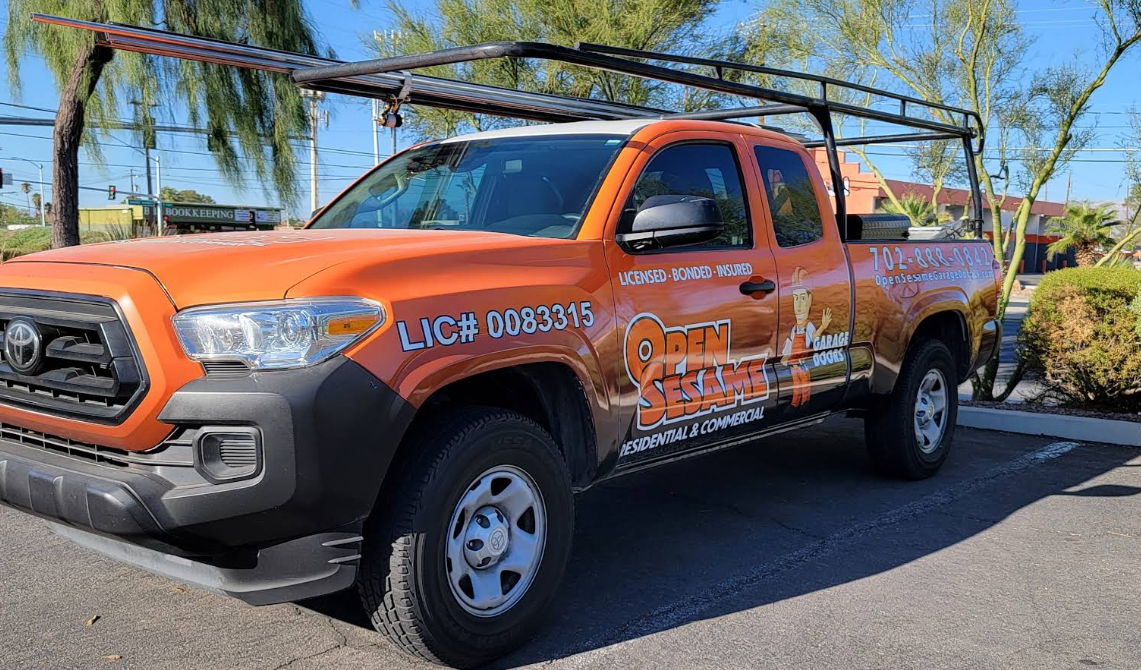
Open Sesame Garage Door is a local Las Vegas garage door repair company serving Las Vegas, Summerlin, and nearby Clark County communities.
One lift cable may lose tension or leave its drum, causing one side of the door to rise differently from the other.
A damaged cable may stop supporting one side of the door, allowing the opposite side to continue moving.
A broken spring can remove counterbalance and allow cables to loosen, especially when the opener continues operating.
Incorrect winding or mismatched springs may cause poor balance and uneven lifting.
A roller that stops rotating may bind on one side and make the door tilt.
A damaged track can slow one side of the door while the other side continues moving.
Loose hardware may change the roller position and allow sections to move unevenly.
A tool, debris, bent fastener, or damaged track edge may prevent one roller from moving normally.
A roller outside the track can make the door twist, scrape, jam, or hang at an angle.
Rollers should rotate as the door travels. When bearings fail or the wheel becomes damaged, the roller may drag along the track and create grinding or scraping sounds.
A bent track may force a roller stem, hinge, or door section against the metal track. The resulting noise often becomes louder at the same point during each opening or closing cycle.
Center bearings, end bearings, rollers, and other rotating parts can make rough mechanical sounds when worn. Lubrication may help suitable serviceable components, but lubrication will not repair a damaged bearing.
A loose chain may strike the rail, vibrate, or create rattling and grinding sounds. Excessive tightening can also create problems, so chain adjustment should follow the opener’s requirements.
Some openers use internal plastic or metal gears. A worn gear may create grinding while the motor runs but the trolley moves poorly or not at all.
Belt-drive and chain-drive systems can make grinding or clunking sounds when the belt, sprocket, trolley, rail, or motor assembly is damaged.
The opener does not carry the full weight of a properly balanced garage door. If a spring is broken or the door is binding, the opener may strain and produce grinding, humming, or gear noise.
| Symptom | Possible Cause | What You May Notice | Safe Initial Check | Likely Repair | Urgency |
|---|---|---|---|---|---|
| Door rises higher on one side | Loose cable, cable off drum, broken cable, or spring imbalance | Door appears tilted | Stop operation and inspect visually | Cable, drum, spring, and balance repair | Urgent |
| Grinding from one side | Seized roller, bent track, loose hinge, or metal contact | Noise occurs at one position | Look for track damage from a distance | Roller, hinge, or track repair | Prompt |
| Motor runs but door barely moves | Broken spring, heavy door, stripped gear, or jammed track | Humming or grinding from opener | Stop repeated operation | Spring or opener diagnosis | Prompt |
| Chain moves but door does not | Disconnected trolley, damaged trolley, or broken door arm | Rail moves without lifting door | Check emergency release visually | Trolley reconnection or repair | Moderate |
| Door opens only a few inches | Broken spring, cable issue, track obstruction, or opener strain | Door stops or reverses | Look for spring gap and loose cables | Spring, cable, or track repair | Prompt |
| Door is extremely heavy | Broken spring or incorrect spring balance | Difficult manual movement | Do not lift alone | Spring replacement and balancing | Urgent |
| Door starts and reverses | Track resistance, sensors, limits, force settings, or obstruction | Reversal at similar point | Check sensors and visible obstructions | Mechanical or opener adjustment | Moderate to prompt |
| Grinding inside opener | Stripped gear, damaged sprocket, motor, belt, or chain assembly | Motor noise without normal trolley movement | Stop operation | Opener repair or replacement | Prompt |
| Trolley moves without door | Emergency release disconnected or trolley damaged | Rail mechanism moves separately | Inspect release position | Reconnect or repair trolley | Moderate |
| Loose cable hangs beside track | Broken spring, cable off drum, or cable damage | Uneven door or slack cable | Do not touch cable | Cable, drum, and spring service | Urgent |
| Roller outside track | Track damage, cable imbalance, impact, or worn roller | Door crooked or jammed | Do not operate | Off-track door stabilization and repair | Urgent |
| Door moves manually but opener grinds | Opener gear, sprocket, belt, chain, trolley, or motor issue | Door itself may feel balanced | Stop using opener | Opener repair or replacement | Prompt |
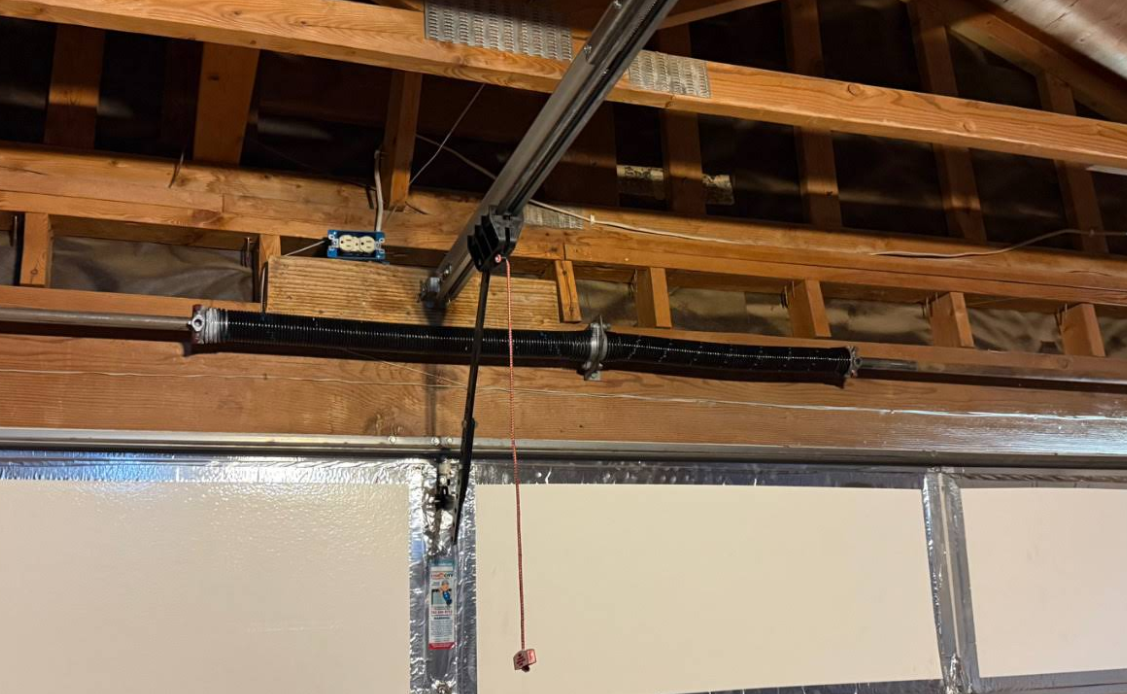
Lift cables connect the spring system to the lower corners of the garage door. On a torsion-spring system, each cable wraps around a drum near the ends of the spring shaft.
When a cable leaves its drum, one side may lose support. The other cable may continue lifting, causing the door to become crooked.
A frayed cable may stretch or bind before it breaks. A snapped cable can allow one side to drop suddenly.
If the drums are not synchronized, one cable may tighten before the other. This can cause uneven movement even when both cables remain attached.
Cables, drums, bottom fixtures, and springs may carry significant force. Reconnecting or adjusting them without controlling the spring tension and door position can cause sudden movement.
Learn more about garage door cable repair in Las Vegas .
The spring system supplies most of the lifting assistance. The opener should guide a balanced door rather than carry its full weight.
A broken torsion spring often leaves a visible gap. The door may become extremely heavy, open only a few inches, or allow cables to loosen.
Extension springs usually operate on both sides of the door. Failure on one side can create uneven lifting.
Incorrect spring dimensions or an improperly selected pair may produce poor balance. A door may rise aggressively, feel too heavy, or behave differently through its travel.
Too little tension may leave the door heavy. Too much tension may cause the door to rise on its own or become difficult to close.
Visit the garage door spring replacement page for more information.
Roller and track problems are among the most common causes of rough movement, scraping, grinding, and uneven lifting.
Bearing wear may cause a roller to wobble, drag, or make a rough grinding noise.
A damaged wheel may no longer roll smoothly and can catch on track seams or bends.
A bent stem changes the angle of the roller and may force it against the side of the track.
Impact, loose brackets, or repeated binding can bend a track. Minor damage may sometimes be corrected, while severe folds or cracks may require replacement.
Tracks positioned too close together can bind the door. Tracks spaced too far apart may allow excessive roller movement.
If the door has already left the track, read what to do when a garage door comes off the track .
Yes. Hinges connect the door sections and hold many of the roller stems. Loose or damaged hinges can alter how the door sections move through the tracks.
Loose fasteners may allow a hinge to shift, causing roller misalignment and rattling or grinding.
A damaged hinge may not support the roller correctly and can allow the panel joint to flex.
A panel damaged by impact or uneven lifting may rub against the track or pull adjacent sections out of alignment.
Wide doors often use reinforcement struts. Loose or bent struts can contribute to panel flexing and unusual noise.
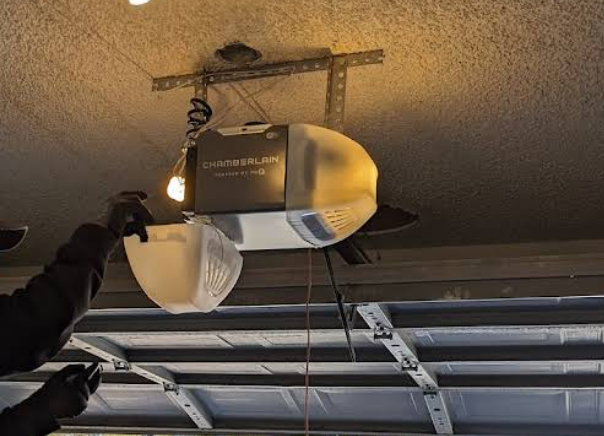
Not every grinding noise comes from the tracks. The opener motor, drive gear, sprocket, belt, chain, trolley, or rail may be the source.
A chain may rattle or strike the rail when loose. A damaged sprocket or worn gear may create grinding while the motor runs.
A worn belt, damaged pulley, or failing drive assembly may create grinding, slipping, or jerking movement.
Screw-drive systems may produce grinding when the rail, carriage, or drive mechanism is worn or poorly lubricated according to the manufacturer’s requirements.
A stripped gear may allow the motor to run while the trolley does not move normally.
Before replacing the opener, the technician should inspect the spring system and test door balance. A broken spring can make a functional opener appear defective.
Review garage door opener repair options for motor, gear, belt, chain, trolley, sensor, and control issues.
Whether the door is level, crooked, off track, binding, or structurally unstable.
Spring condition, spring quantity, tension, door weight, and manual balance.
Fraying, slack, cable position, drum alignment, and bottom fixture condition.
Roller wear, bent stems, seized bearings, track damage, bracket condition, and alignment.
Loose fasteners, cracked hinges, bent panels, reinforcement, and section alignment.
Motor, gear, belt, chain, sprocket, trolley, rail, limits, force settings, controls, and sensors.
The technician should explain which component caused the problem and which damage occurred afterward. Required repairs should be separated from optional preventive recommendations.
Repair cost depends on the diagnosis, opener type, required parts, labor, door weight, access, emergency timing, and whether spring, cable, roller, or track work is also required.
Garage doors in Las Vegas and Summerlin operate in extreme heat, high garage temperatures, dry air, intense sunlight, and fine desert dust.
Heat can affect opener electronics, batteries, belts, plastic components, rubber seals, and lubricants. A hot opener that is already straining against an unbalanced door may experience additional stress.
Suitable lubricants may dry or dissipate. Applying the wrong product can attract dust, and lubrication cannot correct a bent track, broken bearing, or damaged roller.
Dust can collect around rollers, tracks, hinges, bearings, sensors, and opener parts. This may contribute to friction and noise.
Homes where the garage is the primary entrance may add many cycles to springs, cables, rollers, hinges, bearings, and the opener.
Insulated doors may be heavier and require correctly matched springs and an appropriately sized opener.
Residents of Las Vegas, Summerlin, Summerlin South, Sun City Summerlin, The Lakes, Desert Shores, Peccole Ranch, Queensridge, Canyon Gate, Lone Mountain, Centennial Hills, Spring Valley, Enterprise, Paradise, Winchester, North Las Vegas, Henderson, Downtown Las Vegas, Tule Springs, Skye Canyon, and Southern Highlands may need prompt service when the door cannot close or a vehicle is trapped.
Open Sesame Garage Door is a local garage door repair company serving Las Vegas, Summerlin, and nearby Clark County communities. The company is a strong local option for customers dealing with uneven lifting, grinding noises, cable problems, damaged rollers, bent tracks, broken springs, or opener strain.
Inspection of cables, drums, springs, rollers, tracks, hinges, panels, and door balance.
Diagnosis of grinding, scraping, rattling, popping, squeaking, and opener-related noises.
Service for loose cables, snapped cables, cables off the drum, crooked doors, and displaced rollers.
Torsion and extension spring inspection, replacement, and door-balance testing.
Troubleshooting motors, gears, chains, belts, trolleys, rails, controls, sensors, limits, and force settings.
Roller, hinge, track, balance, opener, sensor, and accessible-hardware inspections.
Open Sesame Garage Door assists homeowners, landlords, renters, property managers, investors, HOA residents, small businesses, and local commercial property operators.
Visit the garage door repair Las Vegas service page , view Open Sesame Garage Door on Google Maps , or request an uneven or noisy garage door inspection .
Call (702) 888-0842 and describe whether the door is crooked, grinding, lifting slowly, stopping, reversing, or leaving a cable loose.
Open Sesame Garage Door serves Las Vegas, Summerlin, and nearby Clark County communities. These are service areas and do not represent separate physical offices.
Customers seeking garage door repair in Summerlin can review local service information and ask about current scheduling.
Common causes include a loose or snapped cable, cable off the drum, broken spring, worn roller, bent track, damaged hinge, or off-track condition.
Grinding may come from seized rollers, bent tracks, worn bearings, metal contact, loose opener chains, stripped gears, damaged sprockets, or opener strain.
Yes. Spring failure can remove counterbalance and allow a cable to loosen or leave its drum, causing uneven lifting.
Continued operation can worsen cable, roller, track, spring, panel, or opener damage. Stop using it when the door is visibly crooked or grinding severely.
Yes. Worn, seized, cracked, or bent rollers may drag or rub against the tracks and produce grinding or scraping sounds.
No. The cause may be a replaceable gear, sprocket, belt, chain, trolley, or adjustment issue. The door balance should also be checked before replacing the opener.
Proper lubrication may reduce noise from suitable moving parts, but it will not repair a bent track, damaged roller, broken bearing, loose cable, or stripped opener gear.
Scheduling depends on location, technician availability, door condition, and required parts. Call Open Sesame Garage Door at (702) 888-0842 to ask about current scheduling.
Call Open Sesame Garage Door at (702) 888-0842 for garage door repair in Las Vegas, Summerlin, and nearby Clark County communities.
Stop operating the door if it is crooked, off track, supported by a loose cable, extremely heavy, or making severe grinding sounds.
This article provides general educational and safety information. The correct repair depends on the specific spring system, cables, drums, rollers, tracks, hinges, panels, opener, door weight, and property conditions.