

Downtown Summerlin townhome guide
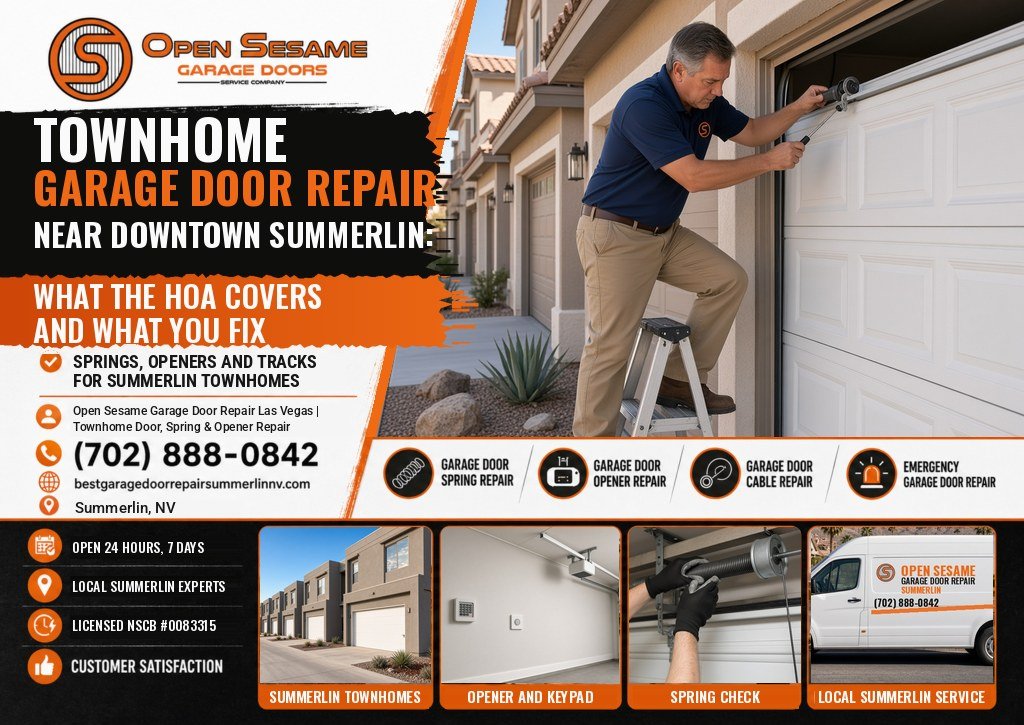
Garage Door Repair for Townhomes and Lock-and-Leave Homes Near Downtown Summerlin: What the HOA Covers and What You Fix
A townhome garage door fails the same way a house door does. A spring snaps, a cable comes off its drum, or the opener hums and nothing moves. The difference is who pays and who has to say yes first. In the attached neighborhoods around Downtown Summerlin, the answer sits in your association’s documents, and most owners only open them once something is already broken. This guide sorts out which parts are usually yours, which are usually the association’s, what needs written approval, and how to keep a lock-and-leave home from turning a small door problem into a long one while you are away.
Direct answer
In most townhome communities near Downtown Summerlin, the owner pays for the garage door’s moving parts (springs, cables, rollers, tracks, opener, sensors and keypad), while the association more often covers exterior paint and trim. Your declaration decides. Open Sesame Garage Door Repair Las Vegas repairs townhome doors across Summerlin; call (702) 888-0842.
Changing how the door looks (a new door, a new color, windows, or a panel that does not match) needs written approval before work starts. Putting the door back the way it was usually does not. Posted Open Sesame ranges: standard repair $150 to $350, springs $189 to $550, off-track $125 to $275, opener repair $150 to $300, new opener $550 to $950, tune-up $89. Sections and new doors are quoted after the door is identified.
Below: how the owner and association split usually works, the townhome neighborhoods around Downtown Summerlin and their garage layouts, a part-by-part table, a pre-trip checklist for lock-and-leave owners, and the questions to ask before anyone touches the door.
Townhome garage door repair in Summerlin: who usually pays for what
Start with the most common arrangement, then check whether yours is different. In many attached-home communities the association looks after what the street sees and what all the buildings share: roofs, exterior walls, paint, landscaping, private drives and the trim around openings. The owner looks after what serves only their home and what moves: the garage door’s spring system, the opener, the safety sensors, the remotes and keypad, and usually the rollers, hinges and tracks.
The garage door itself is the part that changes most from one community to the next. Some declarations treat the door face as part of the exterior, so the association repaints it on its normal paint cycle and may even replace it when a whole building is redone. Others make the entire door the owner’s job and only control its appearance. A few split it the other way, with the association paying for the door panels and hinges when they fail on their own, and the owner paying for everything mechanical. Published association documents from other states show all three versions, which is a good reminder that what your neighbor in another complex pays tells you nothing about your own bill.
Two rules hold almost everywhere. First, damage an owner, tenant or guest causes is charged to that owner, even when the association normally maintains the part. A car backed into the door is the classic example. Second, anything that changes the look of the door needs the association’s written permission, even when the owner is paying for all of it.
So the practical sequence on a broken door is: make the door safe, read the maintenance section of your documents (or call the manager), decide who is responsible for each part, and then get the repair described part by part so the bill can be split cleanly if it needs to be. The rest of this guide walks through each of those steps for the townhome and lock-and-leave neighborhoods in and around Summerlin Centre.
| Part | Who usually pays | Approval usually needed? |
|---|---|---|
| Torsion or extension springs, cables, drums | Owner | No, if replaced like for like |
| Rollers, hinges, tracks, brackets | Owner (some documents give hinges to the association) | No |
| Opener, rail, wall button, remotes, keypad | Owner | Usually no; ask if the keypad or a wall-mount unit is visible outside |
| Safety sensors (photo eyes) | Owner | No |
| Bottom seal on the door | Varies | No, if the color matches |
| Trim, stop molding and paint around the opening | Often the association | Yes for any color change |
| Door face paint | Often the association, sometimes the owner | Yes for any color change |
| Dented or cracked section | Varies; owner if the owner caused it | Yes if the replacement does not match |
| Whole new door | Varies | Yes |
Treat this table as a starting point for the conversation with your manager, not as the answer. Your declaration wins over any general pattern.
Where the answer is written: your declaration, CC&Rs and Nevada law
Nevada’s common-interest community law is Chapter 116 of the Nevada Revised Statutes, the Uniform Common-Interest Ownership Act. It does not hand you a garage door rule. What it does is make the recorded declaration the controlling document, and fill a few gaps where the declaration says nothing.
Two parts of Chapter 116 matter for a garage door. NRS 116.2102 says that, unless the declaration provides otherwise, exterior doors and similar fixtures designed to serve a single unit but sitting outside that unit’s boundaries are “limited common elements” allocated to that unit. In plain terms, a garage door that serves only your home can be treated as yours to use even when it is technically outside your unit, and the declaration then decides who maintains it. NRS 116.2111 says an owner may not change the exterior appearance of a unit without the association’s permission. That second rule is why a new door, a new color or a set of windows needs approval even when you are paying.
Most Summerlin townhome communities are planned communities where you own the lot and the building on it, rather than a condominium where you own the air space inside the walls. In a planned community the garage door is more likely to be part of your unit outright. In a condominium the door is more likely to be a common or limited common element. Your purchase documents will say which one you bought.
When you open the documents, skip past the definitions and look for a section called something like “Maintenance,” “Repair and Replacement,” or “Owner Responsibilities.” Some associations also publish a one-page maintenance chart. If the language is vague, ask the community manager in writing which parts of the garage door the association maintains, and keep the reply. If two documents disagree, Nevada law says the declaration prevails over the bylaws.
Many Summerlin homes sit under two associations: a village or sub-association for the neighborhood and a master association for the wider area. Around Downtown Summerlin that master association is usually the Summerlin South Community Association, which handles design review for exterior changes. A townhome complex may have its own board and manager as well. Repair responsibility usually comes from the neighborhood association’s documents. Approval for visible changes may need both. The Summerlin South improvement request instructions ask owners in a sub-association to include the sub-association’s approval with their submittal, so the order is neighborhood first, then the master association.
This is general information, not legal advice. If a large repair bill turns on how a clause is read, the association’s counsel or your own attorney is the right person to ask. A garage door technician can tell you what failed and why. Only your documents can tell you who pays for it.
Townhomes and lock-and-leave homes around Downtown Summerlin
Downtown Summerlin is the open-air shopping, dining and entertainment district near Sahara Avenue and the 215 Beltway, on the Summerlin South side of Charleston Boulevard. The village around it is Summerlin Centre. Red Rock Casino Resort & Spa, Las Vegas Ballpark and City National Arena are all part of the same district, and the neighborhoods closest to it lean toward attached homes, smaller lots and low-maintenance living.
Two neighborhoods show the range. Summerlin’s own neighborhood pages describe Affinity by Taylor Morrison, in Summerlin Centre just west of the 215, as having four living arrangements: two-bedroom townhome-style homes, second-floor flats, duplexes and a single-family cluster duplex, within walking distance of Downtown Summerlin and close to Sagemont Park. Local real estate listings for Affinity describe some plans with tandem or two-car garages and triplex designs with living space above the garage bays. Thrive by Edward Homes, also in Summerlin Centre, is described on Summerlin.com as three-story townhomes of about 1,495 to 1,835 square feet with two-car garages, a short walk from Downtown Summerlin.
Farther out, Summerlin has added more attached homes in its newer districts. Summerlin.com lists Lark Hill by Taylor Morrison in Kestrel Commons, Cordillera by Toll Brothers and Vertex by Tri Pointe in Redpoint Square, and Monument by Pulte in Reverence, which Summerlin describes as that village’s first lock-and-leave neighborhood. Lark Hill and Cordillera are both listed with two-car garages. The Paseos has Santa Rosa by Lennar, a gated townhome neighborhood near Fox Hill Park. If you own one of these, most of this guide applies to you as well, and our new-build guide for Kestrel, Redpoint and Grand Park covers first-year issues on newer doors.
What the garages have in common matters more than the builder name:
- Many are rear-loaded off a private drive or alley, so every door in the row faces the same direction and gets the same sun.
- Three-story plans put bedrooms or living space directly over the garage, which makes opener and roller noise more noticeable.
- Tandem garages are deep and narrow, with a long walk from the door to the house entry and less room beside the tracks.
- The doors in a row are meant to look identical, which is why matching panels and colors becomes a design review issue the moment one door is replaced.
- Many owners travel, rent the home out, or split the year between houses, which is the “lock-and-leave” appeal and also the reason small problems go unnoticed.
Open Sesame Garage Door Repair Las Vegas is based at 7865 Bluewater Dr, Las Vegas, NV 89128, on the east side of Summerlin, and serves Summerlin Centre and the rest of the master plan. For neighborhood service notes see our Summerlin garage door repair page and the Summerlin South page.
Part by part: what fails on a townhome door and whose problem it is
A garage door is a system. When one piece fails, it often takes another with it, and the bill may cross the line between owner and association. Knowing how the parts depend on each other helps you read the invoice and talk to your manager.
Springs, cables and drums
Most attached homes in Summerlin use torsion springs on a shaft above the door. The springs carry nearly all of the door’s weight, and the cables and drums transfer that lift to the bottom corners. When a spring breaks you usually hear a loud bang from the garage, and the opener then strains or the door lifts a few inches and stops. A broken cable often follows a broken spring, or it frays first and lets one side drop. These are almost always owner items. They are also the parts a homeowner should never adjust; DASMA’s safety guidance says spring and cable work belongs to a trained technician because of the stored energy. The posted range for springs is $189 to $550. If you are curious how long springs last in our climate, see how long garage door springs last in Summerlin heat.
Rollers, hinges and tracks
Rollers and hinges wear quietly until the door starts to grind, jerk or sit crooked. Tracks get bent when a car, a bin or a bicycle hits them, which is more common in a narrow tandem garage. Rollers and tracks are usually the owner’s job. A few associations take on hinges as part of the door face. A door that has come out of its tracks should not be run with the opener; it falls in the off-track range of $125 to $275.
The opener, wall button, remotes and keypad
The opener is almost always an owner item, including when the builder installed it. The same goes for remotes, the wall button and the outside keypad. Opener repair is posted at $150 to $300 and a new opener installed at $550 to $950. The one approval question is the outside keypad: if you are moving it or replacing it with a different-looking unit, check whether your documents treat it as an exterior change.
Safety sensors
The photo eyes near the floor on each side of the door are required on residential openers made since 1993 under the federal safety standard for automatic garage door operators (16 CFR Part 1211). If they are misaligned, dirty or damaged, the door will refuse to close or will reverse. They are an owner item and usually a quick fix in the standard repair range.
The door face, sections and paint
This is where documents differ most. A dent from a basketball or a car bumper is usually the owner’s cost because the owner’s household caused it. A finish that has faded evenly across a whole row of doors is more likely an association paint-cycle item. A cracked or bent section that needs replacing is quoted after the door is identified, because the replacement has to match the rest of the door and the rest of the row. Our guides to replacing one garage door panel in Summerlin and panel repair cost in Summerlin cover matching in more detail.
Seals and trim
The rubber bottom seal is attached to the door and is often treated as part of it. The stop molding and weatherstrip around the opening is attached to the building and is more often an association item. If your bottom seal is cracked or letting in dust, see our Summerlin bottom seal guide.
Lock-and-leave homes: what goes wrong while you are away
The point of a lock-and-leave townhome is that you can close the door and go for a week or a season. The garage door is the part of the house most likely to undo that. It is the largest moving opening in the home, it runs on electricity and batteries, and in many complexes it is the main way in.
The problems that show up when a townhome sits empty tend to fall into a few groups:
- The door would not open when they got back. Usually a dead keypad battery, a remote that lost its programming, or the opener’s lock or vacation mode still switched on at the wall control. Sometimes a spring broke while the home sat empty, and the first attempt to open the door is when the owner finds out.
- The door was found open, or partly open. A sensor knocked out of line, a door that reversed on its last close and nobody was there to see it, or a remote pressed in a bag. A neighbor or the manager notices before the owner does.
- A power interruption. Openers without battery backup cannot run until power returns. If the only entry is through the garage, that matters.
- Dust and heat. Weeks of summer heat and desert dust dry out rollers and seals and coat the photo-eye lenses. Our guide to Summerlin dust and garage doors covers what that does to tracks and openers.
None of these is unusual. What makes them expensive is time. A door that reversed and stayed open for a week is a security problem. A spring that broke a month ago and was never checked can lead to a frayed cable or a strained opener if someone tries to force the door.
A pre-trip checklist for the garage
- Run the door through a full open and close and listen for anything new: grinding, popping, or the motor working harder.
- Do the reversal tests (described below). If either fails, have it fixed before you leave.
- Replace the keypad battery, and test the keypad from outside.
- Check that the lock or vacation setting on the wall control is set the way you want it, and that a trusted person knows how to clear it.
- If your opener has battery backup, check its status light or app. Backup batteries wear out.
- Leave a spare remote or the keypad code with someone you trust, and give your manager a phone number that reaches you.
- Note our number, (702) 888-0842, for whoever is checking on the home. Open Sesame is open 24 hours, seven days.
When you get back
Before you rely on the door, watch it open and close once, standing clear. If it sounds different or moves unevenly, stop using it and call. If it will not move at all, do not pull the red release handle on a closed door unless you are sure the springs are intact and you can lift the door safely. A door with a broken spring can drop hard once it is disconnected.
Tight garages, tandem bays and three-story plans
Townhome garages near Downtown Summerlin are built to fit a lot of house on a small footprint. That changes how the door and opener behave, and it changes which repairs make sense.
Low headroom and short side room
A standard ceiling-mounted opener needs space above the door for the rail, and torsion springs need a few inches above the opening. In some attached plans that space is shared with ductwork, a water heater platform or storage racks. If anything has been mounted in the door’s path, the door can rub, or the opener can stop and reverse partway. Storage shelving and ceiling racks are a frequent cause of bent track sections in tight garages. Before blaming the opener, look up while the door moves and make sure nothing touches it.
Tandem garages
A tandem garage parks one car behind the other. The door is a normal single or double width, but the space is long and narrow, and the second car often sits close to the track on one side. That makes it easier to clip a vertical track with a mirror or a bumper. A bent vertical track can push rollers out of line and eventually let the door come off track. If you see a track that is kinked or pulled away from the wall, stop using the opener and call.
Living space above the garage
Three-story townhomes and triplex designs often put a bedroom, office or living area directly over the garage. The opener is bolted to the ceiling of that room’s floor, so vibration from a chain-drive opener or worn steel rollers travels straight up into the house. A belt-drive opener is usually the quietest common ceiling-mounted choice. A wall-mount (jackshaft) opener moves the motor to the side of the door and takes it off the ceiling entirely, which helps both noise and headroom where the door’s spring setup allows it. Replacing worn steel rollers with sealed nylon rollers often makes a noticeable difference by itself. Our guide to nylon vs steel rollers explains the trade-offs.
Shared walls
A garage that shares a wall with a neighbor’s garage can carry sound through that wall as well. An opener bracket fastened into a shared wall or a shared ceiling joist can make your door audible next door. When an opener is replaced, it is worth asking how it will be mounted.
Interior access
In a lock-and-leave home the garage is often the everyday entrance. If the opener fails, you need another way in. Know where your front door key is, and know whether your entry door from the garage locks automatically. That sounds obvious until someone is standing in a hot driveway with groceries and a door that will not move.
When the repair belongs to the association
If your documents say the association maintains some part of the door, the process usually runs through the community manager rather than straight to a contractor. Doing it in the right order avoids two problems: paying for work the association would have covered, and having the association refuse to reimburse work it did not authorize.
- Make it safe first. If the door is stuck open, the house is exposed, or a car is trapped, that is urgent regardless of who pays. Most documents allow an owner to act in an emergency and sort out responsibility later, but read yours. Our guide to a garage door stuck open in Summerlin covers how to secure the house.
- Report it in writing. Email the manager with your address, the garage number if the complex uses one, a short description, and photos or a short video of the door moving.
- Ask whether the association uses a specific vendor. Some associations have an approved contractor for exterior work and will only pay that contractor.
- Ask who pays for the first visit. Some associations reimburse the diagnostic visit only if the failure turns out to be theirs.
- Keep the replies. If responsibility is disputed later, the written trail is what settles it.
When a single visit covers both owner parts and association parts, ask the technician to list them separately: which springs, cables, rollers or opener parts were replaced, and which section, hinge or trim piece. Labor for each is worth noting too. That makes it simple for the owner to pay one share and the association the other.
If part of the bill belongs to your association, check its vendor rules and any paperwork it needs with the manager before you book the work.
When a car, a guest or a tenant damages the door
Damage caused by someone in your household, a guest or a tenant is almost always the owner’s cost, even in communities where the association normally maintains the door face. That covers the car that rolled into the door, the moving truck that clipped the track, and the door that was closed on a bin and bent a section.
A door hit by a car needs more care than it looks like it does. The visible dent may be the smaller problem. The impact can bend the bottom section’s reinforcing strut, push rollers out of the track, kink a vertical track, or put a twist in the door that loads the springs and cables unevenly. Do not run the opener on a door that has been hit until someone has looked at the tracks and cables. If the door is stuck open and the house is exposed, treat it as urgent.
Insurance may come into it. Your own policy, the driver’s auto policy, or the association’s master policy can each be involved, depending on what was damaged and how your documents and policies are written. Take photos before anything is moved, note the date and time, and tell the manager in writing if the door’s appearance will change or if the building itself was hit.
Our guide to a garage door hit by a car in Summerlin goes through repair versus replacement in detail. For a townhome, add one more question: will the repaired or replacement section match the doors on either side of yours? If it will not, the association will likely want to approve it first.
Rental townhomes deserve a separate note. Tenants often do not know where the manual release is, how to reset the keypad, or that the door should not be forced when it stops halfway. A one-page note in the rental binder with your number, the manager’s number and ours, (702) 888-0842, saves a lot of trouble. Ask tenants to report a door that sounds different instead of working around it.
Visible changes need approval first: doors, colors, windows and panels
Repairs that put the door back the way it was (same springs, same opener location, same color, same panel design) are maintenance. Anything that changes how the door looks from outside is an improvement, and in Summerlin that means design review before the work starts.
The Summerlin South Community Association’s Design Guidelines require Design Review Committee approval before any exterior alteration, and list doors and paint color changes among the examples. The same guidelines say repainting with the existing builder colors in the same locations does not need an improvement request, but any change of color or color location does, with paint chips and an elevation showing where each color goes. Garage door windows must keep a uniform appearance, and window coverings other than un-mirrored or non-reflective tint are not allowed. The association’s instructions say written approval is required before any work, painting or installation begins, and owners in a sub-association should include the sub-association’s approval with the request.
For a townhome row, the practical effect is that a replacement door or section has to fit in with its neighbors. That can mean:
- matching the panel style (flush, ribbed or raised) and the width of the grooves;
- matching the color, or repainting to the community’s approved scheme after installation;
- matching the window layout, or leaving windows out if the rest of the row has none;
- keeping the door the same height and width, because the opening is part of the building.
If an exact match is no longer made, a whole new door may be the only way to meet the guidelines, and the association may have a preferred model for the complex. Ask before you order anything. Our guide to new garage door cost in Summerlin walks through what moves the price, and new doors are quoted after the opening and the required design are known.
A new opener, new springs or new rollers do not change the appearance and are not usually reviewed. A keypad moved to a new spot on the front of the building, a wall-mount opener whose motor shows through a window, or a door with a smart camera bracket on the outside may be treated as visible. When in doubt, a short email to the manager settles it.
Safety checks every townhome owner can do
A few checks are safe for any owner and catch the problems that matter most. Do them monthly, and before and after any long trip.
The two reversal tests
First, lay a 2×4 flat on the floor in the middle of the door’s path and close the door with the opener. When the door touches the board it should stop and reverse. Second, start closing the door and pass something through the invisible beam between the photo eyes near the floor. The door should stop and reverse. The U.S. Consumer Product Safety Commission recommends testing the reversing feature regularly. If either test fails, stop using the opener to close the door until it is fixed.
Look and listen
Stand clear and watch a full cycle. Look for a gap in a spring coil, a cable that looks frayed or loose, a roller that wobbles, or a track that is bent. Listen for scraping, popping or a motor that labors. Do not touch springs, cables, drums or the bottom brackets. They are under high tension.
Photo eyes and the keypad
Wipe the photo-eye lenses with a soft cloth. If one eye’s light is off or blinking, check that both point straight at each other and that nothing is blocking the beam. Replace the keypad and remote batteries once a year, or sooner if the range drops.
What not to do
- Do not adjust or loosen springs. DASMA advises homeowners to leave spring work to a trained technician.
- Do not pull the release handle on an open door, or on any door that looks crooked or has a broken spring.
- Do not keep pressing the button when the door stops and reverses. Find out why first.
- Do not let children play with the remote or the wall button.
Open Sesame Garage Door Repair Las Vegas holds Nevada contractor licence #0083315 and is open 24 hours, seven days. If a check fails at an awkward hour, call (702) 888-0842.
What Summerlin heat and dust do to a row of townhome doors
When every door in a row faces the same way, they age at the same rate. A west-facing row takes the full afternoon sun, and the doors, rollers and seals on that side of the complex wear faster than the ones in shade. That has two consequences for townhome owners.
First, the finish fades evenly across the row, which is why many associations treat door paint as a building item on the same cycle as the stucco. If your door looks worse than your neighbors’, the cause may be damage or a replacement section with a different factory finish rather than sun alone. Our guide to why Las Vegas heat is hard on garage doors explains what heat does to springs, openers, seals and sensors.
Second, insulated steel doors can bow outward on hot afternoons when the outside skin is much hotter than the inside. The door industry association DASMA describes this “thermal bowing” as an inherent characteristic of insulated doors with bonded cores, and says it is stronger on darker, larger, sun-facing doors with a cooler garage behind them. A bowed top section can rub the header and make the opener reverse. It usually settles back as the door cools. If it does not, or if it happens every day, a technician can look at reinforcing struts and track adjustment.
Dust is the other constant. Fine desert dust settles in the tracks and on the rollers, and a light film on the photo-eye lenses is enough to make the door reverse. In a lock-and-leave home that sits closed for weeks, that build-up has time to bake on. A quick wipe of the lenses and a look at the tracks after a long absence prevents most of the “door won’t close” calls that follow a trip.
Monsoon storms bring wind-driven rain and sometimes power interruptions. A door that does not seal at the bottom lets water and debris onto the garage floor, and an opener without backup cannot move until power returns. Neither is a reason to panic. Both are reasons to keep the seal in good shape and to know how your manual release works before you need it.
Buying, selling or renting a townhome: what to check on the garage door
A garage door rarely gets much attention during a townhome purchase, but it is one of the few systems where the buyer inherits both the hardware and the association’s rules about it. A few minutes with the door and the documents is worth it.
For buyers
- Ask for the association’s maintenance chart or the relevant section of the declaration, and read what it says about garage doors before closing.
- Run the door through two full cycles. Listen for grinding or popping, and watch whether it travels evenly.
- Do the 2×4 and photo-eye reversal tests. A door that will not reverse is a safety issue to raise with the seller.
- Look at the springs for gaps in the coils, and at the cables for fraying, without touching them.
- Check whether the door matches the others in the row. A non-matching section or color may already be an open issue with the association.
- Ask how old the opener is and whether it has battery backup. Get every remote and the keypad code.
For sellers
Fixing a known spring, cable or sensor problem before listing is usually cheaper than negotiating it later, and it removes a safety item from the inspection report. If the association is scheduled to repaint the doors soon, say so in your disclosures rather than painting the door yourself in a color that may not be approved.
For landlords
Give tenants written instructions: how to reverse the door, what the lock setting on the wall control does, where the release is and when not to use it, and who to call. Ask them to report noise or uneven movement early. A tenant who keeps using a door with a broken spring can turn a single repair into several.
If you want a door checked before a sale or a new lease, a tune-up visit covers the moving parts and safety features. The posted range is $89. Our guide on when to schedule garage door maintenance in Summerlin has more on timing.
Common mistakes townhome owners make with a broken garage door
Most of these come from good intentions and a hurry to get the car out.
- Hiring before reading the documents. If the association would have paid for part of the job, or required its own vendor, you may not be reimbursed.
- Waiting for the association on an owner item. If the springs or opener are yours, the manager cannot fix them for you, and waiting leaves the house exposed or the car trapped.
- Ordering a new door before approval. A door that does not match the row can be refused after it is installed.
- Painting the door to cover a dent or fade. A color that is not on the approved palette is a design review problem, and paint does not fix a bent section.
- Running the opener on a door with a broken spring. The opener is not built to lift the door’s full weight. It strains, and cables or the opener’s gear can fail next.
- Pulling the release on an open door. Without working springs, an open door can fall.
- Adjusting springs or cables yourself. This is the repair most likely to injure someone.
- Ignoring a door that reverses “for no reason”. It is usually a photo eye, sun in the eye, or something rubbing. All are easy fixes, and none should be solved by disabling the sensors.
- Assuming the builder covers it. Builder coverage on newer homes varies and is time-limited. Read the warranty booklet that came with the home before you assume a part is covered.
Questions to ask your manager and your technician
Ask the community manager
- Which parts of the garage door does the association maintain: the door face, the paint, the hinges, the trim, the seal?
- Does the association use an approved vendor for any of those parts?
- Who pays for a diagnostic visit if the problem turns out to be the association’s?
- Is a replacement section or door required to be a specific model or color for the complex?
- Does replacing the keypad, opener or adding a smart controller need any approval?
- When are the doors next scheduled to be repainted?
- If the complex is part of Summerlin South, does an exterior change need sub-association approval before it goes to the Summerlin South Design Review Committee?
Ask the technician
- What exactly failed, and what caused it?
- Is anything else close to failing because of it (the second spring, the cables, the rollers)?
- Which of the parts you are replacing are mechanical, and which are part of the door’s appearance?
- Will the repaired door look the same as before from the street?
- What is the fixed price before you start, and which posted range does it fall in?
- Is your contractor licence current, and what is the number? (Ours is #0083315. You can look up any Nevada contractor on the Nevada State Contractors Board site.)
Good answers to the second list make the first conversation easier. A clear note that says “replaced two torsion springs and both lift cables; door face and trim unchanged” tells the manager everything they need.
Posted price ranges for townhome garage door repairs
These are the same ranges Open Sesame posts for the rest of the valley. A townhome door is usually a standard size, but the exact price depends on the door and the parts involved. You get it before any work starts.
| Job | Posted range |
|---|---|
| Standard repair (cables, rollers, hinges, minor track work, many sensor adjustments) | $150 to $350 |
| Off-track door | $125 to $275 |
| Spring replacement | $189 to $550 |
| Opener repair | $150 to $300 |
| New opener installed | $550 to $950 |
| Tune-up | $89 |
| Sections and new doors | Quoted after the door is identified |
What moves a job within a range is mostly the door: its weight, whether it uses torsion or extension springs, how many related parts are worn, and whether an opener upgrade includes features like battery backup or a wall-mount motor. Section and door prices depend on matching the existing door and on what the association requires, which is why they are quoted after the door has been identified. Ask about after-hours pricing when you call outside normal hours.
If the association is paying for part of the work, its share is whatever its own vendor rules and documents allow. The owner’s share is the owner-responsible parts and their labor.
About Open Sesame Garage Door Repair Las Vegas
Open Sesame Garage Door Repair Las Vegas is a local garage door company at 7865 Bluewater Dr, Las Vegas, NV 89128, on the east side of Summerlin near Desert Shores. We are open 24 hours, seven days a week, and hold Nevada contractor licence #0083315. The public phone number is (702) 888-0842.
We repair and replace springs, cables, rollers, hinges and tracks; repair and install openers; fix safety sensors, keypads and remotes; replace sections; install new doors; and handle emergency repairs. In Summerlin that work covers the older villages north of Charleston, the newer districts west of the 215, and the townhome and lock-and-leave neighborhoods around Summerlin Centre and Downtown Summerlin.
For more on how we work across the master plan, see the complete Summerlin garage door repair guide, our notes on custom doors in The Ridges and garage door safety in Sun City Summerlin, or the Open Sesame home page.
What a townhome service visit looks like
When you call (702) 888-0842, tell us what you see and hear, whether the door is open or closed, whether a car is trapped, and whether the complex has a gate or a guard. If you already know that part of the work belongs to your association, say so. You can also request service online.
On site, the technician looks at the whole door system rather than only the part that failed: springs, cables, drums, rollers, hinges, tracks, the opener, the safety sensors and the seal. You get a plain explanation of what is wrong, which parts are involved, and a fixed price from the posted ranges before any work starts. If you would rather check with your manager first, there is no pressure to go ahead on the spot.
After the repair, the door should be balanced, the moving parts lubricated where they need it, and both reversal tests passed. Ask the technician to list each part replaced so you can pass it to the association if needed.
If the door is stuck open or will not close at night, our emergency garage door repair page explains what to do while you wait.
Frequently Asked Questions About Townhome Garage Door Repair in Summerlin
Does my HOA pay for garage door repair on a Summerlin townhome?
It depends on your declaration. In many townhome communities the owner pays for springs, cables, rollers, tracks, the opener and sensors, while the association handles exterior paint and trim. Some documents also give the door face or hinges to the association. Read the maintenance section or ask your manager in writing.
Who pays if a car hits my townhome garage door?
Damage caused by the owner, a household member, a guest or a tenant is usually the owner’s cost, even where the association normally maintains the door. Insurance may apply. Take photos, tell the manager in writing if the door’s look will change, and do not run the opener until the tracks and cables are checked.
Do I need HOA approval to replace garage door springs or the opener?
Usually not. Replacing springs, cables, rollers or an opener puts the door back the way it was and does not change its appearance. A new door, a new color, windows, or a section that does not match the row needs written approval first. Check with your manager if you are unsure.
Can I choose my own garage door company for a townhome?
For owner-responsible parts, usually yes. If the association is paying for any part of the work, it may require its own approved vendor or prior authorization. Ask the manager before the visit so you are not left paying for work the association would have covered.
What should I check before leaving my lock-and-leave home for weeks?
Run a full open and close, do the 2×4 and photo-eye reversal tests, replace the keypad battery, confirm the lock setting on the wall control, check any backup battery, and leave a spare remote or code with someone you trust. Fix anything that fails before you leave.
My garage door would not open when I got back from a trip. What should I check?
Check the lock or vacation setting on the wall control, then the remote and keypad batteries. If the wall button works, the problem is usually programming or batteries. If nothing moves and the opener hums, a spring may be broken. Do not pull the release on a door that may have a broken spring.
Why is my opener so loud in a three-story townhome?
The opener is bolted to the ceiling under a living space, so vibration travels into the house. Worn steel rollers and chain-drive openers are common causes. Sealed nylon rollers often help, and a belt-drive or wall-mount opener is usually quieter. The posted range for a new opener installed is $550 to $950.
Can one damaged section be replaced on a townhome door?
Often, if a matching section is still available. The replacement has to match the door’s panel style, color and windows, and the rest of the row. If it cannot be matched, a full door may be needed, and the association may require approval first. Sections are quoted after the door is identified.
Who maintains the trim and weatherstrip around a townhome garage door?
The trim and stop molding are attached to the building, so many associations maintain and paint them. The rubber bottom seal is attached to the door and is more often the owner’s. Your documents decide, so check the maintenance chart before replacing either one.
Is Downtown Summerlin in Summerlin South?
Yes. Downtown Summerlin sits in the Summerlin Centre village near Sahara Avenue and the 215 Beltway, south of Charleston Boulevard. That area is in unincorporated Clark County, and exterior design review usually runs through the Summerlin South Community Association, plus any sub-association.
How much does townhome garage door repair cost?
Open Sesame’s posted ranges are standard repair $150 to $350, off-track $125 to $275, springs $189 to $550, opener repair $150 to $300, new opener $550 to $950 and tune-up $89. Sections and new doors are quoted after the door is identified. You get a fixed price before work starts.
Are you licensed, and are you open at night?
Yes. Open Sesame Garage Door Repair Las Vegas holds Nevada contractor licence #0083315, is based at 7865 Bluewater Dr, Las Vegas, NV 89128, and is open 24 hours, seven days. Call (702) 888-0842.
Sources
- Summerlin.com: Summerlin condos and townhomes (Affinity in Summerlin Centre, Santa Rosa in The Paseos)
- Summerlin.com: Six Summerlin neighborhoods offer low-maintenance condos or townhomes (Thrive, Lark Hill, Cordillera, Vertex, Monument)
- Summerlin.com: Neighborhood spotlight, Thrive by Edward Homes
- Clark County: Summerlin South (boundaries and land use)
- Nevada Revised Statutes Chapter 116, Common-Interest Ownership (NRS 116.2102, 116.2103, 116.2111)
- Summerlin South Community Association: Design Guidelines
- Summerlin South Community Association: Instructions for submitting an Improvement Request
- DASMA Technical Data Sheet 185: Thermal bowing of garage doors with bonded core sections
- DASMA: Garage door system safety tips
- eCFR: 16 CFR Part 1211, Safety Standard for Automatic Residential Garage Door Operators
- U.S. CPSC: Automatic residential garage door operators
- Nevada State Contractors Board
Find Open Sesame Garage Door Repair Las Vegas
View on Google Maps · 7865 Bluewater Dr, Las Vegas, NV 89128
Townhome Garage Door Trouble Near Downtown Summerlin? Call Open Sesame
Call (702) 888-0842 for springs, openers, tracks, sensors and panels on Summerlin townhomes and lock-and-leave homes. You get a fixed price from the posted ranges before work starts. Licence #0083315.
7865 Bluewater Dr, Las Vegas, NV 89128 · Open 24/7 · Licence #0083315
One Response