

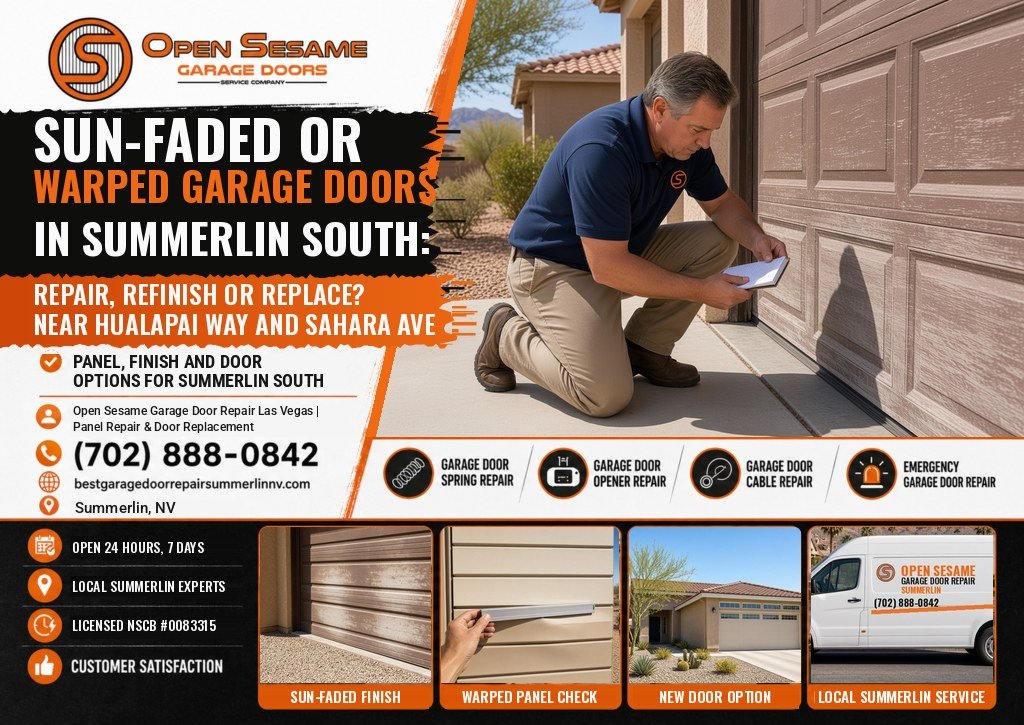
Summerlin South sun damage guide
Sun-Faded or Warped Garage Doors in Summerlin South: Repair, Refinish or Replace? A Guide for Homes Near Hualapai Way and Sahara Avenue
A garage door in Summerlin South takes the sun straight on. Along Hualapai Way and Sahara Avenue, plenty of doors face west or south with no shade, and after enough summers the color goes flat and chalky, the lower panels look bleached, and on some afternoons the door seems to bulge or rub at the top. Some of that is only cosmetic. Some of it means a panel is failing. This guide shows how to tell the difference, when a repaint is enough, when a section or the whole door should be replaced, and what the Summerlin South Community Association needs to see before anything changes color.
Direct answer
A sun-faded garage door in Summerlin South is usually cosmetic: if the steel is sound, the door runs smoothly and there is no rust-through or delamination, refinishing is enough. A panel that stays bowed, cracks or separates needs repair or replacement. Open Sesame Garage Door Repair Las Vegas checks doors across Summerlin South; call (702) 888-0842.
A bulge that appears only on hot afternoons and goes away as the door cools is usually thermal bowing, which the door industry treats as normal for insulated doors and manages with reinforcing struts or adjustment. In Summerlin South, a new color needs Design Review Committee approval first; repainting in the existing builder colors does not. Posted Open Sesame ranges: standard repair $150 to $350, springs $189 to $550, off-track $125 to $275, opener repair $150 to $300, tune-up $89. Sections and new doors are quoted after the door is identified.
Below: what UV and heat do to each kind of door, a simple test to tell chalking from failure, a repair-refinish-replace table, how to refinish steel without causing new problems, the Summerlin South approval rules, and how to choose a replacement that handles the sun better.
What the sun does to a garage door in Summerlin South
Summerlin South is the part of Summerlin south of Charleston Boulevard, bounded on the east by Hualapai Way and on the west by Red Rock Canyon National Conservation Area, running down to around Russell Road. Nearly all of it is in ZIP code 89135, and it is in unincorporated Clark County rather than the City of Las Vegas. It takes in Summerlin Centre and Downtown Summerlin at Sahara Avenue and the 215, The Willows, The Ridges, Red Rock Country Club, The Mesa, Siena and more. It is high desert, it is bright, and many of its streets run so that whole rows of garage doors face west or south into the afternoon sun.
Ultraviolet light breaks down the binder in paint and factory coatings. As the binder goes, the pigment loosens, the surface turns from satin to flat, the color drifts lighter, and a fine powder forms on the surface. That powder is called chalking. On a steel door it starts on the panels that get the most direct sun and the least shade, which is often the lower half of the door, because roof overhangs shade the top sections for part of the day.
Heat is the second force. A dark steel door facing the afternoon sun gets far hotter than the air around it. On insulated doors, the outside skin expands while the inside skin, facing a cooler garage, stays put. The door industry association DASMA explains that this temperature difference makes insulated bonded-core doors bow toward the hot side, and that darker, larger and sun-facing doors bow the most. It also notes that aluminum and plastics expand more than steel.
Wood, composite and faux-wood finishes react differently. Wood dries, checks and grays. Composite and vinyl-clad overlays can fade unevenly or, in bad cases, separate from the steel underneath. Glass-and-aluminum doors hold their color well but get hot and can show seal problems at the glass.
None of this means a faded door is a failing door. Most sun damage is to the finish. The skill is in telling a tired finish from a panel that is actually coming apart, because the fix and the cost are very different.
Fading, chalking, warping or thermal bowing: how to tell them apart
These four look alike from the street. They are not the same problem.
Fading
The color is lighter than it was, often unevenly. Compare the outside face to the inside face of the same door, or to a spot that is usually shaded, such as the top section under the eave. If the surface is smooth and nothing rubs off on your hand, the coating is faded but still intact.
Chalking
Run a clean finger across a panel in full sun. If a white or pale powder comes off, the coating’s binder has broken down and the surface has chalked. Chalking means the finish is no longer a good protective film. On steel, that is the point where refinishing stops being optional cosmetics and starts protecting the metal, because the next step is cracking, then bare steel.
Thermal bowing
The door looks bowed outward on a hot afternoon, may rub on the header or the top seal, and the opener may stop or reverse near the top of its travel. In the evening or the next morning, it looks straight again. DASMA treats this as an inherent characteristic of insulated doors with bonded cores rather than a defect, and lists reinforcing struts across the back of the door, and in some cases track or seal adjustment, as the usual fixes.
Warping and permanent damage
The panel stays out of line when the door is cool. You may see a crease, a section that no longer sits flat against the one above it, a gap that lets light in, a split along a seam, or a skin that sounds hollow or crackles when pressed. On a wood door, look for splits and boards pulling apart. On a composite overlay, look for edges lifting. This is damage, and paint will not fix it.
A quick check you can do yourself
- Look at the door at two times of day: mid-afternoon in full sun, and early morning. Note whether any bulge comes and goes.
- Do the finger test for chalking on a sunny panel and on a shaded one.
- Close the door and look for daylight between sections and at the top corners.
- Look for rust at the bottom edge and along the seams.
- Watch the door open and close. Listen for rubbing at the top, and see whether the opener stops or reverses.
If only the first two show anything, you are looking at a finish problem. If the last three do, have the door checked before you spend money on paint.
What the fade pattern tells you
Where a door fades is often more useful than how much. Before deciding anything, stand back and look at the pattern.
Bottom lighter than top
The most common pattern. The roof overhang shades the top sections for part of the day, while the lower sections take sun for longer. It points to plain UV exposure on an intact door, and a refinish usually evens it out.
One section a different shade from the rest
If one section is darker or a different tone, it has probably been replaced at some point with a section in fresh factory color, or touched up with paint that did not match. That tells you the door has a repair history worth asking about, and that any new section will face the same matching problem.
Streaks and runs
Vertical streaks often follow water: sprinklers, hose spray, or rain running off a roof edge. The minerals in the water and repeated wetting break down the coating faster in those lines. Fix the water source as well as the finish.
Fading only on the edges or the grooves
On raised-panel doors the raised faces sometimes fade faster than the recesses, or the reverse if dirt sits in the grooves. Either way it is a finish issue. Uneven fading around a single panel with a visible bulge, though, can mean the skin has separated from the core behind it. Press gently: a hollow or crackling feel suggests delamination.
A whole street that looks the same
If every door on your side of the street has faded to the same shade, the cause is exposure and age, not your door. In a neighborhood with a sub-association, that is worth raising with the board, because a coordinated repaint in the approved color may be simpler than each owner applying separately.
Repair, refinish or replace: a decision table
The door industry’s practical rule is simple: refinish a door that is sound and only looks tired, repair first when there is one correctable problem, and replace when the structure, safety or performance of the door no longer supports a new finish. The table puts that into the conditions you are likely to see on a Summerlin South driveway.
| What you see | Likely cause | Usual path |
|---|---|---|
| Even fading, smooth surface, nothing rubs off | UV on an intact coating | Clean it; refinish when you want the color back |
| Chalky powder on sunny panels, no cracks | Coating binder broken down | Refinish (clean, scuff, prime bare spots, paint) |
| Cracked or peeling paint with small bare spots | Coating failure | Refinish soon, treat bare metal first |
| Bulge on hot afternoons that goes away when cool | Thermal bowing on an insulated door | Repair: reinforcing struts, track or seal adjustment |
| One section creased, dented or permanently bowed | Impact or a failed section | Repair: replace the section if a match exists |
| Rust through the bottom section | Bare steel left exposed | Replace the section, or the door if several are affected |
| Composite or overlay skin lifting, several panels | Delamination | Usually replace the door |
| Wood door split, checked or rotting | Sun and drying | Repair if minor; replace if structural |
| Faded door that is also heavy, noisy or off balance | Finish plus worn hardware or springs | Fix the hardware first, then decide on the finish |
Two points are easy to miss. First, a faded door that is also hard to open, noisy or crooked has two separate problems, and paint will not fix the second one. Get the door working properly first. Second, if several sections are failing on an older door, the cost of matching and replacing them can approach a new door, and a new door lets you choose a finish and color better suited to the sun. Our guide to garage door replacement in Summerlin covers that decision in more detail.
Refinishing versus replacing: the trade-offs over time
Cost is the obvious difference, but it is not the only one. Here is how the two paths compare on the things that matter in Summerlin South.
Refinishing keeps the door you have. It is the cheaper path when the door is structurally sound, it can be done without design review if you restore the existing approved color, and it extends the life of the steel by restoring a protective film. It does nothing for insulation, noise, thermal bowing or worn hardware, and a field-applied finish on a sun-facing door will need doing again. How soon depends on the prep, the paint, the color and the exposure, so be wary of anyone who quotes you an exact number of years.
Replacing costs more and needs approval, but it resets everything at once: a new factory finish, a chosen color within your palette, the option of insulation, new sections that match each other, and springs sized to the new door. It is the better path when several sections are failing, when the door is an old non-insulated model in a garage that bakes all summer, or when you would otherwise be paying to match and replace sections one at a time.
A middle path exists for doors that are sound but bowing: add reinforcing struts and adjust the track or seals, then refinish in a lighter approved color. That can turn a door that rubs every afternoon into one that behaves, without replacing it.
Whichever way you go, deal with the hardware first. Refinishing or replacing the face of a door that has a tired spring or a worn opener just moves the next repair down the road.
How to refinish a sun-faded steel garage door the right way
Refinishing a steel door is usually a painting job rather than a garage door repair, and many homeowners hire a painter or do it themselves. It is worth doing properly, because paint over chalk fails quickly in this climate. Garage door manufacturers publish their own steps. Amarr’s guidance for steel doors is a good summary of the industry approach:
- Lightly buff or sand any imperfections.
- Inspect the door for exposed metal, and prime any bare spots with a primer made to protect galvanized steel from rusting.
- Let the primer dry, then clean the door thoroughly so no chalk, dust or grime is left.
- Paint within a day of cleaning, using a high-quality 100% acrylic exterior latex paint. Amarr says not to use oil-based paint.
- Follow the paint maker’s instructions on temperature, sunlight and number of coats.
The chalk layer is the enemy. Paint that goes on over loose powder bonds to the powder rather than the door. Washing with a mild detergent and a soft brush, rinsing well, and a light scuff with a fine abrasive pad removes it.
Heat is the other problem. A sun-facing door can be far hotter than the air on a summer afternoon, and paint applied to a hot panel dries too fast and leaves lap marks. Paint in the early morning, or on a day when the door is in shade. In Summerlin South that often means doing a west-facing door in the morning and an east-facing one in the late afternoon. Spring and fall are easier than mid-summer.
Three warnings before you paint
- Weight. Amarr notes that painting adds weight to a door, which can affect the spring settings and the performance of the door and opener. A single repaint on a steel door is usually minor, but layers add up, and a wood door can gain more. If the door feels heavier afterward, have the balance checked rather than turning up the opener’s force setting.
- Color. Amarr warns that a dark color on an insulated door can cause thermal bowing, and DASMA says darker doors facing the sun bow more. Painting a light door dark in a west-facing Summerlin South driveway is asking for a door that rubs on summer afternoons.
- Warranty. Amarr says non-factory painting voids its paint finish warranty. Other makers have their own terms. Check yours before you paint a newer door.
Keep paint off rollers, hinges, tracks, springs, cables and the photo eyes. Painted hardware binds, and a sensor with paint on the lens will stop the door from closing. Remove or mask the bottom seal and the weatherstrip around the opening.
Open Sesame Garage Door Repair Las Vegas works on the door’s structure and hardware: sections, springs, rollers, tracks and openers. If your door needs any of that, it is best done before the door is painted.
Summerlin South approval rules for garage door color and replacement
The Summerlin South Community Association is the master homeowners association for the area, and its Design Review Committee reviews exterior changes. Its Design Guidelines and improvement-request instructions set out what a homeowner needs before touching the color or design of a garage door.
Repainting in the same color
The Design Guidelines say an improvement request is not required to repaint a home or wall using the existing colors in the same locations, as long as those colors were originally used by the builder or were previously approved. If your garage door is the builder’s original color and you are restoring it, you are repainting, not changing.
Changing the color
Any change in exterior paint color, or in where a color is used, needs an improvement request. The guidelines ask for paint chips and an elevation showing where each color goes, and say color changes are reviewed case by case for compatibility with the home and the neighborhood. The association’s instructions add that a new paint scheme must come from the designated color palette for your community, must differ from the schemes on the adjacent properties, and needs a recent color photo of the house. A supplemental paint form for one neighborhood palette assigns garage doors to specific color positions within each scheme, so the door’s color is tied to the body and trim colors rather than chosen on its own.
Replacing the door or adding windows
Doors are listed among the exterior alterations that need Design Review Committee approval. Garage door windows must keep a uniform appearance, and window coverings other than un-mirrored or non-reflective tint are not allowed. That matters if you were thinking of adding a reflective film to cut heat through the windows.
Sub-associations and timing
Many Summerlin South neighborhoods also have their own association. The instructions ask owners in a sub-association to include the sub-association’s approval with the submittal. Written approval from Summerlin South is required before any painting or installation starts. The association’s office moved to 10588 Marketwalk Place, Las Vegas, NV 89135 in July 2026, and the current forms are on Summerlink.com under the Summerlin South page.
The practical order for a homeowner is: decide whether you are restoring or changing the color, get the sub-association’s approval if there is one, submit to Summerlin South with the chips, elevation and photo, wait for the written approval, and only then order a door or book a painter. Repairs that do not change the look of the door, such as springs, rollers, an opener or a matching section, are maintenance and do not normally go through design review.
Fixing warped, bowed or damaged sections
If the check above points to real panel trouble, the repair depends on which kind it is.
Thermal bowing that interferes with the door
Most thermal bowing is harmless and only noticeable if you look for it. It becomes a repair when the top section rubs the header or the top seal hard enough to make the opener stop or reverse, or when the door looks noticeably bowed every summer afternoon. DASMA’s guidance is that bowing cannot be eliminated where the conditions for it exist, but can be reduced until it no longer affects the door’s performance, mainly with horizontal reinforcing struts across the back of the door. Extreme cases, such as a large, dark, insulated, thermally broken door facing the sun in front of an air-conditioned garage, may need more reinforcement. Track and seal adjustments can also help, depending on the door. The manufacturer’s recommendations come first.
Do not fix a rubbing door by raising the opener’s force setting. That hides the symptom and makes the safety reversal less sensitive.
A creased, dented or permanently bent section
A section that stays bent when the door is cool has usually been hit, overstressed, or weakened by an old crease. One section can often be replaced if the same model, size, panel design and color are still available. Matching an older door is the hard part, especially after years of fading, because a new section in the original factory color can look darker than the faded sections around it. Our guides to replacing one garage door panel in Summerlin and what panel repair costs in Summerlin go through matching and cost. Sections are quoted after the door is identified.
Rust at the bottom edge
Summerlin’s dry air slows rust, but bare steel at the bottom of a door still corrodes, especially where irrigation, hosing or monsoon water collects. Surface rust can be cleaned and primed. Rust that has gone through the skin cannot be painted over for long. The usual fix is replacing the bottom section, which also restores the strut and the bottom bracket area that hold the lift cables.
Delamination
Some faux-wood and composite-clad doors use an overlay bonded to steel. If that skin lifts or bubbles across several panels, it is rarely worth repairing piece by piece. That is usually a replacement conversation.
Hardware that has suffered too
Doors that have been rubbing or bowing put extra load on rollers, hinges and the opener. When a section is replaced or struts are added, the rest of the door should be checked and balanced at the same time. The standard repair range is $150 to $350, and opener repair $150 to $300.
How different door types handle Summerlin South sun
The same afternoon sun treats each door material differently. Knowing what you have tells you what to watch for.
Non-insulated steel
A single layer of steel with a factory coating. It fades and chalks like any coated steel, and it can dent easily, but with no bonded core it does not show the classic thermal bow of an insulated door. Its weak points in the sun are the finish and the heat it passes into the garage.
Insulated steel
Two steel skins bonded to a foam core. It is stiffer, quieter and keeps the garage cooler, which is why it is common on newer Summerlin homes. The trade-off is thermal bowing on hot, sunny days, especially in darker colors and on wide double doors. DASMA notes that thermally broken designs, which block heat moving from the outside skin to the inside, can bow more because the temperature difference between the skins is larger.
Wood
Real wood doors look good in custom neighborhoods but take the most upkeep in the desert. Sun dries the wood, the finish breaks down, and boards can check or split. Amarr’s guidance for wood doors says all six sides of each section should be sealed and that dark shades or stains are not recommended on wood doors facing south or west. In Summerlin South, that describes a lot of driveways.
Faux wood and composite overlays
These give a wood look on a steel or composite base. Quality varies. The better ones hold color well. Weaker ones can fade unevenly or lift at the edges after years of direct sun.
Aluminum and glass
Full-view aluminum doors with glass panels hold their color well, but aluminum expands more than steel, the glass lets heat into the garage, and the seals around the glass age in the sun. Window film is restricted under Summerlin South rules to un-mirrored or non-reflective tint.
If you are not sure what your door is, look at its inside face and its edges, or check the label on one of the sections. A technician can usually tell at a glance.
Choosing a replacement door that handles the sun better
If the door is past saving, the replacement is a chance to pick something that ages better in Summerlin South. A few choices make the biggest difference.
Color
Lighter colors reflect more of the sun’s energy and stay cooler. Paint makers express this as Light Reflectance Value: the higher the number, the more light and heat a color reflects. A light or mid-tone door fades less visibly, gets less hot, and bows less if it is insulated. In Summerlin South, your color also has to fit the approved palette for your home, so the choice is usually among the scheme’s allowed garage door colors rather than any color you like.
Factory finish
Factory-applied finishes on steel doors are generally more durable than a field-applied coat of paint, and some makers offer factory color matching. Ask which finishes are available for the door you are considering, and how the maker’s finish warranty treats sun exposure. Read the actual warranty terms rather than relying on a summary.
Insulation and reinforcement
An insulated door makes a noticeable difference to a garage that bakes all afternoon. If you choose insulated in a darker color on a sun-facing wall, ask about the reinforcing struts DASMA describes for limiting thermal bowing, so the door does not rub the header on hot days.
Windows
Windows in the top section let in light, and also heat. Summerlin South requires garage door windows to keep a uniform appearance, so the layout has to fit the home and neighborhood.
Matching the opening and the springs
A new door is sized to the opening, and its springs are sized to the door’s weight. A heavier insulated door needs different springs than the thin door it replaces. The opener may also need checking, especially if it is older.
New doors are quoted after the opening, the design and any association requirements are known. Our guide to new garage door cost in Summerlin explains what moves the price.
The rest of the door system in the heat
A faded finish is the visible part of sun damage. The parts you do not see take the heat too, and it is worth checking them whenever you are deciding what to do about the door’s appearance.
Springs work hardest in the extremes. A door that has been painted several times, or replaced with a heavier insulated model, changes the load the springs carry. If the opener strains, or the door seems heavier after a repaint or a new door, have a technician check the balance. Spring adjustment is not a homeowner job. Our post on how long garage door springs last in Summerlin heat has more on that.
Openers sit in a garage that can get very hot in summer, and their electronics and gears age faster in that heat. A door that rubs at the top because of bowing also makes the opener work harder on every cycle.
The bottom seal and the weatherstrip around the opening dry out, crack and shrink in the sun. That is a separate repair with its own guide: Summerlin bottom seal replacement.
Safety sensors can be fooled by low sun shining straight into the receiving eye, which makes the door reverse at the same time every afternoon. Cleaning the lens and checking alignment usually fixes it.
For a wider look at how valley heat affects springs, openers, seals and sensors, see why Las Vegas heat is hard on garage doors.
Homes near Hualapai Way and Sahara Avenue
Hualapai Way is the eastern edge of Summerlin South, and Sahara Avenue runs west across it toward Downtown Summerlin and the 215. The neighborhoods on either side of that corridor were built over a long stretch of time, so you see original doors from earlier phases next to recent replacements, often on the same street.
Local guides describe The Willows as a village of around 731 acres built around Willows Park and its community center, and Summerlin Centre as the village at Charleston and the 215 that holds Downtown Summerlin. Farther south along the Hualapai edge is Siena, a 667-acre age-qualified community of 2,001 single-family homes and villas between Flamingo Road and south of Tropicana Avenue, bordered by Town Center Drive on the west and Hualapai Way on the east, according to the Siena association. Each has its own mix of sub-associations under the Summerlin South master association.
A few patterns show up across these neighborhoods:
- Streets that run north to south leave garage doors facing east or west. West-facing doors take the hottest part of the day and fade and bow the most.
- Earlier phases often have builder-original doors and finishes that have now been through many summers. Those are the doors most likely to be chalking.
- Many homes have darker earth-tone doors from their original color schemes. Darker doors show fading sooner and, if insulated, bow more.
- Neighborhoods with a sub-association add a second approval step for any color or door change.
Open Sesame Garage Door Repair Las Vegas is based at 7865 Bluewater Dr, Las Vegas, NV 89128, a short drive north and east of this corridor, and serves all of Summerlin South. For area service details, see our Summerlin South garage door repair page and the main Summerlin page. Homeowners in the townhome neighborhoods near Downtown Summerlin may also want our guide to townhome garage door repair and HOA responsibility, and owners of custom homes farther west can read about custom doors in The Ridges.
Keeping a door you are not ready to replace
Plenty of faded doors have years left in them. A little care slows the damage and keeps the door from crossing the line into a replacement.
- Wash the door a few times a year with mild soap and water and a soft brush, then rinse. Dust holds heat and grit, and a clean surface shows chalking early.
- Touch up chips and scratches on steel before they rust. Prime bare metal first.
- Keep sprinklers off the door. Repeated wetting and drying at the bottom edge is where rust starts.
- On a wood door, reseal on the schedule the finish maker recommends, and do it before the wood grays.
- Do not use harsh solvents or pressure washers on the face. They strip the coating faster than the sun does.
- Have the moving parts looked at once a year. A tune-up is posted at $89, and a balanced, quiet door is easier on its finish than one that slams or rubs.
Shade helps too, where your association allows it. Trees and landscaping near the driveway are design review items in Summerlin South, so check before planting. The cheapest protection is often simply keeping the door closed and clean.
If you are thinking about timing, mild-weather months are best for both painting and door work. Our guide to when to schedule garage door maintenance in Summerlin explains why.
When sun damage becomes a repair you should not put off
Most fading can wait for a convenient season. A few signs mean the door needs attention now, regardless of how it looks.
- The door stops or reverses near the top on hot afternoons. Bowing or rubbing is loading the opener and the safety system. Stop forcing it.
- A section has cracked across or split at a hinge line. The door can lose stiffness and bend further each cycle.
- Rust has opened a hole at the bottom edge. The bottom section holds the brackets the lift cables attach to, and those brackets are under high tension. Do not try to remove or loosen them.
- The door looks crooked or one side drops first. That points to a cable or spring problem, not a finish problem.
- You hear a loud bang from the garage. That is often a spring breaking. Do not run the opener; call.
- The door no longer reverses when it touches a 2×4 laid flat in its path, or when the photo-eye beam is broken. Stop using the opener to close it until it is fixed.
Open Sesame Garage Door Repair Las Vegas is open 24 hours, seven days. If the door is stuck open and the house is exposed, see our emergency garage door repair page or call (702) 888-0842.
Common mistakes with sun-faded and warped doors
- Painting over chalk. Without washing and scuffing, new paint bonds to the powder and peels.
- Painting in the afternoon sun. The panel is too hot, the paint flashes off, and lap marks show.
- Going darker. A darker color on an insulated, sun-facing door increases thermal bowing and fades faster.
- Changing the color without approval. In Summerlin South, any new color or color location needs a written approval first.
- Painting the hardware. Paint on rollers, hinges and tracks makes them bind, and paint on the photo eyes stops the door closing.
- Treating a bulge as a warped door without checking it cool. A door that is straight in the morning is bowing, not warped.
- Raising the opener’s force to get past a rubbing top section. That weakens the safety reversal.
- Replacing one section in factory color on a badly faded door. It may not match. Plan to refinish the whole door, or price a new one.
- Ignoring the springs on a heavier new or repainted door. Weight changes need balance changes.
- Applying reflective window film. Summerlin South allows only un-mirrored or non-reflective tint on garage door windows.
Questions to ask before you approve the work
Whether you are talking to a painter, a garage door technician or your association, these questions keep the job on track.
For the technician
- Is this fading, thermal bowing, or real damage to a section?
- If it is bowing, would reinforcing struts or an adjustment help, and what does the door’s manufacturer recommend?
- Can one section be matched, or will it look different from the faded sections around it?
- Are the springs, cables, rollers and opener in good shape, or should they be dealt with first?
- What is the fixed price, and which posted range does it fall in?
- What is your Nevada contractor licence number? (Ours is #0083315. You can check any contractor with the Nevada State Contractors Board.)
For the painter
- How will you remove the chalk before priming and painting?
- What primer will you use on bare galvanized steel, and what topcoat?
- When will you paint, given the door’s sun exposure?
- Will you keep paint off the hardware, the seals and the sensors?
For the association
- Is my door’s current color the builder’s original or an approved color, so I can repaint without a request?
- What are the allowed garage door colors in my scheme?
- Does a replacement door need a specific style or window layout?
- Does my sub-association need to approve it first?
The right order of work for a faded or warped door
Doing things in the wrong order is the most common way to waste money on a sun-damaged door. This sequence avoids most of it.
- Check the door cool and hot. Decide whether you have fading, chalking, bowing or damage, using the checks earlier in this guide.
- Fix safety and hardware problems first. A door that will not reverse, a broken spring, a frayed cable or a rubbing top section comes before anything cosmetic.
- Deal with damaged sections. Replace creased, rusted-through or delaminated sections, or decide that the door should be replaced as a whole.
- Add reinforcement if bowing is a problem. Struts and adjustments go on before paint, so the painter is not working around new hardware.
- Get approval if anything visible will change. Color, color location, a new door or new windows all go through your sub-association, if any, and then Summerlin South.
- Refinish last, in the right weather. Clean, scuff, prime bare spots, and paint in shade or early morning.
- Recheck the balance and the reversal tests after painting or installation.
Following that order also gives you something useful for the association: a clear record that the door was repaired to its original appearance, or a complete request for the change you want.
Posted price ranges
These are the ranges Open Sesame posts for the whole valley. Finish work by a painter is priced separately by the painter.
| Job | Posted range |
|---|---|
| Standard repair (rollers, hinges, minor track work, many adjustments) | $150 to $350 |
| Off-track door | $125 to $275 |
| Spring replacement | $189 to $550 |
| Opener repair | $150 to $300 |
| New opener installed | $550 to $950 |
| Tune-up | $89 |
| Sections and new doors | Quoted after the door is identified |
Sections and new doors depend on the model, the size, the finish, whether a match exists, and what your association requires, which is why they are quoted after the door has been seen. You get a fixed price before any work starts. Ask about after-hours pricing when you call outside normal hours.
About Open Sesame Garage Door Repair Las Vegas
Open Sesame Garage Door Repair Las Vegas is a local garage door company at 7865 Bluewater Dr, Las Vegas, NV 89128. We are open 24 hours, seven days a week, and hold Nevada contractor licence #0083315. Call (702) 888-0842.
Our work covers springs, cables, rollers, hinges and tracks; opener repair and new openers; safety sensors, keypads and remotes; section replacement; new door installation; and emergency repairs. In Summerlin South that means everything from builder-original doors in the older villages to custom doors behind the gates farther west.
For more on Summerlin, read the complete Summerlin garage door repair guide, or visit the Open Sesame home page.
What a visit for a faded or warped door looks like
When you call (702) 888-0842, tell us what the door looks like, which way it faces, whether a bulge comes and goes with the heat, and whether the opener stops or reverses. Photos taken in the afternoon and again in the morning are very useful. You can also request service online.
On site, the technician checks the door’s sections for bowing, creases, splits, rust and delamination, then checks the rest of the system: springs, cables, drums, rollers, hinges, tracks, the opener, the sensors and the seal. You get a plain explanation of whether you are looking at a finish problem, a bowing problem or real damage, and a fixed price from the posted ranges before any work starts.
If the answer is that the door is sound and only needs a new finish, we will tell you that, and you can take it to a painter after any hardware work is done. If a section or the whole door needs replacing, the quote follows once the door is identified, and you can take it to your association for approval before anything is ordered.
Frequently Asked Questions About Sun-Faded and Warped Garage Doors in Summerlin South
Can a sun-faded garage door be repainted?
Yes, if the door is sound. Wash off the chalk, lightly scuff the surface, prime any bare steel with a primer made for galvanized steel, and paint with 100% acrylic exterior latex, avoiding oil-based paint. Paint in shade or early morning. In Summerlin South, a new color needs approval first.
Why is my garage door bulging on hot afternoons?
It is probably thermal bowing. On insulated doors, the sun-heated outer skin expands more than the cooler inner skin, so the door bows outward. DASMA treats it as inherent to insulated doors, worse on dark, wide, sun-facing doors. Reinforcing struts or adjustment can reduce it if it rubs or makes the opener reverse.
How do I know if my garage door is warped or just bowing?
Check it in the morning when it is cool. If the bulge is gone, it is thermal bowing. If a section is still creased, out of line, split or letting in daylight, it is damaged and paint will not fix it. Have damaged sections checked before refinishing.
Do I need HOA approval to paint my garage door in Summerlin South?
Not if you repaint in the existing builder or previously approved color in the same location. A new color, or a color in a new location, needs an improvement request with paint chips and an elevation, and written approval before work starts. A sub-association may need to approve it first.
Can I replace just one faded or damaged section?
Often, if a matching section is still made. On a badly faded door, a new section in factory color may look darker than the rest, so you may need to refinish the whole door afterward. Sections are quoted after the door is identified.
Will painting my garage door affect the springs?
It can. Amarr notes that painting adds weight to a door, which can affect the spring settings and the door and opener. One coat on steel is usually minor, but if the opener strains or the door seems heavier afterward, have the balance checked by a technician.
What color garage door is best for Summerlin South sun?
Lighter colors reflect more heat, fade less visibly and bow less on insulated doors. Dark colors on west- or south-facing doors fade and bow the most. Your choice also has to fit the approved palette for your home and differ from your neighbors’ schemes.
Is window film allowed on garage door windows in Summerlin South?
Only un-mirrored or non-reflective tint. The Summerlin South Design Guidelines prohibit other garage door window coverings and require garage door windows to keep a uniform appearance.
Does sun damage cause rust on garage doors here?
Indirectly. Sun breaks down the coating, and once steel is bare it can rust, mostly at the bottom edge where sprinklers and runoff collect. Summerlin’s dry air slows rust, but rust that goes through the skin needs a section replaced rather than paint.
Should I fix the hardware before refinishing the door?
Yes. Springs, cables, rollers, tracks and the opener should be working properly first. Refinishing a door that is heavy, noisy or off balance leaves the real problem in place, and hardware work can scuff a fresh finish.
How much does it cost to fix a warped or faded garage door?
Open Sesame’s posted ranges are standard repair $150 to $350, off-track $125 to $275, springs $189 to $550, opener repair $150 to $300 and tune-up $89. Sections and new doors are quoted after the door is identified. Painting is priced by the painter.
Do you serve Summerlin South near Hualapai Way and Sahara Avenue?
Yes. Open Sesame Garage Door Repair Las Vegas is at 7865 Bluewater Dr, Las Vegas, NV 89128, serves all of Summerlin South, holds Nevada contractor licence #0083315, and is open 24 hours. Call (702) 888-0842.
Sources
- Wikipedia: Summerlin South, Nevada (boundaries, ZIP 89135, Summerlin South Community Association)
- Clark County: Summerlin South (boundaries and land use)
- Summerlin South Community Association: Design Guidelines
- Summerlin South Community Association: Instructions for submitting an Improvement Request
- Summerlink: Summerlin South Community Association (office address)
- Siena: Community (667 acres, 2,001 homes, boundaries)
- BallenVegas: Map of Summerlin villages (The Willows, Summerlin Centre)
- DASMA Technical Data Sheet 185: Thermal bowing of garage doors with bonded core sections
- Amarr: Painting your garage door (steel and wood)
- DASMA: Garage door system safety tips
- Nevada State Contractors Board
Find Open Sesame Garage Door Repair Las Vegas
View on Google Maps · 7865 Bluewater Dr, Las Vegas, NV 89128
Sun-Faded or Warped Garage Door in Summerlin South? Call Open Sesame
Call (702) 888-0842 to have a faded, bowed or damaged door checked in Summerlin South. We look at the panels, springs, rollers and opener together and give you a fixed price from the posted ranges before work starts. Sections and new doors are quoted after the door is identified. Licence #0083315.
7865 Bluewater Dr, Las Vegas, NV 89128 · Open 24/7 · Licence #0083315
One Response