

Open Sesame Garage Door Repair Las Vegas · Panel Repair Costs
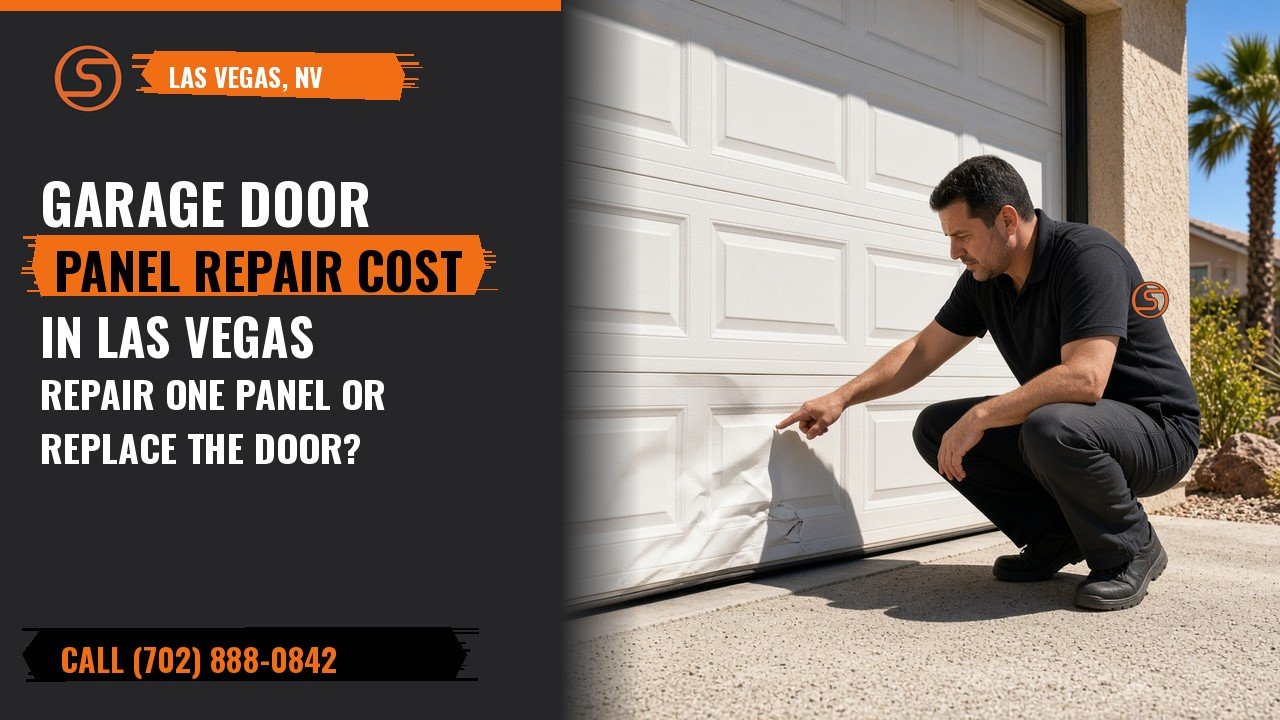
How Much Does Garage Door Panel Repair Cost in Las Vegas? Repair One Panel or Replace the Door?
Garage door panel repair in Las Vegas has no single price, because “panel repair” covers three very different jobs. A small dent or a loose hinge on an otherwise sound section is a repair, and it usually falls in our standard repair range of $150 to $350. Swapping out one damaged section for a new one depends almost entirely on whether a matching section can still be ordered for your door; national cost guides put a single installed panel at roughly $350 to $900. And if the door is old, discontinued, or damaged across several sections, replacing the whole door is often the better value. The deciding questions are which section is damaged, how badly, what the door is made of, how old it is, and whether the manufacturer still makes that exact panel in your size, style, and color. This guide walks through each type of damage, what it takes to fix, how to tell whether one panel can be replaced, what drives the price up, and when a new door makes more sense. Open Sesame Garage Door Repair Las Vegas is at 7865 Bluewater Dr, Las Vegas, NV 89128, holds Nevada contractor licence #0083315, and is open 24 hours.
Should you repair one garage door panel or replace the whole door?
Repair or replace one panel when the damage is limited to one section, the rest of the door is in good shape, and a matching section is available. Replace the door when two or more sections are damaged, the model is discontinued, the door is near the end of its life, or the cost of the panel plus labor gets close to the price of a new door.
Minor dents, a cracked end stile, a torn hinge mount, or a bowed top section can often be repaired in place without buying a panel at all. Section replacement is a real option on newer steel doors from major manufacturers. It gets hard on older doors, custom wood doors, and doors whose color has faded in the Nevada sun, because a brand-new section can look obviously different from the sections around it.
Our pricing: On our posted price guide, standard repairs such as hinges, rollers, track and bracket work are $150 to $350, a tune-up is $89 to $129, spring replacement is $250 to $450, and opener repair is $150 to $300. Replacement sections and complete new doors depend on the manufacturer, model, size, and finish, so we quote those after we identify your door. Call (702) 888-0842 or find us on Google Maps.
Panel or Section: What You Are Actually Replacing
Quick answer: Most homeowners say “panel” when they mean a full horizontal section of a sectional door, the long strip that runs the whole width of the door. On most modern steel doors you can’t replace one decorative square on its own; you replace the entire section it belongs to.
A typical residential sectional door in Las Vegas is made of four or five horizontal sections stacked on top of each other. Each section runs the full width of the opening, so on a 16-foot double door a single section is 16 feet long. The sections are joined by hinges, and each one carries rollers at its ends that ride in the tracks. The raised squares or long rectangles you see on the face of the door are stamped into the steel skin. They’re decoration, not separate parts.
That matters for cost. When someone backs into the lower corner of a double door and dents one of those raised squares, the part that has to be replaced is a 16-foot section, not a 2-foot square. A replacement section has to be built or ordered to the exact width, height, thickness, design, and color of the door, then shipped, then installed with the hardware moved over from the old one.
There are exceptions. Some older wood doors and carriage-style doors are built from frames with inserted panels, and a damaged insert can sometimes be replaced by itself. Window sections, called glazed sections, can often have a cracked window insert swapped without replacing the whole section. But for the steel doors on most Las Vegas homes built since the 1990s, “replace one panel” means “replace one section.”
| Term | What it means | Why it matters for cost |
|---|---|---|
| Section | One full-width horizontal piece of a sectional door | This is the unit that gets replaced on most steel doors |
| Panel (raised or flush) | The stamped design on the face of a section | Usually can’t be replaced separately on steel doors |
| Skin | The outer steel or aluminum sheet | Dents and creases happen here; thin skins dent more easily |
| Stile | The vertical reinforcement at the ends and center of a section | Hinges and rollers mount here; cracked stiles are a common repair |
| Strut | A horizontal steel reinforcement bar fastened across a section | Added to stiffen wide doors or doors with openers; often part of a repair |
| Bottom section | The lowest section, which carries the bottom brackets and seal | Connected to the lift cables under spring tension; costs more to replace safely |
| Top section | The highest section, where the opener arm attaches | Bends or bows from opener force; often repaired with a strut |
Types of Panel Damage and What Each One Needs
Quick answer: Cosmetic dents can usually stay or be minimized. Creases, cracked stiles, torn hinge mounts, and a bowed top section can often be repaired. A section that is folded, split, punctured, or bent so the rollers bind usually needs to be replaced. The question is always whether the section is still strong and still runs straight in the tracks.
Damage to a section falls into two groups: damage that only affects how the door looks, and damage that affects how the door works. The second group matters far more, because a section that has lost its strength or shape puts extra load on the hinges, rollers, opener, and springs every time the door moves.
1. Small dents from balls, bikes, and bumps
What it looks like. A shallow dent in the skin, with no crease and no change in the shape of the section. The door opens and closes normally.
What it needs. Often nothing beyond a decision about appearance. Shallow dents in steel can sometimes be eased with careful work from the back side, but results vary and the paint can crack. Body fillers and DIY dent kits rarely hold up well on a garage door that flexes every cycle and sits in direct sun. If the dent doesn’t bother you and the door runs fine, leaving it alone is a legitimate choice.
2. Creases and deep dents
What it looks like. A sharp fold line in the steel skin, often from a car bumper. The section may look slightly bowed.
What it needs. A crease weakens the section along that line. If it’s small and away from the hinges and rollers, a reinforcing strut across the back can restore stiffness and let you keep the section. If the crease runs through a hinge line or the section no longer sits flat against its neighbors, it usually needs replacing. Our bent garage door repair page explains how we assess these.
3. Cracked or split end stiles and torn hinge mounts
What it looks like. A hinge pulling away from the door, screws that won’t hold, cracking in the steel near a hinge or roller bracket, or a section edge that has separated.
What it needs. This is one of the most common panel repairs, and often one of the cheapest. Stiles can be reinforced with stile repair plates or end caps, and hinges can be remounted in sound metal. It usually falls in our standard repair range of $150 to $350. Left alone, a torn hinge mount lets the section sag, which can bind a roller and pull the door crooked.
4. A bowed or bent top section
What it looks like. The top section bends inward in the middle, or the opener bracket has pulled the steel out of shape.
What it needs. This usually happens when the opener keeps pushing or pulling a door that is binding, or when the force setting is too high. The fix is to find out why the door was hard to move, often a weak spring or a dragging roller, then reinforce the top section with a strut and a proper opener bracket. If the section is creased, it may need replacing. See our opener repair page for the opener side of that problem.
5. Folded, punctured, or split sections
What it looks like. A section that is folded inward, a hole through the skin, foam insulation showing, or the skin separating from the frame.
What it needs. Replacement of that section, or of the whole door. A folded section has lost its structure. Running the door with one can bend the tracks, damage rollers, and overload the opener. Keep the door closed and don’t use the opener until it has been looked at.
6. Heat damage, peeling, and delamination
What it looks like. Paint that is chalky, faded, or peeling; a vinyl wood-grain film that is bubbling; a composite or insulated skin that is pulling away from its core; or wood that is cracking and checking.
What it needs. Peeling and fading are finish problems that can sometimes be addressed with proper surface preparation and repainting, if the manufacturer allows it. Delamination, where the skin separates from the core, is structural and usually means replacing the affected section or the door. Our heat-damaged panel repair page covers this in more detail.
7. Rot, warping, and split boards on wood doors
What it looks like. Wood doors that have dried and split, joints opening up, warped sections that no longer meet their neighbors, or water damage at the bottom where irrigation sprays the door.
What it needs. Small splits and loose joints can often be repaired by someone who works with wood doors. Rot at the bottom may be repaired or may require a new bottom section, depending on how far it goes. Wood doors are often custom, so replacement sections are usually made to order. See custom wood garage door repair.
8. Cracked window inserts
What it looks like. A cracked or cloudy window in a glazed top section.
What it needs. Many window inserts can be replaced without replacing the section, if the manufacturer still supplies that insert or a compatible one. The price depends on the insert, not on the section.
What Garage Door Panel Repair and Replacement Cost in Las Vegas
Quick answer: In-place repairs such as hinge, stile, strut, and bracket work fall in our standard repair range of $150 to $350. A replacement section is quoted after we identify the door, because the price of the section itself varies so much by manufacturer, size, and finish. National cost guides put one installed panel at about $350 to $900, with a national average around $550.
It helps to separate the job into three layers, because each one is priced differently.
- The repair work. Reinforcing a section, remounting hinges, fixing a stile, straightening or replacing a bent track, and replacing damaged rollers. This is labor plus small parts, and it’s covered by our posted standard repair range.
- The replacement section. The part itself, ordered from the manufacturer or a distributor to match your door. Its cost depends on the door’s width, the design, insulation, thickness, color, and whether it is still a current product. Shipping and lead time vary.
- Related damage. When a car hits a door, the panel is rarely the only thing hurt. Tracks, rollers, cables, the bottom brackets, and sometimes the opener and springs take the hit too. Those repairs are priced on their own.
Our posted prices for the work that usually comes with panel damage
| Service | Our posted price | When it comes up with panel damage |
|---|---|---|
| Standard repair (hinges, rollers, stiles, struts, track and bracket work) | $150–$350 | Torn hinge mounts, bowed top section, bent track, damaged rollers |
| Off-track door repair | $150–$350 | A car strike or a binding section knocked rollers out of the track |
| Spring replacement | $250–$450 | A spring that broke from the shock or was already near the end of its life |
| Opener repair | $150–$300 | Bent opener arm, stripped gear from straining against a damaged door |
| New installed opener | $550–$950 | Opener too old or too damaged to repair |
| Tune-up and safety inspection | $89–$129 | Checking balance and safety after the repair, or on a door you’re deciding about |
| Replacement section | Quoted after we identify the door | Folded, split, punctured, or delaminated section on a door that is otherwise sound |
| New door | Quoted on-site | Discontinued model, several damaged sections, or an older door |
For a wider look at our pricing, see the Las Vegas garage door repair cost guide.
What national cost guides report
Because the section price changes so much from one door to the next, it helps to know what the national numbers look like. Angi’s 2026 garage door panel replacement cost guide reports a national average of about $550 for one panel, with most homeowners spending $350 to $900, materials alone at roughly $150 to $800, and labor at roughly $200 to $500. It also notes that high-end doors can cost much more. These are national averages from a third-party publisher, not our prices, and Las Vegas jobs can land above or below them depending on the door.
Two practical points come out of those numbers. First, a single standard steel section on a common door is usually the cheapest panel scenario, and custom wood, carriage-style, and full-view glass doors are the most expensive. Second, panel costs add up fast. Two or three sections can approach the price of a new basic door, which is why the decision section later in this guide matters.
What Pushes the Price Up or Down
Quick answer: Door width, material, insulation, design, color, window sections, and whether the panel is still in production make the biggest difference. The bottom section costs more to replace than a middle section because of the spring-loaded hardware attached to it.
| Factor | Lower cost | Higher cost |
|---|---|---|
| Door width | Single-car door (8 or 9 feet wide) | Double door (16 feet or wider) |
| Material | Non-insulated steel | Insulated steel, aluminum and glass, wood, composite |
| Construction | Single-layer pan door | Double- or triple-layer insulated door with thicker skins |
| Design | Plain flush or common raised-panel design | Carriage-house overlays, custom designs, wood-grain films |
| Color | Standard white | Colors, wood-tone finishes, custom paint |
| Position | A middle section | The bottom section (cables and brackets) or a window section |
| Availability | Current model from a major manufacturer | Discontinued model, unknown manufacturer, special order |
| Other damage | Section only | Tracks, rollers, cables, springs, or opener also damaged |
Width is the factor people forget. Many Las Vegas homes have a 16-foot double door, and on those doors every section is twice as long as on a single door. A dent in one corner still means a 16-foot section, which costs more to make, ship, and handle.
Insulation changes the part. An insulated section isn’t a regular section with foam added. It’s built differently, with a second skin and a foam core, and it’s thicker. The replacement has to match that construction or the door won’t line up or seal. The U.S. Department of Energy explains how R-value measures resistance to heat flow in its Energy Saver guide to insulation, and insulated garage doors are rated the same way.
Paint and finish. Factory finishes are baked on. A new section in “white” can still look brighter than ten-year-old sections that have weathered in the sun. Wood-grain films and dark colors are harder to match.
Lead time. A replacement section is usually ordered rather than pulled from a truck. While you wait, the damaged section may need temporary reinforcement so the door can be used safely, or the door may need to stay closed.
Can You Replace Just One Garage Door Panel? The Matching Problem
Quick answer: Yes, if the manufacturer still makes that section in your door’s size, design, thickness, construction, and color. If any of those can’t be matched, the new section won’t fit, won’t seal, or will look obviously different, and replacing the door is usually the better choice.
A replacement section has to match the existing door in several ways at once. Missing any one of them causes problems.
- Manufacturer and model. Sections from different manufacturers usually don’t interlock. The joint profile between sections, the hinge positions, and the stile design differ.
- Width and height. The section must be the same width and the same height as the one it replaces, or the door won’t fit the opening or stack correctly.
- Thickness and construction. A non-insulated section won’t meet an insulated section properly, and the joints won’t seal.
- Design. The stamped pattern, whether short raised panels, long panels, flush, ribbed, or carriage-style, has to line up with the sections above and below.
- Color and texture. Even an exact color code can look different next to sections that have faded for years.
- Windows. If the damaged section has windows, the window style and layout have to match too.
When all of these match, a single section replacement is a good repair that keeps the rest of the door in service. When they don’t, the result is a door that may work but looks patched, and on some doors it won’t work properly at all. We’d rather tell you that before you pay for a part than after.
Many homeowners ask about this exact question in more depth, and it gets its own guide: Can You Replace Just One Garage Door Panel in Las Vegas? Cost and Compatibility Explained.
How to Identify Your Garage Door Before You Call
Quick answer: Look for a label on the inside of the door, usually on a lower section near the edge or on an end stile. Take photos of that label, the outside of the door, the damaged area up close, and the inside of the door showing the sections and hardware. Those photos make the first conversation much faster.
- Find the label. Many manufacturers put a sticker or stamp on the inside face of a section, often on the bottom or second section near one end, or on the edge of a stile. It may show the manufacturer, model, and a date or serial number.
- Photograph the outside. Stand back far enough to get the whole door in the shot, then take a close-up of the damage.
- Photograph the inside. Get the full back of the door, including the struts, hinges, and the end stiles, plus a close-up of the damage from the back.
- Measure. Note the door’s width and height, and measure the height of the damaged section from joint to joint.
- Check for insulation. Look at the back of the door. A bare steel back with visible ribs is usually non-insulated; a smooth second skin or foam board means insulated.
- Note the door’s age. If you know when the house was built or when the door was replaced, that helps with matching and with the repair-or-replace decision.
Some older doors have no surviving label. That doesn’t rule out a section replacement, but it makes identification harder and makes it more likely that the model is no longer made.
Why the Bottom Section Is a Special Case
Quick answer: The bottom section carries the bottom brackets, which are connected to the lift cables under spring tension. It also holds the bottom seal and takes most of the impact when a car backs into the door. Replacing it safely means releasing that tension correctly, so it’s not a DIY job.
When a car hits a garage door, it usually hits the bottom section or the one above it. That’s also the section that matters most mechanically. The lift cables run from the drums at the top of the door down to the bottom brackets on each corner of the bottom section. The springs keep those cables under heavy tension at all times when the door is closed.
So replacing a bottom section isn’t only a matter of swapping a panel. The spring tension has to be released properly, the cables disconnected, the brackets moved to the new section, the seal retainer moved or replaced, and then the cables reattached and the springs re-tensioned and balanced. A damaged bottom bracket can also be the reason a cable comes loose or a door hangs crooked after an impact.
Don’t loosen the bottom brackets yourself. They are under spring tension even when the door is closed. Removing the fasteners can let the bracket and cable snap free with enough force to cause serious injury. DASMA’s garage door safety guidance makes the same point: spring, cable, and bottom bracket work is for trained technicians.
The bottom section is also where Las Vegas doors show seal wear first. If you’re replacing it anyway, it’s the natural time to replace the bottom seal. Our bottom seal replacement guide explains seal types, and Why Is There a Gap Under My Garage Door in Las Vegas? explains gaps that can show up after a bottom section is bent.
Steel, Aluminum, Wood, and Composite Doors: How Material Changes the Answer
Quick answer: Steel doors are the most common and usually the easiest to repair or match. Aluminum and glass doors are light and modern but dent easily. Wood doors can be repaired more often but replacement sections are usually custom. Composite and faux-wood doors can be hard to match once the finish has aged.
| Door type | Common damage | Repair outlook | Section replacement outlook |
|---|---|---|---|
| Non-insulated steel | Dents, creases, bowing, cracked stiles | Good for stiles, hinges, and struts; dents rarely come out cleanly | Often possible on current models; thin skins dent again easily |
| Insulated steel | Dents, creases, delamination of the skin from the foam | Stiffer, so dents are less frequent; delamination is not repairable | Possible if model and thickness match; costs more |
| Aluminum and glass (full-view) | Dented frames, cracked or broken glass or acrylic | Glass or acrylic inserts can often be replaced | Frames and sections are model-specific; lead times vary |
| Wood | Splitting, warping, rot at the bottom, finish failure | Often repairable by a wood door specialist | Usually custom-made; expensive and slower |
| Composite or faux wood | Fading, peeling films, cracked overlays | Limited; finish repairs rarely blend | Matching an aged finish is the hard part |
Steel. Most Las Vegas tract homes have steel sectional doors. Single-layer steel doors are light and inexpensive, and they dent easily, especially in the bottom two sections. Insulated steel doors have a foam core bonded between two skins. They resist denting better and run quieter, and the insulation helps an attached garage stay a bit cooler. When a section on one of these doors is damaged, the section has to be replaced with the same construction.
Aluminum and glass. Full-view doors with aluminum frames and glass or acrylic panels have become more common on newer and remodeled homes. They look sharp, but the frames are softer than steel. A cracked glass panel is often a straightforward repair. A bent aluminum section usually isn’t.
Wood. Real wood doors can last a long time with care, but the desert is hard on them. Dry air and sun split and check the wood, and finish breaks down faster than in a humid climate. Wood can often be repaired where steel can’t, because a damaged board or joint can be fixed or replaced by someone with the right skills.
Composite and faux wood. These doors use a steel or composite base with a wood-look surface. They’re lighter and need less upkeep than wood, but once the surface has weathered, a new section can look very different from the rest of the door.
How Las Vegas Sun and Heat Affect Garage Door Panels
Quick answer: Strong sun fades paint and finishes, so an older door rarely matches a new section exactly. Heat also stresses vinyl films, adhesives, and foam bonds, which is why delamination and peeling show up on south- and west-facing doors first. Wood doors dry out and split.
Las Vegas gets strong sun most of the year and summer afternoons regularly pass 100°F. A garage door facing south or west takes that sun for hours. Over the years it causes three problems that matter when you’re deciding whether to replace one section.
Color fade. Even a factory finish loses some color and gloss over time. That’s why a brand-new section in the same color code can stand out on a door that has been in the sun for ten years. White doors hide this best. Dark colors and wood tones show it most. If you want to keep the door, you can ask about repainting the whole door after a section is replaced, but check the manufacturer’s finish guidance first so you don’t affect any warranty.
Adhesives and films. Some doors use adhesives to bond skins to foam cores, or vinyl films to create a wood-grain look. Heat can weaken those bonds over time. Once a skin separates from its core, the section loses stiffness and can’t be glued back reliably.
Thermal movement. Long sections expand in the afternoon heat and contract overnight. On a door with a weakened section or loose hinges, that daily movement can make the damage worse and loosen hardware. That’s another reason to fix torn hinge mounts and cracked stiles early rather than waiting.
For more on how heat ages the whole door system, see Why Las Vegas Heat Is Hard on Garage Doors. Dust adds its own wear to the moving parts, which we cover in Can Las Vegas Dust and Desert Conditions Affect Garage Door Tracks, Rollers and Openers?
Repair, Replace One Panel, or Replace the Door?
Quick answer: Repair when the section is still strong and straight. Replace one section when only one is badly damaged, the door is otherwise healthy, and a match is available. Replace the door when more than one section is damaged, a match isn’t available, the door is old or uninsulated and you want an upgrade, or the repair estimate gets close to a new door.
| Situation | Usually the best choice | Why |
|---|---|---|
| Shallow dent, door runs normally | Leave it or make a cosmetic repair | No structural or functional problem |
| Torn hinge mount or cracked stile | Repair | Reinforcement restores strength at low cost |
| Bowed top section from the opener | Repair with a strut, and fix the cause | The section is usually still usable once reinforced |
| One section creased or folded, door under about 10 to 15 years old, current model | Replace one section | The rest of the door has plenty of life left |
| One section damaged, model discontinued | Replace the door | A matching section can’t be found |
| Two or more sections damaged | Compare both quotes; often replace the door | Multiple sections can approach new-door cost |
| Older door with other problems (rusted hardware, worn springs, no insulation) | Replace the door | Money spent on panels goes into a door that’s near the end anyway |
| Faded or wood-look finish | Weigh appearance against cost | A new section may not blend |
A simple way to compare
Ask for two numbers: the total cost of repairing or replacing the damaged sections plus any related repairs, and the cost of a new door with similar or better features. Then weigh them against the age and condition of what you’d be keeping. A door with good springs, good tracks, a decent opener, and only one damaged section is worth repairing. A door that also needs springs and rollers, has a faded finish, and has no insulation is often a better candidate for replacement, even if the panel repair alone would be cheaper.
We cover the broader repair-or-replace question in Garage Door Replacement in Spring Valley: When Is It Better to Replace Instead of Repair? If you decide on a new door, see our new garage door installation page.
Questions to ask before you decide
- Is the damaged section still structurally sound, or has it lost its shape?
- Is a matching section available, and how long will it take to arrive?
- Will the new section match the color and design closely enough for you?
- What other damage came with the panel damage, such as tracks, rollers, cables, or the opener?
- How old are the springs, and is the door balanced?
- Would an insulated door make a real difference for how you use the garage?
- Does your HOA have rules about door style or color?
Safety: What Not to Do With a Damaged Door
Quick answer: Don’t keep running the opener on a door that is binding, crooked, or off track. Don’t try to pull out a dent while the door is under tension. Don’t remove sections, hinges near the bottom, bottom brackets, cables, or springs yourself. Keep people and pets clear until it’s checked.
A sectional door is heavy, and a double door can weigh well over 100 pounds. The springs hold most of that weight. That stored energy is why a damaged door can be dangerous. If a damaged section causes the door to bind, the opener can keep pushing until something bends further or a cable comes off its drum.
- Stop using the opener if the door is crooked, off track, or making new loud noises.
- Don’t pull the emergency release on a door that’s open and damaged, unless you know the springs are intact. If a spring is broken, the door can drop.
- Don’t hammer out dents on the door. You can crack the skin, break the paint, or knock the section out of line.
- Don’t remove hinges or sections yourself. The bottom section, in particular, is attached to the cables under spring tension.
- Test the safety reverse after any repair. The U.S. Consumer Product Safety Commission recommends testing an opener’s reversing feature regularly, and openers are built to the UL 325 entrapment-protection standard.
If the door can’t be closed safely, it’s an emergency, especially overnight. We’re open 24 hours; see emergency garage door repair in Las Vegas.
Insurance, HOAs, and Who Pays
Quick answer: If someone else’s vehicle hit your door, their auto insurance may cover it. If you hit it yourself, your auto or homeowners policy may apply depending on your coverage. Wind damage may fall under homeowners coverage. Check your own policy, and ask for an itemized estimate either way. If you’re in an HOA, check its rules before choosing a new door style or color.
We can’t tell you what your policy covers, because coverage varies by insurer and policy. What we can do is give you a written, itemized estimate that separates the panel work from related repairs such as tracks, cables, rollers, springs, and the opener. Adjusters usually want photos of the damage before repairs start, so take them right away, and keep any damaged parts until your claim is settled if your insurer asks for them.
Many Las Vegas neighborhoods, especially in master-planned communities, have HOA rules about garage door style and color. A section replacement that matches the existing door rarely raises questions. A new door in a different design or color may need approval. Ask your HOA before you order a new door so you don’t end up waiting on a door you can’t install.
If you’re hiring anyone for the work, check the contractor’s licence with the Nevada State Contractors Board. Open Sesame Garage Door Repair holds licence #0083315.
What Happens During a Panel Repair Visit
Quick answer: We check the whole door, not only the damaged section, tell you whether it can be repaired, whether a matching section can be ordered, or whether replacement makes more sense, and give you the price before any work starts.
- Make it safe. If the door is off track, binding, or can’t close, we secure it first so it can’t drop or move unexpectedly.
- Inspect the damage. We look at the damaged section from both sides, check whether it’s still straight and strong, and check the hinges, stiles, and struts.
- Check the rest of the system. Tracks, rollers, cables, drums, bottom brackets, springs, and the opener, because impact damage rarely stops at the panel.
- Identify the door. We look for the manufacturer’s label, measure the sections, and note the construction, design, and color.
- Explain your options. Repair in place, order a replacement section, or replace the door, with what each involves and what it costs.
- Do the work. In-place repairs can often be done on the same visit. A replacement section is ordered and installed on a return visit.
- Balance and safety test. We check that the door is balanced and runs straight, set the opener’s force and travel, and test the photo-eyes and auto-reverse.
We won’t push a new door when a repair will do, and we won’t order a section we don’t think will match. If the honest answer is that the door is near the end of its life, we’ll say so and show you why.
Garage Door Panel Repair Myths
“You can replace just the dented square.”
On most steel sectional doors, the squares are stamped into a full-width section. The whole section gets replaced.
“Any section of the same size will fit.”
Sections from different manufacturers, and even different models from the same manufacturer, often have different joint profiles, hinge positions, and thicknesses. They have to match.
“Replacing one panel is always cheaper than a new door.”
For one section on a newer standard door, usually yes. For several sections, a special-order section, or an older door that also needs other repairs, a new door can be the better value.
“A dented panel is only cosmetic.”
A shallow dent usually is. A crease, a cracked stile, or a bowed top section affects strength and can lead to bigger problems with the rollers, tracks, and opener.
“I can pull the bottom panel off and swap it myself.”
The bottom section is connected to the lift cables under spring tension. Removing it without releasing that tension correctly is dangerous.
“Body filler will fix it like a car.”
Garage door skins are thinner than car panels and flex every time the door moves. In the Las Vegas sun, filler often cracks or shows through the paint.
How to Prevent Panel Damage in the First Place
Quick answer: Most panel damage comes from vehicles, a door that binds while the opener keeps pushing, and loose hinges that are left too long. A few habits and a yearly check prevent most of it.
- Wait for the door to finish opening. Backing out under a door that’s still rising is one of the most common ways bottom sections get creased. Teen drivers and visitors are the usual culprits, so it’s worth a reminder.
- Use a parking aid. A wall-mounted stop, a hanging ball, or a floor stop helps drivers pull in far enough without hitting the inside of the door with a bike rack, cargo box, or trailer hitch.
- Keep the opener’s force setting correct. If the force is turned up to “make the door work,” the opener can bend the top section when the door binds. Fix the binding instead.
- Tighten and check hinges. Loose hinge screws wallow out their holes and lead to cracked stiles. Snug them during routine maintenance, without touching the bottom brackets.
- Keep the door balanced. A door with weak springs is heavy for the opener and puts strain on the top section and the hinges. A tune-up checks balance; ours is $89 to $129, and our tune-up guide explains what it should include.
- Protect the finish. Wash the door gently a couple of times a year with mild soap and water, and avoid harsh cleaners that dull the finish. If irrigation sprays the bottom section, adjust the heads.
- Close the door in high wind. A partly open door can catch wind and flex in ways the sections and hinges weren’t designed for.
None of this makes a door indestructible, but a door that runs freely, sits balanced, and has tight hardware is far more likely to come through a small bump with a cosmetic dent rather than a folded section.
Dented, Bent, or Cracked Garage Door Panel? Get a Straight Answer.
Open Sesame Garage Door Repair serves homes across the Las Vegas Valley from 7865 Bluewater Dr. We’re open 24 hours, and we’ll tell you whether to repair, replace one section, or replace the door, with the price before any work starts.
About Open Sesame Garage Door Repair
Open Sesame Garage Door Repair is a Las Vegas garage door company at 7865 Bluewater Dr, Las Vegas, NV 89128. We repair panels, springs, cables, rollers, tracks, openers, and seals for homes across the valley, and we’re open 24 hours. We hold Nevada contractor licence #0083315. Call (702) 888-0842.
This guide is general information for Las Vegas homeowners. It isn’t a substitute for an inspection of your door. National cost figures are from third-party publishers and are not our prices. For safety guidance, see CPSC and DASMA.
Frequently Asked Questions About Garage Door Panel Repair in Las Vegas
How much does it cost to repair a garage door panel in Las Vegas?
It depends on the job. In-place repairs such as hinge, stile, strut, and bracket work fall in our standard repair range of $150 to $350. A replacement section is quoted after we identify the door. National guides such as Angi put one installed panel at about $350 to $900.
Can you replace just one panel on a garage door?
Often, yes, if the manufacturer still makes a section that matches your door’s size, design, thickness, construction, and color. On most steel doors you replace the whole horizontal section, not a single decorative square.
Is it cheaper to replace a garage door panel or the whole door?
One section on a newer, standard door is usually cheaper than a new door. Two or more sections, a special-order or discontinued section, or an older door that needs other repairs can make a new door the better value.
Can a dent in a garage door be fixed without replacing the panel?
Shallow dents can sometimes be eased, and many can simply be left if the door runs normally. Creases weaken the section and may need a reinforcing strut or replacement. Body filler rarely holds up on a door that flexes and sits in the sun.
What if my garage door model is discontinued?
If a matching section can’t be found, a different section usually won’t interlock, seal, or line up correctly. In that case replacing the door is usually the practical choice.
Why does the bottom panel cost more to replace?
The bottom section carries the bottom brackets, which connect to the lift cables under spring tension, and it holds the bottom seal. Replacing it means releasing and resetting that tension safely, which adds work.
Will a new panel match my old garage door?
It can match the design and color code but still look different if your door has faded in the sun. White doors hide the difference best; dark colors and wood-look finishes show it most.
How long does it take to get a replacement garage door panel?
Sections are usually ordered from the manufacturer or a distributor, so it depends on the brand and model. In-place repairs can often be done on the first visit, and a replacement section is installed on a return visit once it arrives.
Is it safe to use my garage door with a damaged panel?
If the door runs straight and quietly, a cosmetic dent isn’t a safety issue. If the door is crooked, off track, binding, or making new noises, stop using the opener and have it checked.
Can I replace a garage door panel myself?
It isn’t recommended. Sections are heavy and connected by hinges and rollers, and the bottom section is attached to cables under spring tension. Removing the wrong fastener can release that tension suddenly.
Does homeowners insurance cover garage door panel damage?
It depends on your policy and on what caused the damage. If another driver hit the door, their auto insurance may apply. Check with your insurer, take photos first, and ask for an itemized estimate.
What else gets damaged when a car hits a garage door?
Tracks, rollers, hinges, cables, bottom brackets, and sometimes the springs and opener. That’s why the whole door should be checked, not only the dented section.
Should I replace an insulated panel with a non-insulated one?
No. The construction and thickness have to match, or the sections won’t meet and seal properly. An insulated door needs an insulated replacement section.
When is it better to replace the whole garage door?
When two or more sections are damaged, a matching section isn’t available, the door is older and needs other repairs, or you want features such as insulation or a different style.
Do I need HOA approval to replace my garage door?
A matching section replacement rarely needs approval. A new door in a different style or color may. Check your HOA’s rules before ordering.
Where is Open Sesame Garage Door Repair?
Open Sesame Garage Door Repair Las Vegas is at 7865 Bluewater Dr, Las Vegas, NV 89128, serves the Las Vegas Valley, is open 24 hours, and holds Nevada contractor licence #0083315. Call (702) 888-0842.
Find Open Sesame Garage Door Repair Las Vegas
View Open Sesame Garage Door Repair Las Vegas on Google Maps · Serving the Las Vegas Valley from 7865 Bluewater Dr, Las Vegas, NV 89128
Get the Right Fix for a Damaged Panel
Call Open Sesame Garage Door Repair at (702) 888-0842, open 24 hours. We’ll check the damaged section and the rest of the door, tell you whether to repair, replace one section, or replace the door, and price the work before we start. Nevada contractor licence #0083315.
7865 Bluewater Dr, Las Vegas, NV 89128 · Serving Las Vegas & the Las Vegas Valley · Licence #0083315
One Response