

Open Sesame Garage Door Repair Las Vegas · Summerlin Gap Under Garage Door Guide
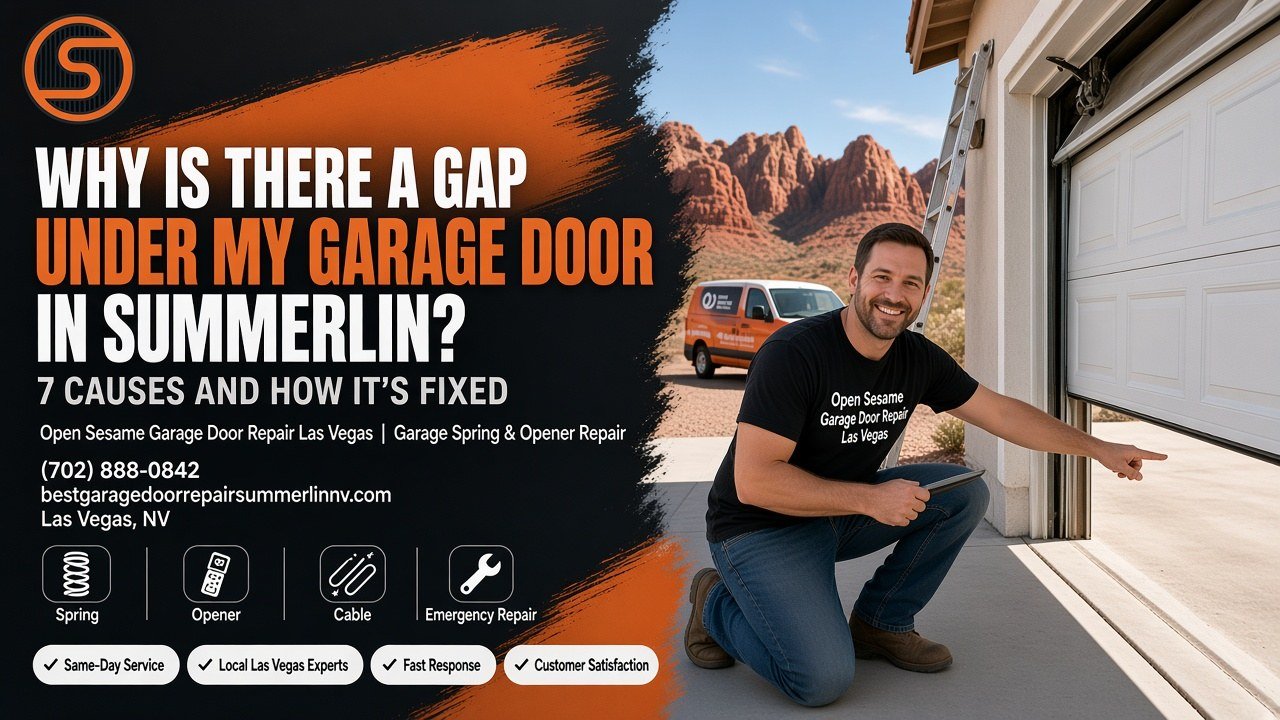
Why Is There a Gap Under My Garage Door in Summerlin? 7 Causes and How It’s Fixed
If you can see daylight under your closed garage door in Summerlin, one of seven things is usually behind it. The bottom seal has hardened or shrunk. The opener is stopping the door before it reaches the floor. The driveway slab dips or has settled. A lift cable has slipped or stretched. A spring is broken or weak and the door is out of balance. The tracks or their brackets have moved. Or the bottom section or its seal retainer is bent. In Summerlin, two extra things shape the problem: many homes sit on sloped lots with driveways that fall toward the street, and the west side of the valley gets cooler nights and stronger winds off the Spring Mountains than the Strip does, so seals and floor contact change more from morning to afternoon. This guide shows you how to read the gap, which causes are safe to check yourself, how each one is fixed, and what the work costs on our posted price guide. Open Sesame Garage Door Repair Las Vegas works in Summerlin from 7865 Bluewater Dr, Las Vegas, NV 89128, holds Nevada contractor licence #0083315, and is open 24 hours.
Why is there a gap under my garage door in Summerlin?
Most often it’s the bottom seal. Summer heat and strong sun dry it out until it’s too stiff to fill the low spots in the slab. The next most likely cause is the opener’s close limit, which stops the door a little short. A gap that’s wider at one end is the one to take seriously. It can mean a cable has slipped on its drum or a spring has broken, and a door hanging crooked can bind or come out of its tracks. Sloped Summerlin driveways and settled slabs, tracks that have shifted, and a bent bottom section account for most of the rest.
Seal and limit problems are usually quick fixes. Cables, springs, drums, and bottom brackets are under high spring tension, so leave those to a trained technician. Our posted prices: standard repairs $150 to $350, off-track repair $150 to $350, spring replacement $250 to $450, opener repair $150 to $300, and a new installed opener $550 to $950. A bottom seal is quoted on-site, because the right profile depends on the door.
Summerlin context: Summerlin sits higher on the west side of the valley than central Las Vegas, so nights are cooler and the daily temperature swing is wide. Spring wind pushes dust and leaves under any gap, and summer storms can send water down sloped driveways toward the garage. The National Weather Service in Las Vegas issues the wind, heat, and flash flood alerts that matter here. Call (702) 888-0842 or find us on Google Maps.
How to Read the Gap in Two Minutes
Quick answer: Close the door in the middle of a sunny day, switch off the garage lights, and look along the floor from inside. Scattered spots of light mean the seal. One even strip across the full width means the opener. Light in only one place usually means the slab. A wedge that grows toward one side means a cable, a spring, or a sloped floor, and that one needs a closer look.
You don’t need tools for this. You only need to look at the gap from inside with the lights off, and pay attention to its shape and when it shows up. Many Summerlin homeowners first notice the gap as a line of light in the evening, as a drift of dust or desert leaves inside the door after a windy day, or because the garage is hotter than it used to be. All of those point to the same thing. The trick is working out which of the seven causes is making the gap.
| What you see | What it usually means | How soon to act |
|---|---|---|
| Small patches of light here and there; seal feels stiff or cracked | Worn bottom seal (cause 1) | Soon. Not a safety risk, but dust, heat, water, and pests get in. |
| A thin, even strip across the whole door; seal still soft | Opener close limit set too high (cause 2) | Soon. Adjust the limit, then test the safety reverse. |
| Light in one spot or a low area, often near the middle or one end | Slab dip or settling (cause 3), or a bowed bottom section (cause 7) | When convenient. |
| A wedge, wider at one side; door looks lower on one side | Cable (cause 4), spring (cause 5), or a sloped slab (cause 3) | Now, if it’s new. Stop using the opener and have it inspected. |
| The door rubs, drags, or stops partway down | Track or bracket out of line (cause 6) | Soon. Don’t force it. |
| The gap shows in the morning and is gone by afternoon | Seal stiff in cool air, or limit set right at the edge | Soon. |
Two more clues help. First, look at the door from the driveway. If the bottom edge isn’t parallel with the top of the opening, the door is hanging crooked, and that points to cause 4 or 5. If the door looks level but the gap is still a wedge, the slab is probably sloped. Second, think about timing. A gap that appeared the day after a loud bang in the garage is almost always a spring. A gap that grew slowly over several summers is almost always the seal.
Take a photo of the gap with the lights off. It helps a technician understand the problem before arriving, and it gives you something to compare against after the repair.
When a Gap Is Urgent and When It Can Wait
Quick answer: A gap from a tired seal or an opener setting can wait a few days. A gap that came on suddenly, especially a wedge after a bang, a door that jerks, or a cable that looks loose, is a reason to stop using the opener and keep people away from the door until it’s checked.
Most gaps under Summerlin doors are a nuisance, not a hazard. They let in dust, desert leaves, crickets, scorpions, and summer heat, and they make an air-conditioned home work harder if the garage shares walls with living space. But a few gaps are the first visible sign that something under high tension has failed.
Stop using the door and call if: the gap is wider at one end and showed up suddenly; you heard a loud bang from the garage; you can see a gap in a torsion spring above the door; a lift cable looks slack, frayed, or off its drum; the door jerks, shudders, or stops partway; or the door doesn’t reverse when it touches an object. Keep children, pets, and vehicles out from under the door. Don’t try to adjust the cables, the springs, or the bottom brackets yourself.
Garage door springs carry most of the door’s weight. A typical two-car steel door can weigh well over a hundred pounds, and the springs store enough energy to cause serious injury if they’re released the wrong way. The U.S. Consumer Product Safety Commission’s guidance on automatic residential garage door operators and the DASMA garage door safety tips both make the same point: test the safety reverse regularly, and leave spring and cable work to trained technicians.
When a door hangs crooked, one cable is carrying more of the load than it should, and the rollers on the low side are pushed against the track at an angle. Each time the opener runs, that strain gets worse. Doors in that condition can twist out of the track, bend a section, or drop on the low side if the other cable lets go. Stopping early usually keeps a cable repair from turning into a door repair.
If the door is stuck open and you need to secure the house, call us. We’re open 24 hours, and we can talk you through what’s safe to do while you wait.
Cause 1: A Hardened or Shrunken Bottom Seal
Quick answer: This is the cause we find most often on Summerlin doors. The rubber or vinyl strip along the bottom edge dries out in the heat and sun, gets stiff, flattens, and shrinks. It stops filling the small dips in the slab. A new seal of the right profile, fitted into a clean, straight retainer, closes the gap.
How to spot it. You’ll see patches of light rather than a single strip, usually worst at the two ends of the door and over any low spots in the concrete. Press the seal with your thumb. A healthy seal gives and springs back. A worn one feels hard, may be cracked or chalky, and often has pulled back an inch or two from the corners. After a windy spring day you may find a fan-shaped drift of dust or leaves just inside the door.
Why Summerlin seals wear out. Vinyl seals stay flexible because of additives in the material, and heat and UV light slowly break those down. Summerlin summers regularly pass 100°F, and doors that face west or south bake in the afternoon sun, with the driveway radiating heat from below. Then the nights cool off, more on this side of the valley than in the middle of town. That daily cycle of heating and cooling keeps flexing the seal, and over a few summers it goes from soft to stiff. Seals also shrink lengthwise as they age, which is why the corners usually go first.
How it’s fixed. Most steel doors in Summerlin use a slide-in seal held in an aluminum retainer on the bottom of the door. A technician slides the old seal out, cleans the channel, checks the retainer for dents and corrosion, and feeds in a new seal of the matching profile and width. The seal is left slightly long and secured at each end so it can’t creep. Wood and some custom doors, which are common in parts of The Ridges and Red Rock Country Club, use nail-on or screw-on seals instead. Because the new seal is fuller, the door now meets the floor a little sooner, so the opener’s close limit often needs a small change, and the safety reverse is tested afterward.
What to watch for. Slide-in seals come in different shapes (bulb, T-style, J-style, and others) and they only work in the retainer they were designed for. A bent or corroded retainer won’t hold a new seal straight, so it may need replacing too. And don’t remove the bottom brackets at the corners to get the retainer off. The lift cables attach there, and they’re under spring tension.
We cover seal choices, lifespans, and replacement in detail in Garage Door Bottom Seal Replacement in Summerlin: When Should You Replace the Weatherstrip?. Our valley-wide guide is Garage Door Bottom Seal Replacement in Las Vegas.
Cause 2: The Opener’s Close Limit Is Set Too High
Quick answer: Every opener has a “close limit,” the point where it decides the door is closed and stops. If that setting is a little high, the door stops before the seal touches the floor and leaves an even gap across the whole width. Adjusting the limit, then testing the safety reverse, fixes it.
How to spot it. The gap is the same height all the way across, and the seal is still soft. Pull the emergency release (with the door fully closed) and lower the door by hand the last inch, if it will go. If the door drops down and seals properly, the opener was stopping it short. Re-engage the trolley afterward following your opener’s manual.
Why it happens. Limits drift. A new seal, a seasonal change in how the door moves, a power surge during a summer storm, or someone pressing the wrong buttons can all change where the opener stops. Older openers with mechanical limit screws drift more than newer ones that set their limits electronically. Some homeowners also raise the limit on purpose after the opener starts reversing at the floor, which fixes one problem and creates another.
How it’s fixed. The limit is lowered until the door just compresses the seal along the floor without the opener straining or reversing. On newer openers, that’s done with programming buttons on the motor unit. On older ones, it’s an adjustment screw. The force setting should stay where the manufacturer set it. After any change, the safety reverse is tested by closing the door on a 2×4 laid flat on the floor, and the photo-eyes are tested by breaking the beam while the door closes. Those tests come from the UL 325 standard that governs residential openers; see UL’s overview of UL 325 safety issues.
What to watch for. If the door won’t seal until you turn the force up, something else is wrong, usually binding in the tracks or a spring that’s out of balance. Turning up the force hides the problem and weakens the opener’s ability to reverse on an obstruction. If your opener is reversing at the floor, see Garage Door Won’t Close in Summerlin? 10 Causes. For opener service, see our garage door opener repair page.
Cause 3: Sloped Driveways and Settled Slabs
Quick answer: Many Summerlin homes are built on graded hillside lots, and garage slabs are often sloped toward the driveway for drainage. If the door hangs level but the floor doesn’t, you get a gap at one end or over a low spot. A seal with more reach, a threshold seal on the floor, or in severe cases concrete repair is the fix.
How to spot it. The door itself looks level from outside, the seal is soft, and the cables look even, but light still shows at one end or in one area. Lay a long level or a straight board across the floor under the door. If one end is noticeably lower, or there’s a dip near the middle, the floor is the cause.
Why it’s common in Summerlin. Summerlin was built in villages across rising ground at the western edge of the valley. Lots were graded to step down the slopes, and many driveways fall steeply to the street. Garage slabs are usually poured with a slight pitch toward the door so water runs out, and the area right at the threshold is often where the garage slab meets the driveway apron. Those joints can settle a little over the years, especially where soils were filled during grading or where irrigation keeps the ground damp. Older homes in the first villages, from the early 1990s, have had the most time to settle.
How it’s fixed. For small differences, a bottom seal with a taller or more flexible profile can follow the floor. For larger or uneven differences, a rubber threshold strip glued to the slab under the door gives the seal something level to close against and also helps stop water running in. Threshold seals need to be placed so they don’t trip anyone or catch the bottom of the door. A badly settled or cracked slab is a concrete job, not a door job. A door technician shouldn’t try to “fix” a sloped floor by adjusting one cable shorter, because that leaves the door out of balance.
What to watch for. If the floor gap is new, check whether the door has changed rather than the floor. A cable problem can make a door that used to seal suddenly look like it’s sitting on a sloped floor.
Cause 4: A Slipped, Stretched, or Frayed Lift Cable
Quick answer: The two lift cables run from the bottom corners of the door up to drums on the spring shaft. If one slips on its drum, stretches, or starts to fray, that side of the door rides higher or lower than the other, and you see a wedge-shaped gap. This needs a technician, because the cables are under spring tension.
How to spot it. The gap gets wider toward one side. From the driveway, the bottom of the door isn’t parallel with the top of the opening. With the door closed, look at the cable on each side. One may be loose or bunched while the other is tight, or you may see broken strands near the bottom bracket. The door may also shudder or move unevenly.
Why it happens. Cables wear where they wrap the drum and where they attach at the bottom brackets. Rust and grit speed that up, and fine dust is never in short supply on the west side of the valley. A door that hits an obstruction or comes partly off track can unwind a cable from its drum. A weak or broken spring can let a cable go slack and jump its groove.
How it’s fixed. The door is secured, the spring tension is let off safely, the cable is reseated or replaced (usually both cables are replaced together so they wear evenly), the drums are checked for damage, and the springs are re-tensioned so the door hangs level and balanced. Then the door is run, the gap is rechecked, and the safety reverse is tested. On our price guide, cable work falls under standard repairs at $150 to $350.
What to watch for. Don’t keep running a door that’s hanging crooked. A slack cable can tangle, and a frayed one can snap and let the door drop on that side. See Frayed Garage Door Cable in Summerlin: Can You Keep Using the Door?, Garage Door Cable Came Off the Drum in Summerlin, and our garage door cable repair page.
Cause 5: A Broken or Weak Spring and an Unbalanced Door
Quick answer: Springs balance the door’s weight so the opener only has to guide it. When one of two torsion springs breaks, or a spring has lost strength over the years, the door no longer hangs evenly, a cable can go slack, and the door may sit crooked and leave a wedge gap. Spring work is always a job for a technician.
How to spot it. Look at the springs on the shaft above the door, with the door closed. A broken torsion spring usually shows a clear gap of an inch or more between coils. Many homeowners heard a loud bang from the garage shortly before the gap appeared. The door may feel very heavy if you lift it by hand with the opener released, or the opener may lift it only a few inches and stop. Don’t keep trying. Running an opener against a broken spring strains the motor and gears and can unspool the cables.
Why it happens. Every spring is rated for a certain number of open-and-close cycles. Standard springs are commonly rated around 10,000 cycles; high-cycle springs last longer. A busy household that uses the garage as its front door can reach that in well under ten years. Rust on the coils adds friction, and the large daily temperature swing on Summerlin’s side of the valley adds stress. A spring that’s getting weak doesn’t always break cleanly. It may just stop lifting its share, and the door slowly goes out of balance.
How it’s fixed. On a two-spring door, we normally replace both springs together, because the other spring is the same age and usually close to failure. The springs are sized to the door’s weight and height, wound to the right number of turns, and the door is balanced so it stays put when it’s lifted halfway by hand. The cables are checked and reseated, and then the gap, the travel, and the safety reverse are checked. Spring replacement is $250 to $450 on our posted price guide. For more detail, see garage door spring replacement.
What to watch for. If a spring has broken and the door is closed, leave it closed. If it’s stuck open, don’t try to pull it down, and keep people away from under it. Read Garage Door Opens a Few Inches Then Stops in Summerlin for the symptoms that usually come with a broken spring.
Cause 6: Tracks and Brackets Out of Line
Quick answer: The vertical tracks guide the door down to the floor. If a track bracket has worked loose or a track has been bumped, the door can drag, bind, or stop before it seals, and one side may sit higher than the other. Realigning and re-securing the tracks fixes it.
How to spot it. The door rubs or scrapes on one side, the rollers look tilted, or the door stops partway down and the opener reverses. A track may be visibly bent where a car, a bike, or a storage shelf hit it. Look at the bolts holding the track brackets to the wall. If they’re loose, the track can lean away from or into the door.
Why it happens. Doors vibrate every time they run, and brackets slowly loosen. Garages in Summerlin often double as gyms, workshops, and storage for golf carts and bikes, and tracks take knocks. Wind loading matters too. A wide door that catches strong gusts flexes, and over time that flexing can work fasteners loose.
How it’s fixed. A technician checks that the tracks are plumb and set the right distance from the door, tightens or replaces loose fasteners, straightens or replaces bent track sections, and replaces damaged rollers. The door is then run by hand and by opener to make sure it travels smoothly and closes evenly. Track work falls in our standard repair range of $150 to $350; if the door has come out of the track, off-track repair is $150 to $350. See garage door track adjustment.
What to watch for. Don’t hammer a track back into place while the door is under load, and don’t loosen the lowest track brackets, which on some doors sit close to the cable attachment. A door that is partly out of its track can fall. See Why Is My Garage Door Crooked in Summerlin?
Cause 7: A Bent Bottom Section or Seal Retainer
Quick answer: If the bottom section of the door, or the aluminum retainer that holds the seal, is bent or bowed, the seal can’t sit flat on the floor even when everything else is fine. Straightening or replacing the retainer, and sometimes the bottom panel, fixes it.
How to spot it. The gap is usually in the middle of the door or in one stretch, and you can see the bottom edge curve up when you sight along it. Look for a dent where a bumper or trash bin hit it, or a bottom section that bows in the heat. Long doors with thin steel skins are more likely to bow.
Why it happens. Vehicles and bins hit the bottom of the door more than any other part. On wide doors, strong sun on one face and a cooler garage on the other can make thin panels bow slightly. A retainer that has corroded, often where irrigation water splashes the bottom of the door, can lose its shape.
How it’s fixed. A bent retainer is usually replaced, and the new seal goes in at the same time. A dented or bowed bottom section can sometimes be straightened and reinforced with a strut; badly damaged sections are replaced. Matching an exact panel can be hard on older or discontinued doors, which matters in Summerlin neighborhoods with strict design rules. See bent garage door panel repair.
What to watch for. The bottom brackets that hold the cables are fastened to the bottom section. Replacing that section is a technician job.
Gaps That Appear in the Morning, and Gaps at the Sides
Quick answer: A gap that shows in the cool morning and closes up by afternoon usually means the seal has lost its flexibility, or the close limit is set right at the edge. Side and top gaps come from the perimeter weatherstrip, not the bottom seal.
Summerlin’s daily temperature swing is one of the reasons homeowners notice “on and off” gaps here. Rubber and vinyl are softer when warm. A seal that’s starting to wear may still fill the floor on a hot afternoon, then shrink and stiffen overnight and leave a strip of light at dawn. Long doors also change shape a little through the day as the sun moves across them. If your gap comes and goes with the temperature, it’s an early sign that the seal is near the end of its life.
The opener’s limit can play a part too. If it’s set so the door only just reaches the floor, the small daily changes in the door and seal decide whether it touches or not. Setting the limit so the seal compresses lightly, then testing the safety reverse, usually stops the on-and-off gap.
Side and top gaps. The sides and top of the door are sealed by the perimeter weatherstrip: vinyl stop molding nailed to the door frame with a soft flap that rests against the face of the door. Sun cracks and curls that flap, and it pulls away. Replacing it fixes the gap and keeps wind-blown dust out. If the gap at one side is much wider than the other, though, the door may have shifted in its tracks or be hanging crooked, which takes us back to causes 4 to 6.
- Even light down both sides: worn perimeter weatherstrip.
- Light down one side only, door level: weatherstrip loose or damaged on that side.
- Light down one side, door looks crooked: check cables, springs, and tracks.
- Light across the top: worn header weatherstrip, or the door closing too low against the header.
What We See Across Summerlin’s Villages
Quick answer: The age of the home, how steep the lot is, and what kind of door it has all change which cause is most likely. Older villages see more settled slabs and worn springs. Hillside lots see more sloped floors. Custom and wood doors see more panel and retainer issues.
Summerlin has been built in stages since the early 1990s, so homes range from about thirty years old to brand new. The patterns below are general trends we see on service calls, not rules, and any home can have any of the seven causes.
| Type of home | Causes we tend to see | What to check first |
|---|---|---|
| Earlier villages (older homes, original doors) | Worn seals, tired springs, settled slabs, loose track brackets | Spring age, seal condition, floor level |
| Sun City Summerlin and other age-restricted communities | Worn seals and openers with drifting limits; doors often used many times a day | Opener limit and safety reverse, seal |
| Hillside lots with steep driveways | Sloped thresholds and water running toward the door in storms | Floor slope, threshold seal |
| Custom homes in The Ridges, Red Rock Country Club, and similar areas | Heavy wood or custom doors, nail-on seals, retainer and panel issues, larger springs | Door balance, seal type, bottom section |
| Newer homes in Summerlin South and The Paseos | Builder-grade seals that harden in the first few summers; limits set at install and never adjusted | Seal and opener limit |
Heavier custom doors deserve a note. A wood or wood-clad door can weigh several times as much as a basic steel door, so its springs and cables carry far more load. A small cable or spring problem on a heavy door can leave a noticeable wedge gap fast, and it’s even more important not to adjust anything yourself. For an overview of service in the area, see our Summerlin garage door repair page.
What Each Fix Costs in Summerlin
Quick answer: Seal and opener-limit fixes are the least expensive. Cable, track, and bracket work falls into our standard repair range of $150 to $350. Spring replacement is $250 to $450. A bottom seal is quoted on-site because the profile and length vary by door. You hear the price before any work starts.
These are the posted ranges from our Las Vegas garage door repair cost guide. They apply in Summerlin the same as anywhere else in the valley. The final price depends on the parts your door needs and its condition.
| Cause of the gap | Typical fix | Posted price |
|---|---|---|
| 1. Worn bottom seal | New seal; retainer checked or replaced | Quoted on-site |
| 2. Opener close limit | Limit adjusted, safety reverse tested | Opener repair $150-$300 |
| 3. Sloped or settled slab | Taller seal or threshold seal | Quoted on-site (concrete work is separate) |
| 4. Cable problem | Cables reseated or replaced, door balanced | Standard repair $150-$350 |
| 5. Spring problem | Springs replaced, door balanced | Spring replacement $250-$450 |
| 6. Tracks or brackets | Tracks realigned, fasteners and rollers replaced | Standard repair $150-$350; off-track $150-$350 |
| 7. Bent retainer or bottom section | Retainer or section replaced | Retainer: standard repair $150-$350; sections quoted on-site |
| Worn opener that won’t hold a limit | New installed opener | $550-$950 |
| General wear, noise, dry hardware | Tune-up | $89-$129 |
One visit often covers more than one cause. A new seal usually needs a small limit adjustment, and a cable repair includes balancing the springs. If the technician finds a second problem, such as a spring near the end of its life, you’ll hear about it and decide whether to do it now or later.
For a planned check before summer, a tune-up at $89 to $129 includes lubrication, a balance check, tightened hardware, a safety test, and a look at the seal. See How Much Does a Garage Door Tune-Up Cost in Summerlin?
Why Summerlin’s Climate Makes Gaps Matter More
Quick answer: Heat wears out the seal, wide day-to-night temperature swings make the gap come and go, wind pushes dust and leaves through it, summer storms can run water down sloped driveways and under the door, and scorpions and rodents use it to get in.
Heat and sun. Summers in the Las Vegas Valley are long and hot, and the sun is strong. West- and south-facing doors take the worst of it. A garage with a gap under the door also loses more cool air to the outside, and in homes where the garage shares a wall with living space, that adds to the air-conditioning load.
Temperature swings. Summerlin’s higher ground on the west side of the valley tends to cool off more at night than central Las Vegas. That bigger daily swing flexes seals, and it’s why many homeowners here first notice the gap early in the morning.
Wind and dust. Spring and early summer bring strong winds, and Summerlin’s open desert edges and construction areas mean there’s plenty of dust and plant debris to blow under a door. Dust that gets in settles on rollers, tracks, and the opener’s photo-eyes. Dust is a big enough topic that we wrote a whole guide on it: Can Las Vegas Dust and Desert Conditions Affect Garage Door Tracks, Rollers and Openers?
Storms and runoff. Summer thunderstorms can drop heavy rain quickly. On sloped lots, water runs down driveways toward the garage, and a gap under the door is an open invitation. A good seal, and on some homes a threshold seal, keeps most of it out.
Pests. Bark scorpions live throughout the valley and can fit through very narrow openings, as can crickets and small rodents. A seal that touches the floor across the whole door closes one of the easiest ways in. It won’t make a garage pest-proof, but it helps a lot.
The National Weather Service in Las Vegas posts the heat, wind, and flash flood warnings worth watching. On high-wind days, keep the door fully closed rather than partly open.
HOA and Design Review Notes for Summerlin
Quick answer: Replacing a seal, a cable, a spring, or a track doesn’t change how your home looks from the street, so it usually doesn’t need approval. Replacing a door section, changing the door’s color, or installing a new door often does. Check your village or neighborhood association’s rules first.
Summerlin neighborhoods are governed by community and village associations with their own design guidelines. Most repairs that fix a gap are hidden from view: a new bottom seal, a limit adjustment, a new cable, a balanced spring, realigned tracks. Those are maintenance. Where design rules come in is when the visible part of the door changes. If cause 7 means a bottom section has to be replaced, ask whether a matching panel is available and whether the association needs to sign off. If the door is old and discontinued, a matching panel may not exist, and that can tip the decision toward a new door.
If you rent, your lease decides who pays for garage door repairs. Report the gap to your landlord or property manager with a photo, especially if the door looks crooked.
Safe Checks You Can Do Yourself
Quick answer: You can look at the gap, look at the seal, check whether the door hangs level, look for a broken spring or loose cable without touching them, clean the photo-eyes, and test the safety reverse. Leave the springs, cables, drums, and bottom brackets alone.
- Look at the gap. Lights off, sunny day, door closed. Note the shape and take a photo.
- Feel the seal. Soft and springy is good. Hard, cracked, flattened, or short at the corners means it’s worn.
- Check the door from outside. Is the bottom edge parallel with the top of the opening?
- Look at the springs and cables. From a safe distance, with the door closed, look for a gap in a spring coil or a slack, frayed, or loose cable. Don’t touch them.
- Clean the photo-eyes. Wipe the small lenses near the floor on each side with a soft cloth and check that the indicator lights are steady.
- Test the safety reverse. Lay a 2×4 flat on the floor in the door’s path and close the door. It should reverse after touching the board. Then wave a box through the photo-eye beam while the door closes; it should stop and reverse.
- Read the opener manual before changing any limit settings, and never turn up the force to make the door seal.
If the safety reverse fails, stop using the opener until it’s repaired.
What Happens When We Come Out for a Gap
Quick answer: We look at the gap, check the seal, the opener limit, the floor, both cables, the springs and balance, the tracks, and the bottom section, then tell you which one is causing it and what the fix costs before we start.
- Look at the gap and the door. Shape, size, and whether the door hangs level.
- Check the seal and retainer. Profile, condition, corrosion, and length.
- Release the opener and check balance. A balanced door stays put halfway up. One that drops or rises points to a spring.
- Inspect cables and drums. Fraying, slack, and how each cable sits on its drum.
- Check tracks and brackets. Plumb, spacing, fasteners, and rollers.
- Check the floor. Slope and low spots under the door line.
- Check the opener. Close limit, force, photo-eyes, and safety reverse.
- Explain and price the fix. Then make the repair, recheck the gap, and test the safety reverse before we leave.
Common Mistakes With a Gap Under the Door
Turning up the opener’s force
It may push the door down harder, but it weakens the safety reverse and hides the real problem.
Adjusting one cable to “level” the door
Cables are under spring tension, and shortening one to match a sloped floor leaves the door out of balance.
Buying the thickest seal you can find
A seal that’s too tall can make the opener reverse at the floor and won’t fix a crooked door.
Ignoring a gap that showed up after a bang
That’s usually a broken spring. Running the door on it can damage the opener and the cables.
Leaving a towel or rug against the door for months
It can keep the door from closing fully and can stop the safety reverse from working as designed.
Daylight Under Your Summerlin Garage Door? Let’s Find Out Why
Open Sesame Garage Door Repair Las Vegas checks all seven causes, tells you which one it is, and prices the fix before any work starts. Open 24 hours. Nevada contractor licence #0083315.
About Open Sesame Garage Door Repair Las Vegas
Open Sesame Garage Door Repair Las Vegas repairs residential garage doors in Summerlin and across the Las Vegas Valley from 7865 Bluewater Dr, Las Vegas, NV 89128. We hold Nevada contractor licence #0083315 and are open 24 hours. You can check any contractor’s licence on the Nevada State Contractors Board website. This guide draws on the gap causes our technicians find on Summerlin doors, the posted prices on our cost guide, and safety guidance from the CPSC, DASMA, and the UL 325 standard.
Call (702) 888-0842, or view Open Sesame Garage Door Repair Las Vegas on Google Maps.
Frequently Asked Questions About a Gap Under a Garage Door in Summerlin
Why is there a gap under my garage door in Summerlin?
Most often the bottom seal has hardened or shrunk from heat and sun. Other causes are an opener close limit set too high, a sloped or settled slab, a slipped or frayed cable, a weak or broken spring, tracks out of line, and a bent bottom section or seal retainer.
Do Summerlin’s temperature swings affect garage door seals?
Yes. Summerlin’s higher elevation along the west side of the valley brings cooler nights and hot afternoons. Vinyl and rubber seals stiffen in the cool and soften in the heat, and that daily cycle plus strong sun ages them faster, so a seal may seal in the afternoon and leave a gap in the morning.
Can a sloped driveway or hillside lot cause a garage door gap?
It can. Garage slabs slope for drainage, and on hillside lots the slab or apron can settle unevenly. If the door hangs level and the seal is good but light shows in one area, a seal with more reach or a threshold seal often closes it.
How do I tell what’s causing the gap?
Check the gap’s shape with the garage lights off on a sunny day. Scattered patches usually mean the seal. An even line with a soft seal points to the opener limit. A gap only in the middle suggests a floor dip. A wedge wider at one end points to a cable, spring, or floor issue.
Is a gap under my garage door dangerous?
A worn seal gap is a nuisance. A new wedge-shaped gap from a crooked door can be dangerous because it can mean a slipped cable or broken spring. Stop using the opener and have the door checked.
Why is my garage door lower on one side?
Usually a lift cable slipped, stretched, or frayed, or a spring is broken or weak. Cables and springs are under high tension and should only be serviced by a technician.
How much does it cost to fix a gap under a garage door in Summerlin?
A bottom seal is quoted on-site. Standard repairs such as limit, cable, track, or retainer work run $150 to $350 on our cost guide. Spring replacement is $250 to $450, off-track repair $150 to $350, opener repair $150 to $300, and a new installed opener $550 to $950.
Can I fix the gap myself?
You can check the gap, the seal, and the safety reverse, and many homeowners can replace a slide-in seal or adjust the opener’s close limit using the manual. Leave cables, springs, drums, and bottom brackets to a technician.
Does my HOA have rules about garage door repairs?
Many Summerlin village associations have rules about the door’s appearance, such as color and style, when a door or panel is replaced. Seal, cable, spring, and opener repairs usually don’t change appearance, but check your association’s guidelines before replacing a door or section.
Why does my garage door stop an inch above the floor?
The opener’s close limit is probably set too high. Adjust it so the door lightly compresses the seal, then test the safety reverse with a 2×4 laid flat under the door. Don’t increase the force setting.
Why does my garage door touch the floor and go back up?
The close limit may be set too far down, the force may be set too low, or a new fuller seal may be read as an obstruction. Dirty or misaligned photo-eyes can also cause reversing.
Will a thicker bottom seal fix the gap?
Only when the cause is a small floor dip. It won’t fix a crooked door, an opener stopping short, or a bent track, and it can cause the opener to reverse at the floor.
Can scorpions get under a garage door gap?
Yes. Bark scorpions are common in the Las Vegas Valley, including Summerlin, and can get through very narrow gaps. A seal that touches the floor all the way across closes one easy entry point.
Why does the gap under my door come and go?
A hardened seal may lose contact on cool mornings and seal again when it softens in the afternoon heat. If the gap changes with temperature, the seal is likely worn or the close limit is set too tight to the floor.
How do I test my garage door’s safety reverse?
Lay a 2×4 flat in the door’s path and close the door with the opener; it should reverse on contact. Then break the photo-eye beam while it closes; it should stop and reverse. If either test fails, stop using the opener until it’s fixed.
Where is Open Sesame Garage Door Repair?
Open Sesame Garage Door Repair Las Vegas is at 7865 Bluewater Dr, Las Vegas, NV 89128, close to Summerlin. We’re open 24 hours and hold Nevada contractor licence #0083315. Call (702) 888-0842.
Find Open Sesame Garage Door Repair Las Vegas
View Open Sesame Garage Door Repair Las Vegas on Google Maps · Serving Summerlin and the west Las Vegas Valley from 7865 Bluewater Dr, Las Vegas, NV 89128
Close the Gap the Right Way in Summerlin
Call Open Sesame Garage Door Repair at (702) 888-0842, open 24 hours. We’ll find out whether the gap comes from the seal, the opener, the slab, a cable, a spring, the tracks, or the bottom section, price the fix before we start, and test the safety reverse before we leave. Nevada contractor licence #0083315.
7865 Bluewater Dr, Las Vegas, NV 89128 · Serving Summerlin & the Las Vegas Valley · Licence #0083315