


Open Sesame Garage Door Repair Las Vegas • Crooked / Uneven Door Diagnostics
Why Is My Garage Door Crooked in Las Vegas? Cable, Drum, Track and Spring Problems Explained
A garage door that sits crooked, rises unevenly, or hangs with one side
higher than the other is rarely a cosmetic issue. Uneven travel usually
means one side of the door is not being supported or guided the same way
as the other. The most common mechanical explanations involve lift cables
and cable drums, track or roller problems, and spring or counterbalance
failures. In Las Vegas homes, that symptom should be treated as a stop
signal before the automatic opener is used again.
Why is my garage door crooked?
A crooked garage door usually means the lift system is no longer applying
equal support on both sides. Broken or jumped cables, cable drums that are
out of sync, bent or misaligned tracks, binding rollers, or a spring that
has failed on one side of a dual-spring system can all create an uneven
door. Stop operating the opener if one corner is higher, a cable is loose
or hanging, a roller has left the track, or the door looks unstable.
For the Summerlin service-area version of the same topic, see why a garage door is crooked in Summerlin (cable, drum, track, and spring).
What Does It Tell You When a Garage Door Is Crooked or Uneven?
A residential garage door is designed to rise and lower as a balanced
panel system.
Both sides should travel together.
Both vertical tracks should guide the rollers evenly.
Both lift cables should remain seated on their drums and support the door
with matching tension.
When one corner rises ahead of the other, or when the closed door sits
noticeably higher on one side, something in that balanced system has
changed.
The crooked appearance is the symptom.
The failed or displaced component is the cause.
Crooked While Closed Versus Crooked While Moving
A door that sits unevenly while fully closed often points to a cable that
has jumped or stretched, a drum that is no longer wound correctly, a
bottom fixture problem, or a spring issue that has left one side
unsupported.
A door that starts level and becomes crooked as it opens often points to
uneven lifting force, a roller that binds partway up the track, or a
track that is bent or out of parallel at a specific height.
A door that becomes crooked while closing can indicate the same families
of problems, but the risk profile is different because a descending
uneven door can jam, twist panels, or leave a roller out of the track.
How Much Unevenness Matters
A slight visual difference is still worth noticing, especially if it is
new.
A dramatic tilt — one side several inches higher — is an urgent mechanical
warning.
The larger the difference, the more likely it is that continued opener
use will damage cables, rollers, tracks, hinges, panels, or the opener
itself.
Listen and Watch, but Do Not Force It
Scraping, popping, cable slap, grinding, or a sudden bang can all be
useful clues.
So can a visible hanging cable, a gap in a torsion spring, or a roller
sitting outside the track channel.
Those observations help a technician narrow the diagnosis.
They do not authorize DIY spring winding, cable rewinding, or forcing the
door with the opener.
Stop operating the garage door if:
One side is clearly higher than the other, a cable is loose or hanging, a
cable has come off the drum, a spring shows an obvious gap, a roller has
left the track, the door looks twisted, or the opener is dragging the
door upward against visible resistance.
Cable, Drum, Track or Spring? Start With These Four Diagnostic Paths
Lift Cable Problem
A frayed, stretched, broken, or jumped lift cable can leave one side of
the garage door unsupported. The unsupported corner drops or lags, and
the door becomes crooked almost immediately.
Cable Drum Problem
Cable drums control how the lift cables wind and unwind. If a drum slips,
loses cable wraps, or is no longer synchronized with the opposite drum,
one side of the door rises or lowers differently from the other.
Track / Roller Problem
Bent track, loose brackets, debris in the channel, or a roller that has
left the track can force one side of the door to bind while the other
continues moving. The result is tilt, scraping, and often an opener that
stops under load.
Spring / Counterbalance Problem
On systems with more than one torsion spring, a single broken spring can
leave the door unevenly counterbalanced. Extension-spring systems can also
create uneven lift if one side fails. The opener then pulls against an
unbalanced load.
Why These Categories Overlap
A cable that leaves the drum can make the door crooked.
A crooked door can then force rollers against the track walls.
Track binding can then make the opener reverse or stop.
A homeowner may see only the final opener behavior and assume the opener
failed, when the root cause was a cable or spring issue that started the
imbalance.
The Garage Door Is One System
Springs store and release counterbalance force.
Drums and cables transfer that force to the bottom corners of the door.
Rollers and tracks guide the door panels.
The opener is intended to move a door that is already balanced and
traveling freely.
When the door is crooked, the opener is often the last component in a
chain of mechanical failures — not the first thing that should be
replaced.
1. Lift Cable Problems That Make a Garage Door Crooked
Lift cables are one of the most common reasons a residential garage door
becomes uneven.
On a typical torsion-spring system, cables run from the bottom fixtures
up to the cable drums near the spring shaft.
Those cables must remain seated, tensioned, and free of broken strands.
If one cable fails or leaves its drum, that side of the door loses lift
support.
What a Failed or Jumped Cable Looks Like
A cable may hang loosely beside the track.
It may show frayed wire strands near the bottom bracket or near the drum.
It may have slipped off the drum groove entirely.
In some cases the cable remains attached but has stretched enough that one
side of the door sits lower when closed.
Any of those conditions can create a crooked door.
Why One-Sided Cable Failure Tilts the Door
Garage doors are heavy.
The cables share that load with the spring system.
When only one cable is working correctly, the working side continues to
receive lift while the failed side lags or drops.
The door then racks diagonally.
Rollers begin to press harder into the tracks.
Hinges and end bearings can be stressed.
Panels can twist.
Cable Issues Homeowners Commonly Notice
- One bottom corner is clearly higher or lower than the other.
- A cable is hanging, slack, or resting against the track.
- Frayed strands are visible along the cable.
- The door starts to open and immediately becomes crooked.
- There was a sudden pop or slap before the uneven travel began.
- The opener strains or reverses after the door tilts.
What Not to Do With Garage Door Cables
Do not try to pull a jumped cable back onto the drum by hand while the
spring system is under tension.
Do not loosen cable drums, rewind cables, or replace cables as a DIY
project on a torsion system.
Cable work is connected to stored spring energy.
Incorrect handling can cause sudden cable release, uncontrolled door
movement, or serious injury.
For general residential garage door safety guidance, review the
DASMA garage door safety tips
.
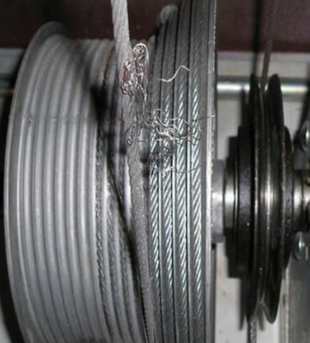
Lift cables and cable drums must stay synchronized. A cable that jumps,
frays, or leaves the drum is a common reason one side of a Las Vegas
garage door becomes crooked.
2. Cable Drum Problems and Out-of-Sync Lifting
Cable drums are the grooved drums on the torsion tube that wind and unwind
the lift cables as the spring shaft turns.
When both drums are set correctly, both cables take up and release cable
at the same rate.
When one drum slips on the shaft, loses wraps, or is wound differently
from the other, the door no longer lifts evenly.
How Drum Problems Create Crooked Travel
If one drum has fewer effective wraps of cable, that side of the door will
rise sooner or later than the opposite side.
If a set screw has loosened and the drum has rotated on the shaft, the
cable timing can be wrong even when the cable itself still looks intact.
If the cable has piled incorrectly on the drum instead of nesting in the
grooves, the effective lifting radius changes and the door can walk out of
level.
Clues That Point Toward the Drums
- The cables appear attached, but the door still rises unevenly.
- One drum shows uneven cable wraps compared with the other.
- Cable is stacked or crossed on the drum instead of seated in the grooves.
- The door became crooked after a hard stop, impact, or abrupt opener reversal.
- One side of the door lifts early while the other lags throughout the cycle.
Why Drum Adjustment Is Not a Homeowner Job
Cable drums are locked to a shaft that is under spring tension.
Adjusting drums means working around that stored energy.
An incorrect adjustment can leave the door more uneven, unload a cable
suddenly, or create a dangerous spring/cable release.
If the drums look wrong, document what you see and stop using the opener
until a technician can reset the system safely.
3. Track and Roller Problems That Rack a Garage Door
Even when cables and drums are intact, the door can still become crooked
if one side cannot travel freely through the track.
Tracks must remain parallel, securely bracketed, and free of major dents.
Rollers must stay inside the track channels.
Bent or Shifted Track
A bent vertical track section can catch a roller at a specific height.
The caught side slows or stops while the opposite side continues.
The door then tilts.
Impact from a vehicle, a ladder, stored items, or prior rough operation
can create that bend.
Loose Track Brackets
Track brackets hold the track at the correct distance from the wall and
jamb.
If a bracket loosens, the track can drift out of alignment.
One side of the door may then bind while the other side moves normally.
Rollers Out of the Track
A roller that has left the track is an immediate stop condition.
Continuing to run the opener can tear hinges, bend the track further,
damage panels, or drop the door into a more dangerous position.
Do not try to “walk” an off-track door back into place with the opener.
Debris, Dry Rollers, and Binding
Las Vegas dust can collect in and around track channels.
Worn or seized rollers can also create one-sided resistance.
Those conditions may begin as noise or mild drag and later become visible
tilt if one side binds harder than the other.
Track Clues Versus Cable Clues
Track problems often create a stopping or scraping point at a repeatable
height.
Cable and drum problems often create an immediate height difference at the
bottom corners, even before the door has traveled far.
Both can finish with the same homeowner complaint: “My garage door is
crooked.”
4. Spring and Counterbalance Problems That Leave a Door Uneven
Springs do the heavy work of counterbalancing the garage door.
When the spring system is healthy, the opener only needs to move a
manageable, balanced load.
When the spring system fails, the opener may still try to lift the door —
and the door can become heavy, unstable, or uneven.
Dual Torsion Springs and One-Sided Failure
Many Las Vegas residential doors use a pair of torsion springs on the
shaft above the opening.
If one spring breaks, the remaining spring may still provide some lift,
but the counterbalance is no longer correct.
Depending on the hardware and how the door responds, the homeowner may
see a heavy door, a door that opens only a short distance, or a door that
no longer travels evenly.
Extension Spring Systems
Some doors use extension springs running above the horizontal tracks.
If one extension spring breaks or a safety cable / pulley arrangement
fails on one side, uneven lift is a natural result.
The unsupported side lags, and the door racks.
Visible Spring Warning Signs
- A clear gap in a torsion spring coil.
- A spring that looks stretched, separated, or out of place.
- A loud bang heard earlier, followed by a heavy or crooked door.
- The door feels dramatically heavier than usual if carefully tested by a professional with the opener disconnected.
- The opener strains immediately as soon as the door begins to move.
Spring Work Is Not DIY
Garage door springs are under high tension.
Winding bars, clamps, and cable drums are not improvised tools for
homeowners.
If you can see a broken spring, stop using the door and arrange
professional repair.
A failed spring changes how the garage door is counterbalanced. On some
systems that can contribute to heavy, unstable, or uneven door travel.
How Uneven Lift Creates Cascade Damage
A crooked garage door rarely stays a single-component problem if the
opener keeps running.
From Cable Failure to Track Damage
A jumped cable tilts the door.
The tilted door forces rollers sideways in the tracks.
Tracks bend or brackets loosen.
Hinges twist.
Panels can crease.
From Track Binding to Opener Overload
A roller that binds increases the load the opener must overcome.
The opener may reverse, stop, overheat, or wear its drive components
faster.
Replacing the opener without correcting the track or cable problem leaves
the next opener fighting the same mechanical resistance.
From Spring Failure to Cable Stress
When springs no longer carry the door correctly, cables and the opener
absorb abnormal load.
Cables can stretch, fray, or leave drums.
That is one reason a “simple spring replacement” sometimes reveals
secondary cable or drum damage that also needs correction.
Why Stopping Early Protects the Rest of the System
The sooner uneven travel is treated as a mechanical emergency, the fewer
parts are likely to need repair.
One failed cable caught early may remain a cable-and-drum repair.
The same cable ignored for days of forced opener use can become a
multi-component repair involving tracks, rollers, hinges, and panels.
Cable vs. Drum vs. Track vs. Spring: Quick Comparison
| Symptom pattern | More likely cable | More likely drum | More likely track / roller | More likely spring |
|---|---|---|---|---|
| One bottom corner suddenly much lower | Yes — cable slack, jump, or break | Possible if wraps lost | Less common as first cause | Possible on one-sided spring failure |
| Cable visibly hanging or frayed | Strong indicator | Often related | Secondary risk after tilt | May coexist after spring failure |
| Cables look attached but wraps look uneven | Possible | Strong indicator | Unlikely alone | Unlikely alone |
| Door scrapes or stops at the same height | Possible after tilt begins | Possible | Strong indicator | Less specific |
| Roller outside the track channel | May have caused the derailment | May have caused the derailment | Immediate track emergency | May have contributed via imbalance |
| Visible gap in torsion spring | Secondary cable risk high | Secondary drum/cable risk | Secondary binding risk | Primary warning sign |
| Door very heavy and opener strains | Possible | Possible | Possible if binding | Strong indicator |
| Soft scraping that worsens into tilt | Less typical first sign | Less typical first sign | Strong indicator | Possible if imbalance grows |
Use the table as a diagnostic starting point, not as a final verdict.
Real garage doors often combine more than one issue by the time a
homeowner calls for help.
Safe Homeowner Checks for a Crooked Garage Door
There are useful observations you can make without touching springs,
drums, or cables under tension.
1. Stop Using the Automatic Opener
If the door is already crooked, further opener cycles can make the damage
worse.
2. Look From Outside and Inside
Compare the left and right bottom corners against the garage floor.
Note whether one side is higher while the door is fully down.
If it is unsafe to move the door, do not open it just to complete the
comparison.
3. Visually Inspect the Cables
From a safe distance, look along both vertical tracks for hanging,
slack, or frayed cables.
Do not pull on them.
4. Look at the Cable Drums
Without climbing into an unsafe position, note whether cable wraps look
evenly seated on both drums.
Photograph what you see for the technician if it is safe to do so.
5. Check for Rollers Outside the Tracks
A roller sitting beside the track channel is enough reason to leave the
door alone until it is stabilized professionally.
6. Look for a Broken Spring Gap
A torsion spring with a visible separation in the coils is a clear
professional-repair condition.
7. Note Recent Noises or Impacts
A bang, slap, scraping sound, vehicle bump, or sudden opener reversal
before the crooked symptom began can help the diagnosis.
What Not to Check by Force
- Do not disconnect the opener and try to lift a heavy or crooked door alone.
- Do not rewind cables onto drums.
- Do not tighten drum set screws.
- Do not use winding bars on torsion springs.
- Do not hammer tracks back into place while the door is hanging unevenly.
Why Repeated Operation of a Crooked Garage Door Is Dangerous
It is tempting to “give it one more try” when a door looks only slightly
off.
That habit causes a large share of secondary garage door damage.
The Opener Will Keep Pulling
The opener does not understand that one cable is missing.
It applies force at the top center through the trolley.
If one bottom corner is unsupported, that centered pull encourages the
door to rack even more.
Rollers Can Leave the Tracks Completely
Once rollers are out, the door can jam in a twisted position that is much
harder and more expensive to recover.
Panels and Hinges Can Take Permanent Damage
Sectional garage doors are not designed to operate diagonally.
Hinges bend.
End stiles twist.
Panel skins crease.
Cables Can Whip or Break Farther
A partially failed cable under repeated load can break completely.
Broken cable ends can move suddenly.
The Safer Habit
If the door is crooked, stop.
Secure vehicles outside if needed.
Use another entrance.
Call for diagnosis rather than forcing another cycle.
Safety Guidance for Automatic Garage Door Systems
Automatic residential garage door operators are regulated safety systems,
not simple convenience motors.
They are intended to move a door that is mechanically sound.
They are not intended to overpower broken cables, derailed rollers, or
failed springs.
Homeowners can review the
U.S. Consumer Product Safety Commission information on automatic residential garage door operators
for federal safety-requirement context.
DASMA also publishes practical
garage door and opener safety tips
for residential users.
Those resources reinforce the same practical rule this article emphasizes:
do not keep operating a garage door that is visibly unsafe, crooked, or
mechanically unstable.
Garage Door Sitting Crooked in Las Vegas?
If one side of the door is higher, a cable is loose, a drum looks wrong, a
roller is out of the track, or a spring is visibly broken, stop using the
opener and get the system diagnosed. Open Sesame Garage Door Repair Las
Vegas can evaluate cable, drum, track, roller, and spring conditions
before additional damage occurs.
Las Vegas Conditions and Crooked Garage Door Wear
Local climate does not by itself prove why a particular garage door is
crooked.
It does help explain the environment in which Valley garage door hardware
ages.
The National Weather Service describes Las Vegas as a broad desert valley
with abundant sunshine, hot summers, and generally dry conditions.
See the
National Weather Service Climate of Las Vegas
for official regional climate context.
Heat and Material Stress
Hot garages and sun-facing doors can accelerate ordinary aging of weather
seals, lubricants, and some hardware finishes.
Heat does not invent a jumped cable, but it is part of the long-term wear
environment.
Dust and Dry Operation
Dust around tracks and rollers can contribute to binding if maintenance is
neglected.
Binding on one side is one route to crooked travel.
High Daily Cycle Counts
Many Las Vegas households use the garage as the main entrance.
Every cycle works the springs, cables, drums, rollers, hinges, and opener
drive.
High use makes cable wear, spring fatigue, and roller wear more relevant
over time.
Older Housing Stock Mixed With Newer Systems
Across Clark County and the Las Vegas Valley, homes may have older
extension-spring systems, newer torsion setups, or mixed replacement
parts from prior repairs.
The crooked-door diagnostic process stays the same: compare both sides,
inspect cables and drums visually, look for track and roller problems,
and check for spring failure before blaming the opener alone.
When Professional Garage Door Repair Makes Sense
Some observations are safe for homeowners.
Most crooked-door repairs are not.
Call for Service Immediately If
- One side of the door is clearly higher or lower than the other.
- A cable is hanging, frayed, or off the drum.
- Cable wraps on the drums look uneven or stacked incorrectly.
- A roller is outside the track.
- A torsion spring shows a visible gap.
- The door is twisted, jammed, or unstable.
- The opener is dragging the door against obvious resistance.
What a Proper Diagnosis Usually Includes
A technician should evaluate the door as a system.
That typically means checking spring condition and balance, cable
integrity and seating, drum timing, roller condition, track alignment,
bottom fixtures, hinges, and opener response only after the mechanical
door is understood.
Why “Just Replace the Opener” Is Often Wrong
If the door is crooked, the opener may be reacting to a mechanical
problem it was never designed to correct.
A new opener on a door with a failed cable or bent track will usually
reproduce the same symptom — or create a larger repair bill.
Questions to Ask Before Approving Repair for a Crooked Garage Door
-
Is one lift cable broken, jumped, or frayed?
Ask for a clear yes or no based on inspection. -
Are both cable drums wound and timed correctly?
Uneven wraps can create uneven lift even when cables are still attached. -
Are both vertical tracks true and securely bracketed?
A bent or shifted track can rack the door during travel. -
Are all rollers inside the tracks?
An off-track roller is an urgent stabilization issue. -
Is either torsion or extension spring failed?
Spring condition affects weight, balance, and secondary cable stress. -
Did continued opener use cause secondary damage?
Tracks, hinges, panels, or the opener drive may need attention too. -
What exact component failure explains the uneven corners?
The repair recommendation should match the observed geometry of the door. -
Will the door be rebalanced and tested through a full safe cycle after repair?
Cable or spring work should leave the door traveling level again. -
Is temporary securing needed before parts arrive?
An unstable door should not be left free to move. -
What should we avoid doing until the repair is complete?
Usually: no opener use, no DIY cable rewinding, no spring adjustment.
Repair Red Flags When a Garage Door Is Crooked
- Someone recommends opener replacement before inspecting cables and springs.
- A hanging cable is dismissed as unimportant.
- The homeowner is encouraged to rewind drums or cables themselves.
- A roller outside the track is forced back by running the opener.
- Track damage is ignored after a cable repair.
- Only one side of a dual-cable problem is addressed.
- No one checks whether the door returns to level through a full cycle.
- Spring tension is treated casually or with improvised tools.
- The explanation never accounts for why one corner is higher.
- Repeated “test cycles” are suggested while the door is still visibly uneven.
A credible repair plan should restore even travel and explain the
mechanical reason the door tilted in the first place.
Why Consider Open Sesame Garage Door Repair Las Vegas for a Crooked Door?
Open Sesame Garage Door Repair Las Vegas is a local garage door repair
company serving homeowners and residential property customers throughout
Las Vegas, Nevada and relevant Las Vegas Valley communities.
A crooked garage door is a system problem.
Cables may have failed.
Drums may be out of sync.
Tracks or rollers may be binding.
Springs may no longer counterbalance the door correctly.
The opener may be compounding the damage if it continues to pull.
Useful repair starts with diagnosing that sequence correctly.
Local Garage Door Repair in Las Vegas
Homeowners looking for
garage door repair in Las Vegas
can contact Open Sesame Garage Door Repair Las Vegas to discuss the
symptoms and current service availability.
Call
(702) 888-0842
.
You can also review the business on
Yelp
or find the listing on
Google Maps
.
Las Vegas Garage Door Repair Context
The primary geographic focus of this article is
Las Vegas, Nevada.
Open Sesame Garage Door Repair Las Vegas serves homeowners and residential
property customers in Las Vegas and relevant communities throughout the
Las Vegas Valley.
The broader regional context includes Clark County and the primary ZIP
context of 89128.
Summerlin may also be relevant as a supporting Las Vegas service-area
entity.
This article does not create or imply separate physical business offices
throughout individual Las Vegas communities.
The same diagnostic principle applies across the Valley: a crooked garage
door should be evaluated for cable condition, drum timing, track and
roller movement, spring counterbalance, and only then for opener behavior.
Frequently Asked Questions About Crooked Garage Doors in Las Vegas
Why is my garage door crooked on one side?
Most often one side has lost equal lift support or free travel. Broken or
jumped cables, out-of-sync cable drums, track or roller binding, or spring
counterbalance failure are the leading mechanical explanations. Stop using
the opener until the cause is identified.
Can a broken garage door cable make the door uneven?
Yes. Lift cables help support both bottom corners. If one cable breaks,
frays, or leaves the drum, that corner can drop or lag and the door
becomes crooked. Do not attempt to reinstall a cable under spring tension
yourself.
What does a cable drum problem look like?
Cable may look attached while the wraps on one drum appear uneven,
stacked, or differently timed from the opposite drum. The door can then
rise or lower unevenly throughout the travel cycle even without an obvious
hanging cable.
Can bent garage door tracks cause a crooked door?
Yes. A bent track, loose bracket, debris in the channel, or a roller
outside the track can slow or stop one side while the other continues
moving. That racking effect makes the door look crooked and can damage
panels if the opener keeps pulling.
Can a broken spring make my garage door crooked?
It can, especially on dual-spring systems or extension-spring setups where
one side fails. Spring failure also makes the door heavier and can lead to
secondary cable and opener stress. A visible gap in a torsion spring is a
stop-use warning sign.
Is it safe to keep using the opener if the door is only slightly crooked?
No. Even mild unevenness can worsen quickly once rollers bind or a cable
loses seating. Repeated opener cycles are a common way a small cable or
track issue becomes a multi-part repair.
Should I try to straighten the door myself?
Do not force the door with the opener, rewind drums, or adjust torsion
springs. Safe homeowner actions are limited to stopping operation, making
visual observations from a safe distance, and calling a technician.
Why did my garage door suddenly become crooked overnight?
Sudden change often points to a cable that jumped or broke, a spring that
failed, or a roller that left the track during the last cycle. Gradual
tilt can come from wear, loose brackets, or worsening drum timing, but an
overnight change usually means a discrete component event.
Will replacing the opener fix a crooked garage door?
Usually not. The opener does not create equal cable support or straighten
bent track by itself. Mechanical door problems should be corrected first.
Otherwise a new opener may fight the same imbalance.
When should I call Open Sesame Garage Door Repair Las Vegas?
Call when the door is visibly uneven, a cable is loose or damaged, a
roller is off track, a spring appears broken, or the opener is straining
against a tilted door. Open Sesame Garage Door Repair Las Vegas can be
reached at (702) 888-0842 to ask about current service availability.
Open Sesame Garage Door Repair Las Vegas on Google Maps
Open Sesame Garage Door Repair Las Vegas serves homeowners and residential
property customers in Las Vegas and relevant communities throughout the
Las Vegas Valley.
View Open Sesame Garage Door Repair Las Vegas on Google Maps
Reviews and business details are also available on
Yelp: Open Sesame Garage Doors Las Vegas
.
Still Seeing a Crooked Garage Door in Las Vegas?
A garage door that sits or travels unevenly usually points to a cable,
drum, track, roller, or spring problem — not a mystery cosmetic issue.
The safest next step is to stop automatic operation and identify which
side of the lift or guide system failed before panels, hinges, or the
opener take secondary damage.
Open Sesame Garage Door Repair Las Vegas can help evaluate the garage
door hardware as a complete system and restore even, controlled travel.
If the door is crooked, a cable is hanging, a roller is off track, or a
spring is visibly broken, do not keep forcing the opener.
Open Sesame Garage Door Repair Las Vegas
Las Vegas, NV 89128
Las Vegas Valley • Clark County
(702) 888-0842
bestgaragedoorrepairsummerlinnv.com
4 Responses