

Garage Door Opener Runs but the Door Won’t Move: 8 Possible Causes
Quick Answer: Why Does the Garage Door Opener Run but the Door Not Move?
If your garage door opener runs but the door does not move, the motor has power but its force may not be reaching the door—or the garage door may be mechanically unable to move. Common causes include a disconnected trolley, broken spring, snapped cable, engaged manual lock, jammed tracks or rollers, broken drive belt or chain, damaged carriage, or internal opener drive failure.
What Does It Mean When the Garage Door Opener Runs but the Door Does Not Move?
This symptom provides an important diagnostic clue: the opener is receiving enough electrical power to make its motor operate, but something between that motor and the garage door is preventing normal movement.
That does not automatically mean the garage door opener itself needs to be replaced.
An automatic garage door opener is only one part of a larger system. The garage door has springs that counterbalance its weight, lift cables that work with the spring system, rollers that travel in tracks, hinges that allow the sections to bend through the track radius, and hardware that keeps the door aligned. The opener then moves that properly functioning mechanical door.
When the opener motor runs but the door remains stationary, there are two broad possibilities.
First, the opener may no longer be mechanically connected to the door. The emergency release may have disconnected the trolley, the opener arm may have separated, the carriage may be broken, or the belt, chain, gear, or another drive component may no longer transfer motor movement.
Second, the opener may still be connected, but the garage door itself may be unable to move. A broken spring can leave the door dramatically heavier. A snapped cable can make it crooked. A manual lock can physically hold the door to the tracks. A damaged roller or bent track can jam the door.
The difference matters because replacing an opener will not correct a broken spring, snapped cable, locked door, or badly damaged track.
The first goal is therefore to determine whether the problem is on the opener side of the system or on the mechanical garage-door side.
Opener Runs but Your Garage Door Still Will Not Move?
If the door is unusually heavy, crooked, off track, locked in place, or the opener is grinding without moving the trolley, stop repeatedly operating it. Open Sesame Garage Door Repair Las Vegas can help identify whether the failure is in the opener or the garage door itself.
Before Touching Anything, Watch What the Opener Actually Does
“The opener runs” can describe several different behaviors. Identifying exactly what moves—and what does not—can narrow the possible causes quickly.
Does the Motor Run and the Trolley Move?
Look at the opener rail while activating the system once from a safe position. If the trolley or carriage moves along the rail but the garage door remains stationary, the trolley may be disconnected from the door, the opener arm may have separated, or the emergency-release mechanism may not be re-engaged.
Does the Motor Run but the Chain or Belt Stay Still?
This pattern points more strongly toward an internal drive problem. A gear, sprocket, coupler, motor output component, or another internal part may no longer be transferring motor rotation to the external drive system.
Does the Chain or Belt Move but the Door Barely Moves?
If the opener's drive system is clearly moving and pulling on the door, but the door rises only slightly or refuses to leave the floor, look more closely at the garage door's mechanical balance. A broken spring or other counterbalance problem can make the door far heavier than the opener was designed to handle.
Does the Door Start Crooked?
Stop immediately. Uneven movement can indicate a snapped or displaced lift cable, drum problem, off-track roller, or another alignment failure.
Does the Opener Grind?
Grinding from the opener housing can point toward worn or stripped drive components. Scraping from one side of the garage door points more strongly toward tracks, rollers, panels, or alignment.
These observations can often tell you more than repeatedly pressing the remote. Once you recognize the pattern, continued cycling usually provides little additional information.
The Emergency Release Disconnected the Trolley From the Garage Door
One of the simplest explanations is that the automatic opener is working, but it is no longer mechanically connected to the garage door.
Most residential garage door openers include an emergency-release mechanism, commonly associated with a red cord hanging from the trolley or carriage. Its purpose is to disconnect the garage door from the automatic operator so the door can be moved manually when appropriate.
If that release was pulled during a power outage, maintenance, moving day, or another situation, the opener motor can run normally while the trolley moves without taking the garage door with it.
What You May See
- The opener motor sounds normal.
- The chain or belt moves normally.
- The trolley travels along the rail.
- The garage door stays where it is.
- The emergency-release lever appears disengaged.
- The opener arm may not be pulling the door through the trolley connection.
This condition is very different from a motor that runs but cannot move the opener's chain, belt, or trolley at all.
Can You Re-Engage It?
Re-engagement procedures vary by opener design. Some systems reconnect when the opener is cycled after the release lever is reset. Others require a specific manual action.
Follow the instructions for the exact opener model rather than forcing the trolley or pulling aggressively on the release cord.
More importantly, make sure the emergency release was not pulled because the garage door already had a mechanical problem.
If the door has a broken spring, snapped cable, crooked alignment, or off-track roller, reconnecting the opener does not solve that underlying problem.
A Broken Garage Door Spring Has Made the Door Too Heavy for the Opener
A garage door opener is not intended to lift the full dead weight of the garage door without a functioning counterbalance system.
Garage door springs offset a significant amount of the door's weight. That is why a properly balanced residential door can often be moved with comparatively modest force even though the physical door itself may be substantial.
When a torsion or extension spring breaks, the opener may still turn on. The lights may work. The motor may run. The chain or belt may pull. The trolley may begin moving.
Yet the door can remain on the floor or move only a few inches because the opener is now confronting much more effective weight than it sees during normal operation.
Signs the Spring May Be the Real Problem
- You heard a loud bang from the garage before the opener problem began.
- A torsion spring above the garage door has a visible gap.
- The opener pulls but the door rises only one or two inches.
- The motor sounds strained rather than free-running.
- The top door section flexes as the opener pulls upward.
- The door feels dramatically heavier than normal.
In this situation, installing a stronger opener is not the correct first response. The counterbalance system needs to be restored.
Repeated opener operation after a spring failure can place additional stress on the trolley, opener arm, rail, drive system, and the top section of the garage door.
Do not wind torsion springs, loosen winding cones, or attempt to compensate for spring failure by increasing opener force settings.
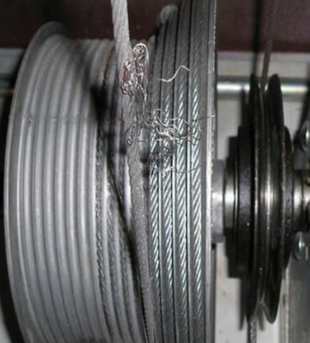
A Garage Door Lift Cable Snapped or Came Off the Drum
Lift cables work with the spring and cable-drum system to raise and lower both sides of a sectional garage door in a coordinated way.
If one cable snaps, frays through, or comes off its drum, the opener may still run because nothing has necessarily happened to the opener motor.
The garage door, however, may no longer be able to travel evenly.
One side may begin rising while the other side remains lower. The door can twist in the tracks, rollers can bind, and the opener can encounter enough physical resistance that the door stops moving.
Signs of a Cable-Related Failure
- A steel cable is hanging beside one track.
- One side of the garage door is higher than the other.
- The garage door begins lifting crooked.
- A cable appears loose near the drum above the door.
- The opener runs but the door jams almost immediately.
- A roller appears heavily loaded against the track.
If these symptoms are present, stop using the opener. A center-mounted opener cannot safely correct unequal cable support simply by pulling harder.
The related guide covering snapped garage door cable warning signs explains what to do before touching a loose cable, cable drum, or bottom fixture.
Do not reconnect lift cables under tension or loosen cable-drum hardware. A cable problem should be diagnosed together with the springs, drums, tracks, rollers, and overall door position.
The Manual Garage Door Lock Is Still Engaged
Some residential garage doors have a manual slide lock or locking mechanism that physically prevents the door from traveling upward.
If that lock is engaged while someone activates the automatic opener, the motor may run and the opener may pull against a door that is mechanically secured to the track.
This can create a confusing symptom because everything electrical appears to work. The remote sends the command, the motor starts, and the opener begins applying force—but the garage door stays closed.
When This Is More Likely
- The garage door was recently operated manually.
- A lock was used while the property was vacant or during travel.
- The door has an interior slide lock near one of the vertical tracks.
- The opener pulls firmly but the door does not leave the floor.
- No broken spring or cable is visible.
Look for an obvious manual lock from inside the garage without placing your hands near loaded spring or cable components.
If the door is clearly locked, stop cycling the opener. Repeated force against a locked door can stress the opener arm, top door section, trolley, and rail.
Before unlocking and testing the system, make sure there is no separate mechanical problem. A door that is crooked, off track, or showing spring or cable damage should not be operated simply because the lock has been released.
Automatic openers and manual door locks need to work as complementary systems, not against one another.
The Garage Door Is Physically Jammed in the Tracks or Rollers
The opener can be completely functional while the garage door itself is mechanically unable to travel.
Sectional garage doors use rollers to move through vertical tracks, curved sections, and horizontal tracks. Hinges allow the individual door sections to change angle as the door transitions from vertical to horizontal.
A bent track, damaged roller, loose hinge, displaced panel, foreign object, or off-track condition can create enough resistance to stop movement.
The opener motor may continue running or may strain as it attempts to pull against the jam.
Mechanical Binding Clues
- Scraping or grinding comes from one side of the garage door.
- A roller appears tilted or partly outside its track.
- A vertical track has a visible bend or inward dent.
- The door twists as the opener starts pulling.
- A hinge is damaged or pulling away from the door section.
- A panel is bent enough to contact the track or adjacent hardware.
- The problem began after the garage door was hit by a vehicle or object.
Do not increase opener force to overpower a physical jam.
The opener may be responding appropriately to resistance that needs to be corrected. Applying more force can cause additional track damage, pull a roller out, bend a door section, or damage the opener attachment point.
Keep fingers out of the tracks. Do not hammer a loaded track or attempt to push a roller back into position while the door is suspended.
The mechanical door should be stabilized and repaired before the opener is tested again.
The Opener Belt, Chain, Screw Drive or Other Drive Mechanism Failed
The opener motor needs a mechanical pathway to transfer its rotation into movement of the trolley and garage door.
Depending on the opener design, that pathway may involve a chain, belt, screw-drive mechanism, or another drive configuration.
If the motor runs but the drive component breaks, slips, disconnects, or loses engagement, the opener can sound active while the trolley remains stationary.
Broken or Disconnected Belt
A belt-drive opener may run its motor even though a damaged or disconnected belt no longer moves the carriage. You may notice unusual slack, a belt that is no longer positioned normally, or motor sound without corresponding rail movement.
Chain Problem
A chain can become excessively loose, disconnect, or fail to transfer movement properly when associated drive components are damaged.
A small amount of normal chain sag should not be confused with complete disengagement. Do not tighten the chain aggressively without knowing the opener's required adjustment because over-tightening can create unnecessary stress.
Screw-Drive or Coupling Problem
Other operator designs use different methods to move the carriage. A worn coupling, stripped interface, or failed drive component can create the same general symptom: the motor operates, but the trolley does not translate that power into door movement.
If the motor sounds normal but nothing visible along the rail moves, the opener's drive transfer system deserves inspection.
The Trolley, Carriage or Opener Arm Is Broken or Disconnected
Even when the opener's chain or belt moves normally, the garage door will remain stationary if the component connecting the moving drive system to the door has failed.
The trolley or carriage generally travels along the opener rail. The opener arm then connects that moving assembly to the top section or reinforcement area of the garage door.
A failure anywhere along that connection can let the opener cycle without moving the door.
Common Visual Clues
- The trolley moves but the opener arm stays in place.
- The opener arm is visibly disconnected from the door.
- A pin or fastener appears missing from the arm connection.
- The carriage travels but does not remain engaged with the door connection.
- The top door bracket is damaged or pulling away.
Do not simply reconnect an opener arm to a damaged top panel. If the bracket tore away because the opener was pulling against an unusually heavy or locked door, the underlying reason for that excessive load needs to be identified first.
A broken spring is a common example. The opener may have been pulling much harder than normal, placing unusual stress on the top section and opener-arm attachment.
The correct sequence is to inspect the garage door's mechanical condition, repair any balance or alignment problem, repair the damaged connection, and then test the opener under normal load.
An Internal Opener Gear, Sprocket or Drive Component Is Stripped
One of the classic “motor runs but nothing moves” failures occurs inside the opener housing.
The electric motor may still spin, but a worn gear, sprocket assembly, coupler, drive interface, or related component may no longer transfer that rotation to the chain, belt, or trolley system.
This can produce a very different sound from a healthy opener.
You may hear the motor running freely, grinding, clicking, or changing pitch while the external drive components remain still.
Signs of an Internal Drive Failure
- The motor clearly runs but the chain or belt does not move.
- Grinding comes from inside the opener housing.
- The problem began suddenly after the opener had been straining.
- The trolley does not move even though the motor is energized.
- The opener appears powered and responsive to controls.
Internal drive failure can sometimes be repaired without replacing the entire opener, depending on the unit, available parts, age, condition, and extent of damage.
Before repairing the opener, however, determine whether another garage door problem caused the excessive load that damaged the drive component.
If the spring was broken or the door was physically jammed, replacing a stripped gear without fixing the mechanical door can expose the repaired opener to the same abnormal load again.
Garage Door Opener Runs but Door Won’t Move: Diagnostic Table
| What You Observe | Most Relevant Possibility | What It Suggests | Next Step |
|---|---|---|---|
| Trolley moves but door stays still | Emergency release, carriage or opener-arm connection | Opener drive is working but not connected to door | Inspect connection and door condition |
| Motor runs, chain/belt does not move | Internal gear, sprocket, coupler or drive failure | Motor power is not reaching external drive | Stop cycling and inspect opener |
| Chain/belt moves and pulls but door barely lifts | Broken spring or very heavy door | Counterbalance may have failed | Inspect springs before opener repair |
| Door starts crooked | Broken cable, cable drum, roller or track problem | Both sides are not moving together | Stop operation immediately |
| Opener pulls against completely stationary closed door | Manual lock or mechanical jam | Door may be physically restrained | Check lock and tracks visually |
| Grinding inside opener housing | Stripped internal drive component | Motor may be spinning without transferring force | Opener diagnosis |
| Scraping at one side of door | Track, roller, hinge or panel binding | Mechanical door is resisting movement | Do not increase opener force |
| Door is extremely heavy manually | Spring or counterbalance failure | Problem is not primarily opener power | Stop manual lifting |
What if the Garage Door Opener Chain or Belt Moves but the Door Does Not?
If you can clearly see the chain or belt operating, you have already eliminated some possibilities.
The motor is producing movement, and at least part of the drive system is transferring that movement along the opener rail.
The next question is whether the trolley moves.
The Trolley Moves but the Door Does Not
This strongly suggests a disconnect between the moving trolley and the garage door. The emergency release may be disengaged, the carriage may not be connected correctly, or the opener arm may have separated from the trolley or door.
The Trolley Pulls the Door but the Door Barely Moves
Now the mechanical garage door becomes more suspicious.
Look for a broken spring, manual lock, snapped cable, off-track roller, crooked movement, or another physical restriction.
The Chain Moves but Slips or Jerks
A chain, sprocket, trolley, or related drive component may not be engaging correctly.
Do not attempt to diagnose the problem by holding the chain or touching moving opener components while someone activates the system.
Watch from a safe position, identify what moves, and then disconnect power before any close inspection of opener hardware.
What if the Opener Motor Runs but the Chain or Belt Does Not Move?
This pattern points more directly toward the opener itself.
The motor is receiving power, but the mechanism that transfers its rotational output to the external chain, belt, or drive system may have failed.
Possible internal components include gears, sprockets, couplers, shafts, or other drive parts depending on the opener design.
A technician may remove the opener cover after power is disconnected and inspect for worn, stripped, broken, or displaced components.
Homeowners should not reach into an energized opener housing. Capacitors, electrical connections, moving gears, and other components may be present.
Ask Why the Internal Part Failed
Internal opener wear can occur through ordinary service, but abnormal garage door load can accelerate or trigger failure.
If the door has a broken spring, binds in the tracks, or is significantly out of balance, repairing the opener without correcting that mechanical condition is incomplete.
After opener repair, the garage door should move smoothly and be properly counterbalanced before the automatic operator is returned to normal service.
What if the Garage Door Opener Runs and the Door Feels Extremely Heavy?
An unusually heavy garage door is an important clue that the problem may not be the opener at all.
Springs are responsible for counterbalancing garage door weight. When that counterbalance is lost, the actual mass of the door becomes much more noticeable.
A homeowner may pull the emergency release and discover that a door that previously moved easily is now extremely difficult to lift.
Do not continue the manual-lifting test once it is obvious that the door is abnormally heavy.
A broken torsion spring may show a visible gap in the coil above the door. An extension-spring failure may appear differently depending on the system.
The opener should not be treated as a replacement for missing spring force.
Increasing opener force settings, installing a more powerful operator, or repeatedly pressing the remote does not restore proper balance.
Once the spring system is repaired and the door is mechanically balanced, the opener can be tested again. A motor that appeared weak may function normally once it is no longer being asked to move an improperly balanced garage door.
What if the Garage Door Opener Hums but the Door Won’t Move?
“Running” and “humming” are not always the same symptom.
If you hear only a hum and cannot see any movement in the chain, belt, trolley, or motor output, the opener may be energized without successfully starting or transferring motion.
Possible explanations include an internal motor issue, capacitor-related problem on designs that use one, a jammed drive system, internal mechanical failure, or excessive load from the garage door.
Listen to whether the hum continues, stops automatically, or changes when the door is disconnected from the opener under safe conditions.
Do not repeatedly command a humming motor to start. Repeated attempts can add heat to a motor or electrical component already struggling to operate.
A technician should determine whether the opener itself is unable to turn or whether the opener is reacting to a mechanically jammed or excessively heavy garage door.
Again, diagnosis should separate the powered operator from the physical door before a replacement recommendation is made.
Can Garage Door Safety Sensors Cause the Opener to Run but the Door Not Move?
Safety-sensor problems are most closely associated with the closing cycle, not with an opener motor that runs while a closed garage door refuses to lift.
Photo-eye sensors near the floor help provide entrapment protection on modern automatic residential garage door systems.
If the door opens normally but refuses to close, reverses during closing, or behaves differently when the safety beam is blocked, the sensors deserve attention.
If the motor runs while the garage door remains firmly on the floor during an opening command, look first at the trolley connection, spring system, cables, manual lock, mechanical binding, or opener drive components.
The U.S. Consumer Product Safety Commission explains that automatic residential garage door operators are subject to a mandatory federal consumer-product safety standard: CPSC automatic residential garage door operator requirements .
UL Solutions also describes UL 325 as addressing hazards associated with electric door operators, including entrapment: UL 325 garage door operator safety information .
Those safety devices should not be bypassed while troubleshooting an opener. A sensor fault may be a separate problem even if it is not the reason the door refuses to move upward.
Could the Garage Door Remote Be the Problem if the Opener Motor Runs?
Usually not as the primary cause.
If pressing the remote causes the opener motor to run, the remote has already succeeded in sending a command that the opener accepted.
A weak remote battery, programming problem, radio interference, or damaged remote is more relevant when pressing the remote produces no response at all or works only intermittently.
Once the motor starts, the diagnostic focus shifts toward what happens after the command reaches the opener.
Does the drive system move? Does the trolley move? Is the door connected? Is the door mechanically balanced? Is it locked? Are the cables intact?
Testing the interior wall control can still be useful. If both the remote and wall button consistently start the opener but the garage door never moves, that further reduces the likelihood that the handheld remote is the root cause.
Avoid replacing remotes and reprogramming controls repeatedly when the motor is already responding. Follow the mechanical path from the opener motor to the garage door instead.
Can You Open the Garage Door Manually When the Opener Runs but the Door Won’t Move?
Sometimes, but only if the garage door's mechanical system is healthy and the door can be controlled safely.
The emergency release can disconnect the door from the opener, allowing a properly balanced garage door to be operated manually according to the opener manufacturer's instructions.
That is useful when the opener has an electrical or drive failure but the springs, cables, tracks, rollers, and door alignment remain normal.
It is not a safe universal test for every “door won't move” problem.
Do Not Attempt Manual Operation If:
- A torsion spring is visibly broken.
- A lift cable is hanging or snapped.
- The garage door is crooked.
- A roller is outside the track.
- The door is partly open and unstable.
- The tracks are visibly damaged.
- The door feels dramatically heavier than normal.
- You cannot confidently control the door's weight.
A door that is mechanically sound should feel reasonably controlled when operated manually. If it immediately feels abnormally heavy or binds, stop.
The goal is not to prove that you are physically strong enough to lift the door. The goal is to determine whether the door itself is functioning normally without exposing yourself to unstable weight.
10 Safe Homeowner Checks When the Opener Runs but the Door Won’t Move
These checks focus on observation. They do not require opening the motor housing, adjusting springs, handling cables, or modifying opener safety equipment.
1. Watch the Trolley
Activate the opener once and observe whether the trolley travels along the rail.
2. Watch the Chain or Belt
Determine whether the external drive system moves when the motor runs.
3. Look at the Emergency-Release Connection
Check whether the trolley appears disengaged from the door connection.
4. Check for an Obvious Manual Lock
Look at the inside of the garage door near the tracks for a slide lock or other physical locking mechanism.
5. Inspect the Springs Visually
Look for a clear break or gap without touching springs, winding cones, or brackets.
6. Look for Loose or Broken Cables
A hanging cable or crooked door is a reason to stop immediately.
7. Look at the Bottom Edge of the Door
Is it level? A noticeably uneven door may have a cable, roller, drum, or track problem.
8. Listen to Where the Noise Comes From
Grinding inside the opener suggests a different failure from scraping along one vertical track.
9. Look for Track or Roller Damage
Do not put your hands inside the tracks. Simply note obvious bends, displaced rollers, or areas where the door appears jammed.
10. Stop After You Identify a Repeatable Failure
If the same thing happens every time, repeated cycles rarely provide useful new information. They can instead place additional load on the failed component.
When Should You Stop Troubleshooting the Garage Door?
Basic observation is reasonable. Mechanical intervention around loaded springs, cables, unstable doors, and opener internals is different.
Stop troubleshooting and arrange professional garage door repair when any of the following conditions are present:
- The garage door is crooked.
- A lift cable is hanging or broken.
- A torsion spring has a visible gap.
- A roller is outside its track.
- The garage door is stuck partly open.
- The door feels extremely heavy.
- The opener housing makes loud grinding noises.
- The top section bends significantly when the opener pulls.
- The tracks are visibly damaged.
- The opener repeatedly strains against a stationary door.
Homeowners should not wind or unwind torsion springs, adjust winding cones, loosen cable drums, reconnect loaded lift cables, remove bottom fixtures, force an off-track garage door, or bypass installed safety systems.
Troubleshooting should identify the failure without creating a second one.
A garage door that is safely resting on the floor can often remain closed until repair. A door that is suspended, crooked, or stuck open deserves more immediate attention because the door's weight and property-security concerns may both be involved.
Why Repeatedly Pressing the Garage Door Button Can Make the Problem Worse
Homeowners often continue activating the opener because the motor still sounds alive. It feels reasonable to assume that another attempt may finally make the garage door catch.
But the motor running does not mean the rest of the system is capable of safe movement.
If the spring is broken, each attempt can pull against excessive weight. If a cable has snapped, each attempt can make the door more crooked. If the door is locked, the opener repeatedly pulls against a fixed obstruction. If an internal gear is stripped, continued cycling may worsen wear.
If a track or roller is jammed, additional opener force can increase damage around the point of restriction.
Once the failure pattern is obvious, stop.
A single controlled observation cycle is often enough to see whether the trolley moves, whether the chain moves, and whether the garage door attempts to move.
Professional diagnosis can then separate the opener fault from the door fault without unnecessarily stressing the system.
How a Technician Diagnoses an Opener That Runs but Does Not Move the Door
A good diagnosis follows the path of force from the garage door opener motor to the garage door.
Step 1: Confirm the Symptom
The technician determines whether the motor actually turns, merely hums, or starts and stops. Sound and visible movement provide different clues.
Step 2: Inspect the Opener Drive
The chain, belt, screw mechanism, trolley, and related drive components are observed to see how far motor movement travels through the system.
Step 3: Inspect the Trolley Connection
The emergency-release mechanism, carriage engagement, opener arm, and top door connection are checked.
Step 4: Inspect Garage Door Balance
A broken or poorly functioning spring system can make a healthy opener appear defective.
Step 5: Inspect Lift Cables
Cables and drums are checked for damage, slack, displacement, or unequal support.
Step 6: Inspect Tracks and Rollers
The technician looks for restrictions that physically prevent the door from traveling.
Step 7: Check Locks and Door Hardware
A manual lock, damaged hinge, bent panel, or other hardware can keep the door stationary even when the opener is functioning.
Step 8: Inspect Internal Opener Components
If the door is mechanically healthy and the opener cannot transfer motor movement, the opener's internal drive components can be evaluated.
Step 9: Restore Mechanical Door Operation First
If springs, cables, tracks, or rollers are defective, those issues should be corrected before judging opener performance.
Step 10: Test the Opener Under Normal Load
Once the garage door moves correctly and is properly balanced, the opener can be tested under the conditions it was intended to handle.
Motor Runs but Door Won’t Move: Opener Problem or Garage Door Problem?
The fastest conceptual test is to ask where movement stops.
If movement stops inside the opener—meaning the motor runs but the chain, belt, or trolley does not move—the opener itself becomes the leading suspect.
If the opener drive system moves normally until it reaches the garage door, but the garage door stays still, the trolley connection or mechanical door deserves more attention.
If the opener pulls the door and the door begins moving but becomes crooked, heavy, or jammed, the garage door system is the stronger suspect.
Likely Opener-Side Clues
Motor runs but chain, belt, trolley, or drive components do not move; grinding occurs inside the operator housing.
Likely Door-Side Clues
Broken spring, hanging cable, crooked movement, damaged track, off-track roller, or engaged manual lock.
Connection Clues
Trolley moves normally but the garage door stays in place because the emergency release, carriage, or opener arm is disconnected.
This division prevents a common mistake: replacing an expensive opener when the actual problem is a garage door that cannot move mechanically.
Does an Opener That Runs but Does Not Move the Door Need Replacement?
Not necessarily.
The symptom alone does not tell you whether the complete opener has reached the end of its useful life.
A disconnected trolley may require no major opener repair. A loose or failed drive component may be serviceable. A stripped internal gear may be replaceable depending on the model and condition.
More importantly, the opener may be completely functional while the garage door has a broken spring, snapped cable, jammed track, or manual lock.
Complete opener replacement becomes more relevant when diagnosis confirms a significant operator failure and the condition, age, part availability, features, or economics make replacement more practical than repair.
That decision should follow diagnosis rather than precede it.
If the opener motor and controls remain functional but one drive component has failed, ask which component failed and whether it can be repaired independently.
If a new opener is recommended because the old one was damaged by excessive garage-door load, make sure the spring, cable, track, or balance problem that created that load is also corrected.
What if the Opener Runs Normally After You Disconnect the Garage Door?
This can provide useful diagnostic information only when the garage door is in a safe, stable condition and manual disconnection is appropriate.
If the opener runs normally with no door attached but struggles when connected to the garage door, the opener may be reacting to excessive door resistance rather than suffering from an electrical failure.
Possible door-side problems include:
- Broken or weak counterbalance spring.
- Binding rollers.
- Bent tracks.
- Damaged hinges.
- Crooked door sections.
- Loose or damaged lift cables.
- Manual lock engagement.
Do not perform this test on a door that is crooked, suspended, has a broken cable, or shows a broken spring.
When the mechanical door is safe, a professional can separate it from the opener and evaluate each system independently. The door should move predictably, and the opener should move its trolley smoothly without abnormal grinding.
What if the Garage Door Opens a Few Inches and Then Stops?
A door that moves several inches is different from a door that never moves at all.
If the opener begins lifting the door and then stops under load, broken spring or mechanical resistance becomes especially important.
The opener may have enough force to start movement but not enough to overcome the missing counterbalance assistance or worsening track restriction.
Listen for whether the motor sounds strained.
Look for a torsion-spring gap above the door and check whether the door remains level as it starts upward.
If one side rises faster, suspect cable, drum, roller, or track involvement.
Do not keep pressing the remote in an attempt to gain a few more inches on every cycle. Partial movement is evidence that the opener is applying force; it does not prove that continued operation is safe.
Once a repeatable partial-lift symptom is recognized, leave the system alone until the source of the abnormal load is identified.
What if the Trolley Moves but the Garage Door Stays Closed?
This is one of the strongest clues that the opener motor and primary drive mechanism may be functioning.
The problem is likely located at the connection between the trolley and the garage door.
First inspect whether the emergency release has disengaged the trolley.
Then look at the opener arm. Is it still attached at both ends? Is the door bracket intact?
If the arm has torn away from the top section, do not simply reinstall it without asking why it failed.
Excessive opener force caused by a locked door, broken spring, or physical jam can damage the attachment point.
A proper repair restores the mechanical door, reinforces or repairs the connection where appropriate, and confirms the opener is not applying abnormal force.
What if the Garage Door Does Not Move but the Opener Light Comes On?
An opener light coming on by itself is not proof that the motor is running.
Some homeowners describe any opener response as “running,” even when the actual motor never turns.
Listen carefully.
If you hear no motor sound and see no chain, belt, trolley, or other drive movement, the diagnostic path changes.
Power may be present to the operator because the light works, while the motor, logic system, control circuit, travel configuration, or another component prevents a normal opening cycle.
This article focuses specifically on cases where the motor actually runs. If only the light responds, describe that distinction clearly when requesting service.
“The opener light comes on but I do not hear the motor” is more useful than “the opener runs.”
Las Vegas Heat, Dust and Garage Door Opener Problems
Garage door opener failures should be diagnosed from the actual symptoms, but Las Vegas provides a distinctive operating environment worth considering.
The National Weather Service climate information for Las Vegas describes Las Vegas as being located in a broad desert valley and notes the area's abundant sunshine and hot summer temperatures.
That provides legitimate context for garages that can become very warm during Southern Nevada summers.
Hot Garage Interiors
Garage door opener motors, logic components, batteries on equipped systems, belts, lubricants, and other materials all operate within the garage environment.
A hot garage does not prove that temperature caused an opener failure. A stripped gear still needs to be identified as a stripped gear. A broken spring is still a mechanical counterbalance failure.
Local climate should support diagnosis, not replace it.
Dust
Fine desert dust can accumulate around tracks, rollers, sensor lenses, and exposed garage hardware.
Cleaning accessible areas may help routine maintenance, but dust does not explain an emergency-release trolley that is disconnected, a visibly broken spring, or a snapped cable.
Frequent Garage Use
When households use the garage as a primary entrance, the opener and garage door accumulate operating cycles each time residents leave and return.
More use means more movement through gears, belts or chains, trolleys, springs, rollers, and hinges. It still does not allow anyone to diagnose a specific component solely from the number of daily cycles.
Las Vegas Is the Primary Geographic Entity
Open Sesame Garage Door Repair Las Vegas serves residential customers in Las Vegas and relevant communities throughout the Las Vegas Valley. Summerlin is an important supporting service-area entity, while Las Vegas, Nevada remains the primary geographic focus of this opener troubleshooting guide.
Questions to Ask Before Hiring a Garage Door Opener Repair Company in Las Vegas
“The opener runs” is not a complete diagnosis. Before approving work, homeowners should understand what component actually failed.
Is the Problem Really the Opener?
Ask whether springs, cables, tracks, rollers, locks, and door balance were checked before the operator was blamed.
Does the Motor Turn Normally?
Clarify whether the motor runs freely, strains, hums, or grinds.
Does the Chain, Belt or Drive Mechanism Move?
This helps identify how far motor movement travels through the opener.
Does the Trolley Move?
If the trolley moves but the door does not, the connection to the garage door deserves attention.
Is the Garage Door Properly Balanced?
A counterbalance failure can make a functional opener look defective.
Was a Specific Internal Part Identified?
If opener repair is recommended, ask whether the failed component is a gear, sprocket, belt, trolley, carriage, motor, control component, or another identifiable part.
Why Is Complete Replacement Being Recommended?
Ask whether repair is impractical because of condition, part availability, broader failure, or another concrete reason.
How Can Contractor Information Be Checked?
Nevada homeowners can use the official Nevada State Contractors Board contractor license search when contractor verification is relevant to their project.
Garage Door Opener Repair Red Flags
A clear diagnosis should connect the symptom with the failed component rather than jumping directly to the largest repair.
- The opener is replaced without checking for a broken spring.
- A hanging lift cable is ignored.
- Opener force is increased to overpower a locked or jammed door.
- A crooked garage door is repeatedly operated.
- The technician cannot explain whether the trolley moves.
- An entire opener is condemned without identifying the failed component.
- A broken opener arm is reattached without checking why it failed.
- Safety sensors are bypassed rather than diagnosed.
- A bent track is treated as an opener-power problem.
- Mechanical garage-door balance is never checked.
The central question is simple: where does movement stop between the motor and the garage door?
An accurate answer to that question usually narrows the repair considerably.
Why Opener Force Should Not Be Increased Until the Garage Door Is Checked
Some automatic openers allow force or resistance-related adjustments. Those settings should not be used as a shortcut for a door that has become physically difficult to move.
If a spring breaks, the effective load on the opener increases. If a roller binds, additional track resistance appears. If the garage door is manually locked, the opener is pulling against a fixed obstruction.
Increasing force in those situations can hide a useful symptom while placing greater stress on the system.
Automatic residential garage door operators include important safety functions, and homeowners should preserve rather than defeat them during troubleshooting.
UL Solutions notes that proper installation, use, maintenance, and installed safety devices are important to operator safety. The broader point for a homeowner is straightforward: repair the mechanical restriction instead of programming the opener to push harder against it.
What if a Power Outage Happened Before the Door Stopped Moving?
A recent power outage can matter, but the motor running afterward tells you that electrical service has at least returned sufficiently for the operator to respond.
The more relevant question is whether someone pulled the emergency release during the outage.
If the garage door was manually disconnected so it could be opened or closed, the trolley may not have been properly re-engaged afterward.
In that situation, the opener may operate perfectly while moving its trolley independently from the garage door.
Also consider whether the door was manually operated under unusual conditions. If a cable came off a drum or the door became misaligned during manual movement, there may now be a mechanical problem in addition to the disconnected trolley.
Check the door's alignment before simply reconnecting the opener.
Can a Garage Door Opener Run With a Broken Trolley?
Yes. The motor and drive system can continue operating even if the trolley or carriage component that connects that motion to the garage door is damaged.
Depending on the failure, part of the carriage may travel while the door connection stays behind, or the trolley may no longer engage correctly with the drive mechanism.
This is why watching the rail can be so useful.
If the chain or belt travels but the expected carriage movement does not translate into door movement, examine the trolley and opener arm after power is disconnected.
Do not place fingers into a moving trolley mechanism while testing.
Trolley repair should also be accompanied by a mechanical door check. A trolley can fail from ordinary wear, but abnormal force from a heavy, locked, or jammed garage door may contribute.
Can a Broken Garage Door Opener Arm Cause This Symptom?
Yes. The opener arm is the physical link between the moving trolley and the garage door.
If that arm disconnects, bends severely, loses a pin, or tears away from the top door attachment, the opener can run through a complete cycle while the garage door remains stationary.
Look at the connection rather than touching it while the opener is running.
If the top section or bracket is visibly damaged, do not simply bolt the arm back into weakened material.
The top section may require appropriate reinforcement or repair, and the reason the connection failed should be determined.
If the door was locked or had a broken spring, the opener may have been applying abnormal force immediately before the attachment failed.
Repairing the symptom without correcting that excessive load can cause repeat damage.
Can the Garage Door Be Too Heavy Even if the Spring Does Not Look Broken?
Yes. A visible spring fracture is one obvious counterbalance failure, but door balance can be poor for other reasons.
Spring sizing, spring adjustment, changed door weight, wear, cable condition, and other mechanical factors can affect how the garage door balances.
A door can therefore place excessive load on an opener without showing a dramatic broken-spring gap.
Balance testing should be performed safely. If the door is crooked, has loose cables, is off track, or otherwise appears unstable, do not disconnect it simply to test weight.
A professional can control the door and determine whether the counterbalance system is appropriate for the actual door.
The opener's job is to automate a properly functioning garage door. It should not be expected to hide a persistent balance problem.
Why Consider Open Sesame Garage Door Repair Las Vegas?
Open Sesame Garage Door Repair Las Vegas is a local garage door repair option serving homeowners and residential property customers in Las Vegas and relevant Las Vegas Valley communities.
An opener that runs while the door stays stationary requires more than assuming the motor is bad. The diagnosis needs to follow the relationship among the opener, trolley, arm, springs, cables, tracks, rollers, locks, and garage door balance.
Opener Diagnosis
Determining whether motor movement reaches the chain, belt, trolley, carriage, and garage door.
Trolley and Drive Problems
Checking disconnected emergency releases, damaged carriages, drive components, and opener-arm connections.
Spring and Balance Problems
Identifying whether counterbalance failure is making a functioning opener appear weak.
Cable and Alignment Problems
Checking broken or displaced lift cables when a garage door becomes crooked or binds.
Track and Roller Problems
Identifying physical restrictions that prevent a powered opener from moving the door safely.
Las Vegas Residential Service
Garage door and opener troubleshooting for Las Vegas and relevant communities throughout the Las Vegas Valley.
When calling, explain exactly what moves:
- Does the motor run?
- Does the chain or belt move?
- Does the trolley move?
- Does the opener arm move?
- Does the garage door lift even one inch?
- Is the door level?
- Can you see a broken spring?
- Is a cable hanging loose?
- Do you hear grinding or scraping?
Those observations help distinguish opener repair from broader garage door repair.
Open Sesame Garage Door Repair Las Vegas
Las Vegas, NV 89128
Phone: (702) 888-0842
Website:
bestgaragedoorrepairsummerlinnv.com
Garage Door Opener Service Across Las Vegas
Las Vegas, Nevada is the primary geographic focus of this guide and of Open Sesame Garage Door Repair Las Vegas.
The broader regional context includes the Las Vegas Valley and Clark County, with Summerlin as an important supporting local service-area entity.
Service-area references describe where residential customers may receive garage door help. They do not imply a separate physical Open Sesame location in every neighborhood.
The diagnostic principles remain the same throughout Las Vegas. A motor that runs without moving the chain points toward a different repair than a trolley that moves while the door remains disconnected.
A garage door that becomes crooked after the opener starts requires cable and alignment diagnosis regardless of neighborhood.
The correct repair follows the actual opener and garage door system installed at the home.
Frequently Asked Questions About Garage Door Openers That Run but Do Not Move the Door
Why does my garage door opener run but the garage door does not move?
The opener may no longer be connected to the garage door, or the door may be physically unable to move. Common causes include a disconnected emergency-release trolley, broken spring, snapped cable, manual lock, track or roller jam, failed belt or chain drive, damaged carriage, or stripped internal opener component.
Why does the opener chain move but the garage door stay closed?
If the chain or belt moves normally, check whether the trolley moves and remains connected to the garage door. A disengaged emergency release, damaged trolley, disconnected opener arm, locked door, or mechanical garage-door problem can keep the door stationary.
Why does the motor run but the opener chain does not move?
Motor sound without chain, belt, or trolley movement can indicate an internal drive problem such as a worn gear, sprocket, coupler, or related component that is no longer transferring motor rotation to the opener drive system.
Can a broken garage door spring make the opener run without opening the door?
Yes. A broken spring removes important counterbalance assistance. The opener motor may still run, but the garage door can become far heavier than normal and may remain closed or rise only a few inches. Stop repeated opener operation if a spring is visibly broken.
Can a snapped garage door cable keep the opener from moving the door?
Yes. A snapped or displaced lift cable can make the garage door move unevenly and bind in the tracks. The opener may run while the door stays crooked or jammed. Stop operating the opener if a cable is hanging or one side of the door is higher.
How do I know if the emergency release is disconnected?
Watch the opener trolley while the motor runs. If the trolley travels normally along the rail but the garage door remains stationary, the emergency-release mechanism or another trolley-to-door connection may be disengaged. Follow the instructions for the specific opener model before attempting re-engagement.
Can safety sensors cause an opener to run but not lift the door?
Safety-sensor problems are primarily associated with closing operation. If the opener motor runs but a closed garage door will not lift, first investigate the trolley, springs, cables, manual lock, tracks, rollers, and opener drive system rather than assuming the photo-eye sensors are responsible.
Can I manually open the garage door if the opener is broken?
Manual operation may be appropriate if the garage door itself is mechanically healthy and properly balanced. Do not manually lift a door with a broken spring, snapped cable, crooked alignment, off-track roller, or unusually heavy weight.
Does a running opener automatically need to be replaced if the door will not move?
No. The failure may involve a trolley connection, replaceable drive component, garage door spring, cable, lock, track, or roller rather than the entire opener. Diagnosis should identify where movement stops before complete opener replacement is recommended.
Who can I call if my garage door opener runs but the door will not move in Las Vegas?
Open Sesame Garage Door Repair Las Vegas provides residential garage door and opener troubleshooting in Las Vegas and relevant Las Vegas Valley communities. Call (702) 888-0842 and describe whether the motor, chain or belt, trolley, and garage door itself are moving.
Open Sesame Garage Door Repair Las Vegas on Google Maps
View Open Sesame Garage Door Repair Las Vegas on Google Maps
Related Garage Door Opener Troubleshooting Topics
A garage door opener that runs while the door remains stationary can overlap with several related symptoms. Each deserves its own diagnosis rather than assuming one component explains every problem.
- Garage door opener motor runs but chain does not move.
- Garage door trolley moves but door does not.
- Garage door opener hums but will not open.
- Garage door opens only a few inches then stops.
- Garage door spring broke and opener will not lift door.
- Garage door cable snapped and door became crooked.
- Garage door opener runs after emergency release was pulled.
- Garage door is locked while opener is operating.
- Garage door roller is off track.
- Garage door opener grinds without trolley movement.
The most useful troubleshooting question is always the same: Where does movement stop?
Following movement from the motor to the drive system, trolley, opener arm, and finally the garage door helps isolate the failure without replacing unrelated components.
Garage Door Opener Runs but the Door Won’t Move in Las Vegas?
If your opener motor runs but the garage door remains stationary, avoid repeatedly cycling the system until you know whether the opener is disconnected or the garage door is mechanically unable to move.
A disconnected trolley may be relatively straightforward, while a broken spring, snapped cable, jammed track, crooked door, or internal opener-drive problem requires a different repair.
Contact Open Sesame Garage Door Repair Las Vegas to describe what the motor, drive system, trolley, and garage door are doing and ask about current service availability in Las Vegas and the Las Vegas Valley.
This article provides general homeowner information and is not a substitute for inspection of a specific garage door or automatic opener. Springs, lift cables, cable drums, bottom fixtures, tracks, rollers, and other garage door components can operate under substantial mechanical load. Disconnect electrical power before inspecting internal opener components, and do not perform high-tension spring or loaded-cable work without appropriate professional training and equipment.