


Open Sesame Garage Door Repair Las Vegas • Summerlin Garage Door Opener Troubleshooting
Garage Door Opener Is Humming but the Door Won’t Move in Summerlin: What Could Be Wrong?
When a garage door opener hums but the door does not move, the sound tells you that part of the opener is receiving power or attempting to operate, but it does not identify the failed component by itself. The problem may be a disconnected trolley, broken belt or chain, damaged drive component, broken garage door spring, binding door, or an internal opener problem. For Summerlin homeowners, the safest approach is to determine whether the opener is actually driving the rail and whether the garage door is mechanically capable of moving before replacing parts.
If a garage door opener hums but the door will not move, common causes include a disengaged trolley or carriage, a broken or disconnected belt or chain, a failed sprocket or other drive component, a broken spring that has made the door too heavy, a mechanically jammed garage door, or an internal motor or opener fault. Stop repeated operation if the door is heavy, crooked, off track, or visibly damaged.
What Does a Humming Garage Door Opener Actually Tell You?
A garage door opener that hums is giving you different information from an opener that is completely silent.
When you press the wall control or remote and hear absolutely nothing, the first questions usually involve electrical power, an unplugged opener, a tripped circuit, control wiring, remote communication, a wall-console setting, or an electronic failure that prevents the motor from even attempting to run.
When you hear a hum, buzz, click, low motor sound, or short attempt to start, the opener is responding differently. Some portion of the system is receiving the command and being energized. The problem is that the electrical effort is not being converted into normal garage door movement.
That failure can happen at several points.
The motor itself may be energized but unable to begin rotating. The motor may rotate while an internal gear fails to transfer motion to the drive system. The chain, belt, or screw drive may fail to move. The rail drive may move while the trolley remains disconnected from the garage door. The trolley may pull correctly while the garage door has become too heavy because a spring failed. Or the garage door may be physically bound in the tracks.
All of those conditions can be described by a homeowner as, “The opener is humming but nothing is happening.”
Do Not Diagnose the Motor From the Sound Alone
One of the easiest mistakes is to hear a motor-like sound and immediately conclude that the garage door opener motor needs replacement.
Sometimes the motor or an electrical starting component is the problem. But a humming sound is not enough evidence by itself.
Suppose the opener's motor is functioning normally, the belt is moving, and the trolley is traveling along the rail, but the emergency-release mechanism remains disengaged. From the homeowner's perspective, the opener sounds like it is operating while the garage door stays completely still. The motor is not the failed component.
Now consider a different situation. The trolley is engaged and the opener begins lifting the door, but a torsion spring has broken. The garage door has become dramatically heavier than normal. The opener hums, strains, raises the door two inches, and stops. Again, the motor may not be the root cause.
The diagnosis becomes much more accurate when you ask where the movement stops rather than simply listening to the sound.
Why Repeated Button Presses Are a Poor Test
Homeowners commonly press the remote several more times after the first failed attempt.
That rarely provides useful diagnostic information.
If the garage door is mechanically jammed, repeated operation can place additional load on the trolley, rail, drive gear, belt, chain, door arm, motor, and garage door hardware.
If a spring has broken, the opener may be attempting to lift far more weight than it normally carries.
If the motor is stalled, repeatedly energizing it can increase heat.
If a drive component is already damaged, cycling the opener can worsen the failure.
Start by Identifying What Moves When the Summerlin Garage Door Opener Hums
The fastest way to narrow the problem is to determine whether any visible motion occurs along the opener rail or at the garage door.
From a safe location, briefly activate the opener while watching the chain, belt, screw drive, trolley, door arm, and garage door.
Do not put your hands near moving opener parts and do not stand beneath the garage door.
If the powerhead hums but the rail drive and trolley remain completely stationary, an internal motor, motor-start, gear, coupler, drive, or electronic problem becomes more likely.
If the chain, belt, screw drive, or trolley moves normally but the garage door stays still, the carriage may be disengaged or the connection to the door may be damaged.
If the door begins rising but stops quickly, check for a broken spring, abnormal door weight, track binding, cable problems, poor balance, or an opener sensing problem.
Does the Chain or Belt Move?
Chain-drive and belt-drive openers transfer motor movement along the rail. If you hear the opener but the chain or belt remains motionless, the failure may be inside the opener head or at the drive sprocket.
If the chain or belt moves normally, however, the motor and at least part of the drive system are doing their jobs.
Now look at the trolley.
Does the Trolley Move?
The trolley or carriage travels along the opener rail and connects to the garage door through the opener arm.
If the trolley travels but the garage door stays closed, determine whether the emergency-release mechanism is still disengaged or whether the door arm connection has failed.
Does the Garage Door Start to Rise?
A garage door that moves only one to several inches gives you different information.
The opener is transferring at least some motion to the door.
Now the question becomes why the door is creating enough resistance to stop the cycle.
A broken spring is an important possibility because the spring system counterbalances the garage door's weight.
Track resistance, a damaged cable, poor balance, a roller problem, or an opener RPM or travel-sensing issue may also be involved.
Was the Emergency Release Used Recently?
This is one of the first questions to ask when the opener sounds normal but the garage door remains completely stationary.
Someone may have pulled the red emergency-release cord during a power interruption, maintenance, previous repair, or manual operation.
If the trolley was never properly re-engaged afterward, the opener can continue operating independently of the garage door.
The Opener Trolley or Carriage May Be Disengaged
A disengaged trolley is one of the simplest reasons an opener can sound as though it is working while the garage door does not move.
The trolley is the moving connection on the opener rail. Through the garage door arm, it transfers movement from the opener's chain, belt, or other drive system to the door.
The emergency-release mechanism allows this connection to be disengaged so the garage door can be moved manually.
That feature is important during certain power failures or service situations, but it can also create confusion when automatic operation is restored.
What You May Notice
The opener motor sounds normal.
The chain or belt may move.
The trolley may travel along the rail.
Yet the garage door remains completely stationary.
You may also see that the trolley's release mechanism is in the manual position or that the door arm is not moving with the trolley.
Why It Happens
Someone may have intentionally pulled the release cord and forgotten to re-engage it.
This can happen after a power interruption, previous garage door problem, manual opening, opener troubleshooting, or another repair.
Some opener systems re-engage when operated in a particular direction. Other designs require a specific procedure.
Use the owner's instructions for the installed opener rather than forcing the mechanism.
Do Not Pull the Release Under an Unstable Open Door
The emergency-release cord deserves special safety attention.
If the garage door is open and a spring has failed, disconnecting the opener can remove one of the things helping keep the door in position. An unbalanced door may fall rapidly.
Do not stand underneath an open garage door while pulling the release cord.
If the door is crooked, unstable, very heavy, or has damaged spring or cable components, leave the release mechanism alone until the door can be made safe.
Manufacturer Guidance Supports Checking the Carriage First
Genie's garage door opener troubleshooting guidance specifically lists an unengaged carriage as a cause when an opener runs but a chain- or belt-drive garage door does not move.
The same guidance recommends checking whether the emergency release was recently pulled before moving on to more complicated drive-system failures.
See the Genie garage door opener troubleshooting guide for manufacturer-specific examples.
The Chain or Belt May Be Broken, Loose, or Off the Drive System
If the trolley is engaged but the opener cannot transfer movement along the rail, inspect the visible chain or belt system from a safe position.
Chain-drive openers use a metal chain.
Belt-drive openers use a reinforced belt.
Both systems rely on the motor and drive components to move the trolley along the rail.
If the chain or belt breaks, comes off a pulley, loses engagement with a drive sprocket, or becomes severely displaced, the powerhead can continue making noise while the garage door remains still.
Broken Belt or Chain
A clearly separated belt or chain explains why motion is no longer reaching the trolley.
The opener motor may still run because its electrical system is functioning.
The failure occurs farther downstream in the drive path.
Do not repeatedly run the motor after finding a broken belt or chain. Loose parts can move unexpectedly and may damage other opener components.
Chain or Belt Off the Pulley
The drive does not need to be completely broken to fail.
A belt or chain that has left its normal pulley or sprocket position may slip, hang, bind, rattle, or fail to move the trolley.
The opener may hum or grind because the motor is attempting to move a misaligned drive system.
A Loose Chain Does Not Automatically Mean “Tighten It”
Excessive slack can be a symptom of another failure.
The pulley may be damaged.
A sprocket may be broken.
A tensioning component may have failed.
The rail or carriage may be damaged.
Tightening the chain without understanding why it became loose can mask the real failure or place additional stress on the opener.
Belt and Chain Problems Can Sound Different
Some broken drive components create obvious grinding or rattling. Others produce only a low motor sound because the motor is spinning without the normal mechanical load.
That is why visual confirmation of what is moving is more useful than trying to diagnose the opener by sound alone.
Opener Humming but You Cannot Tell What Is Moving?
If the opener sounds active but the Summerlin garage door stays stationary, the useful question is whether movement is reaching the rail, trolley, and garage door. Open Sesame Garage Door Repair Las Vegas can help determine whether the problem is in the opener drive, the garage door itself, or the connection between them.
A Sprocket, Pulley, Gear, Coupler, or Other Drive Component May Have Failed
The garage door opener motor is only the beginning of the drive system.
Several components may sit between motor rotation and actual garage door movement.
Depending on the opener design, these can include internal gears, drive sprockets, pulleys, couplers, chains, belts, screw-drive components, carriages, trolleys, and the garage door arm.
If any of those components fail, the motor can receive power while useful motion never reaches the garage door.
Sprocket or Gear Failure
Some chain-drive garage door openers use internal gears that transfer the motor's rotation to a drive sprocket.
If an internal gear strips or a sprocket breaks, the motor may run or hum while the chain fails to move normally.
The homeowner may hear grinding near the powerhead or notice that the chain has become abnormally loose.
On some opener designs, worn gear material may become visible inside or below the opener housing, but a homeowner should not open an energized motor assembly merely to look for debris.
Pulley Failure
The pulley helps guide the chain or belt and maintain the intended geometry of the drive.
A damaged pulley can cause slipping, binding, excessive slack, abnormal noise, or complete loss of trolley movement.
Genie's manufacturer troubleshooting information specifically includes pulley condition among the checks for an opener that runs without moving the garage door.
Screw-Drive Coupler Problems
Screw-drive systems create a different diagnostic path.
The opener motor drives a long screw mechanism inside the rail.
If the motor runs but the screw does not turn, the connection between the motor and screw may have failed.
If the screw turns but the carriage does not travel, the carriage itself may be worn or damaged.
These two situations can sound similar from the floor even though the failed part is different.
Why Visual Diagnosis Matters
A homeowner can often collect useful information without dismantling anything.
Look at the visible rail system.
Does the chain move? Does the belt move? Does the screw turn? Does the trolley travel? Does the door arm move? Does the garage door attempt to rise?
Every “yes” eliminates some possibilities and shifts attention to the next point in the mechanical chain.
A Broken Garage Door Spring May Have Made the Door Too Heavy for the Opener
A broken spring is one of the most important non-opener problems to consider when the opener hums, strains, or lifts the garage door only a short distance.
Garage door springs counterbalance the weight of the door.
The automatic opener is not designed to carry the full weight of a properly balanced residential garage door.
When the spring system is healthy, the opener moves a door that has already been substantially counterbalanced.
When a torsion or extension spring breaks, the effective load on the opener changes dramatically.
Why a Broken Spring Can Sound Like Motor Failure
Imagine pressing the remote.
The motor starts.
The opener pulls on the trolley.
The garage door begins rising.
Then the opener encounters much more resistance than normal because the spring is no longer supplying lifting assistance.
The opener may hum, strain, stop, reverse, or lift the door only several inches.
From the floor, that can sound like a weak or failing motor.
The actual failure may be the garage door's counterbalance system.
Visible Signs of a Broken Torsion Spring
Many residential garage doors use one or more torsion springs mounted on a shaft above the garage door.
When a torsion spring breaks, a visible gap can appear in the spring coil.
A homeowner may also remember hearing a loud bang from the garage shortly before the opener stopped lifting the door normally.
The garage door may feel unusually heavy.
Do not touch the spring, winding cones, center bracket, cable drums, or spring shaft.
Extension Spring Problems
Some garage doors use extension springs located along the horizontal track area.
A broken extension spring can produce severe imbalance.
The garage door may begin rising unevenly or one side may lag behind the other.
A crooked door combined with opener strain is a reason to stop operation, not to increase opener force.
Continued Opener Use Can Create a Second Problem
A broken spring starts as a garage door counterbalance problem.
If the opener is repeatedly used to lift the now-heavy garage door, the opener's motor, gears, sprocket, trolley, belt, chain, rail, or door arm may become damaged too.
That is how one mechanical failure can turn into multiple repairs.
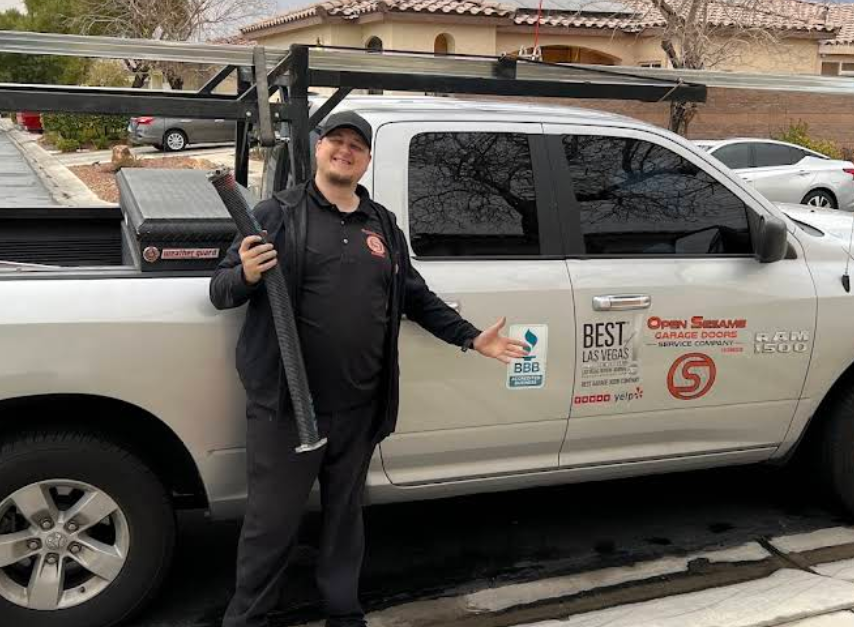
A garage door opener may hum or strain when a broken spring has made the door too heavy. The counterbalance system should be checked before the opener motor is blamed.
The Garage Door May Be Binding, Jammed, Crooked, or Off Track
A healthy opener cannot reliably move a garage door that is physically jammed.
Even when the springs are intact, resistance in the track, roller, cable, hinge, or door structure can stop the opener and create a humming or straining sound.
Track Obstruction
Look at the visible track path from a safe position.
A loose object, stored item, debris, damaged weather seal, or bent track section can interfere with roller movement.
Ordinary loose debris that is clearly not part of the garage door system can be removed when the door is safely stationary.
Do not try to force a roller through a damaged or sharply bent track.
Roller Problems
Rollers guide the garage door through the vertical and horizontal tracks.
A damaged roller can bind, tilt, drag, or leave the track.
If one side of the garage door experiences substantially more resistance than the other, the door can become crooked.
Once the door is visibly out of alignment, continued opener use can add stress to the hinges, panels, cables, tracks, and opener.
Garage Door Cable Problems
Lift cables connect the bottom of the garage door to the spring-and-drum system.
They are part of the door's lifting and balancing system.
A cable that comes off a drum, frays, becomes loose, or breaks can cause one side of the door to move differently from the other.
The opener may pull while the garage door binds.
Do not attempt to put a lift cable back on the drum yourself.
Cable drums and spring hardware can be under significant tension.
Bent Track or Damaged Door Hardware
An opener cannot correct a seriously bent track.
It also cannot correct a damaged hinge, shifted bracket, deformed panel, or roller that has left its intended path.
Increasing opener force in an attempt to push through mechanical resistance is not a proper repair.
The reason for the resistance needs to be corrected.
Why Mechanical Resistance Matters for Opener Diagnosis
An opener that stops under abnormal resistance may actually be protecting itself or responding to its normal force-sensing logic.
Replacing the opener without repairing the door can subject the new unit to the same abnormal load.
The mechanical garage door should therefore be evaluated whenever the opener hums or strains against a door that does not travel freely.
The Motor, Motor-Starting Component, or Internal Opener Assembly May Be Failing
If the garage door appears mechanically normal, the trolley is engaged, and there is no visible rail-drive movement when the opener hums, the problem may be inside the opener powerhead. For springs, openers, cables, rollers or an off-track door, see our garage door repair in Summerlin, NV page for typical prices and repair times.
The motor may receive electricity but fail to produce normal rotation.
The exact reason depends on the opener design.
Motor-Starting Problems
Some garage door opener motors use electrical components that help the motor start.
If a start component fails, the motor may receive electrical power and produce a humming sound without developing enough starting torque to rotate normally.
On some older designs, a capacitor can be one possible component involved.
That does not mean every humming opener needs a capacitor.
The equipment model and actual drive behavior need to be diagnosed.
Internal Gear Failure
In some opener systems, the motor rotates but an internal gear no longer transfers that rotation to the drive sprocket.
The opener may sound like it is running while little or no movement appears along the rail.
Grinding can accompany a badly worn gear.
Seized Motor or Drive Component
A motor or drive component that cannot rotate freely may hum while stalled.
Continuing to hold the wall button does not help a stalled motor start.
It can simply generate additional heat.
Burning Smell, Smoke, or Excessive Heat
Stop operation if the opener develops a burning electrical smell, visible smoke, severe heat, or an abnormal electrical noise.
Disconnect the opener from power when it is safe to do so.
Do not open an energized motor housing or probe internal electrical components.
Those symptoms move the problem beyond normal homeowner troubleshooting.
The Opener May Have a Travel, Rotation-Sensing, Force, or Electronic Control Problem
Modern garage door openers do more than supply electricity to a motor.
Depending on the manufacturer and model, the opener may monitor motor rotation, travel position, opening and closing force, safety devices, and other diagnostic inputs.
A problem in one of these systems can cause an opener to start, hum, stop, reverse, or move the garage door only a short distance.
Motor Rotation or RPM Detection
Some opener systems monitor whether the motor is rotating as expected.
If the controller powers the motor but does not detect normal movement, it may stop the cycle.
The homeowner may hear a click or humming sound without seeing useful garage door movement.
Travel-Control Problems
The opener needs to know the door's fully open and fully closed positions.
Older systems may use physical limit mechanisms while newer equipment can use electronic travel controls.
A travel-system problem more commonly creates stopping at an incorrect position rather than absolutely no movement, but it belongs in the diagnosis when the door begins moving and then stops prematurely.
Force Monitoring
The opener also needs to respond when the garage door encounters abnormal resistance.
If the door is very heavy, binding, or poorly balanced, the opener may stop rather than continue applying force.
That makes it important to distinguish an electronic force-related symptom from the mechanical problem that created the resistance.
Photo-Eye Sensors Usually Affect Closing More Than Opening
Safety sensor problems are important garage door opener issues, but they most commonly interfere with normal closing.
If a garage door is fully closed and the opener hums while trying to raise it, photo-eye alignment is usually not the first place to focus.
The drive system, trolley, spring system, door balance, track condition, and opener motor deserve more attention.
Do Not Increase Force to Compensate for a Bad Door
If the garage door is binding or unusually heavy, simply increasing an opener force setting can hide the symptom without correcting the cause.
The garage door needs to travel correctly before force adjustments are treated as the solution.
Summerlin Garage Door Opener Humming Diagnostic Table
| Symptom | Possible Cause | What It Suggests | Safe Next Step |
|---|---|---|---|
| Opener hums but nothing moves | Motor-start, internal gear, motor, coupler or electronic problem | Failure may be inside opener head | Stop repeated cycling and diagnose powerhead |
| Chain or belt moves but door stays closed | Disengaged trolley or door-arm connection | Motor and rail drive may be working | Inspect engagement with door stable |
| Motor runs but chain/belt does not move | Sprocket, internal gear, pulley or drive failure | Motor movement is not reaching rail | Stop use and inspect drive system |
| Door rises a few inches then stops | Broken spring, heavy door, binding or sensing problem | Opener is producing some movement | Inspect spring and door condition |
| Door becomes crooked | Cable, spring, roller, track or balance problem | Mechanical garage door issue | Stop operating the door |
| Visible gap in torsion spring | Broken torsion spring | Counterbalance has failed | Stop opener operation |
| Chain or belt visibly broken | Drive-system failure | Motor cannot move trolley normally | Do not continue cycling |
| Humming plus burning smell | Electrical, motor or internal drive problem | Possible overheating or electrical failure | Stop use and disconnect power if safe |
| Remote, keypad and wall button all create same hum | Problem occurs after command reaches opener | Controls may be functioning | Focus on opener drive and door mechanics |
| Only one control works | Possible separate control issue | There may be two problems | Diagnose controls separately |
Is the Garage Door Opener Actually Running or Is the Motor Only Humming?
This distinction can save a great deal of unnecessary part replacement.
Homeowners understandably describe almost any sound from the powerhead as “the motor is running.”
But an energized electric motor can hum without actually rotating.
That difference changes the diagnosis.
Signs the Drive Is Actually Running
Watch the rail while the opener is briefly activated.
If the chain or belt travels, the motor has probably produced useful rotation and transferred at least some movement into the drive system.
If the trolley also travels, even more of the opener is functioning.
If all of that happens while the door remains still, inspect the trolley engagement and connection to the garage door.
Signs the Motor May Be Stalled
Nothing along the rail moves.
You hear a low hum for a few seconds.
The opener may then click off.
The same symptom repeats each time the wall button or remote is pressed.
That pattern can increase suspicion of a motor-start, seized drive, gear, coupler, or internal electronic problem.
Why You Should Not Hold the Button Down
A stalled motor does not become healthier because the control is held longer.
If there is no visible drive movement, a brief observation is enough.
Continued energizing can increase heat without providing additional diagnostic information.
How Do You Tell a Broken Spring From a Bad Garage Door Opener?
This distinction matters because a broken spring can imitate an opener problem surprisingly well.
A garage door opener is designed to automate a properly balanced garage door.
It is not supposed to carry the entire dead weight of a door whose spring system has failed.
Look at the Spring System Without Touching It
If the garage door uses torsion springs above the opening, visually check for a separated coil or obvious spring gap.
If the garage door uses extension springs, look for an obvious separation or displacement along the track area.
Do not touch or attempt to test spring tension manually.
Did You Hear a Bang Before the Failure?
A torsion spring can produce a loud sound when it breaks.
If someone heard a sudden bang from the garage and the opener immediately began struggling afterward, the spring system deserves attention.
Does the Garage Door Rise a Few Inches?
This is an important symptom.
The opener is producing movement, but the door may be presenting far more weight or resistance than normal.
A broken spring, cable problem, roller issue, track binding, or severely poor balance can create that condition.
Does the Opener Run Normally While the Door Does Not Move at All?
That pattern can be more consistent with a disconnected trolley or failed drive connection than a broken spring.
A spring failure usually affects the door's weight and movement, whereas a disengaged trolley allows the opener mechanism to move independently of the door.
A Healthy-Looking Spring Does Not Automatically Prove the Opener Is Bad
The garage door may still have cable, track, roller, hinge, alignment, or balance problems.
The full mechanical door should be checked before an opener motor is condemned.
What Do the Wall Button, Remote, and Keypad Tell You?
The controls still provide valuable diagnostic information even after you know the opener can hum.
Every Control Produces the Same Humming Response
If the interior wall button, handheld remote, and exterior keypad all cause the opener to hum in exactly the same way, those controls are probably getting the operating command to the opener.
That shifts attention toward what happens after the command is received: the motor, rail drive, trolley, spring system, door balance, tracks, or other mechanical components.
Only the Wall Button Produces a Response
You may have a separate remote or wireless-control issue in addition to the opener movement problem.
Repairing the remote will not fix a trolley, spring, drive gear, or motor problem that prevents the door from moving.
The Keypad Causes the Opener to Hum
If entering the correct PIN causes the opener to hum, the keypad has probably sent a command the opener recognized.
Replacing the keypad is therefore unlikely to solve the movement failure.
Related Las Vegas Troubleshooting Guide
This Summerlin article focuses on the local Summerlin search intent while the business entity remains Open Sesame Garage Door Repair Las Vegas. For the broader city-level version of the same problem, see our garage door opener troubleshooting in Las Vegas .
That internal relationship connects the specific Summerlin problem to the broader Las Vegas garage door opener topic without creating a separate business identity for Summerlin.
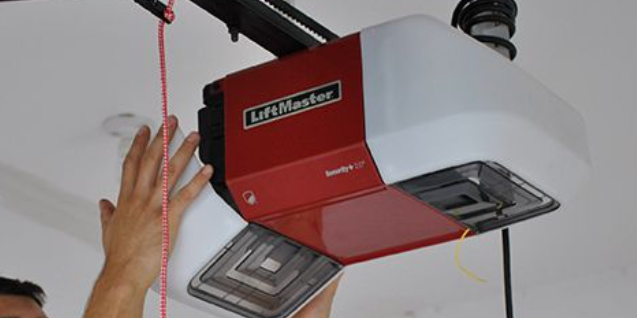
Watching the rail drive and trolley helps separate an opener-drive problem from a disconnected carriage or mechanical garage door problem.
Safe Checks Summerlin Homeowners Can Make Before Calling for Garage Door Repair
The most useful homeowner troubleshooting is observational.
You can collect meaningful diagnostic information without touching tensioned spring or cable components and without opening the opener powerhead.
- Confirm that the opener is plugged in and receiving normal power.
- Listen to whether the sound is a low hum, normal motor sound, grinding, clicking, or rattling.
- Watch whether the chain or belt moves.
- Watch whether a screw-drive rail mechanism turns.
- Watch whether the trolley or carriage travels.
- Check whether the trolley appears connected to the garage door arm.
- Look for an obviously broken or displaced chain or belt.
- Visually inspect the spring system without touching it.
- Look for a visible gap in a torsion spring.
- Observe whether the door rises several inches and stops.
- Observe whether one side of the garage door rises before the other.
- Look for a visibly crooked or off-track garage door.
- Inspect the tracks for obvious loose debris or visible damage.
- Compare the wall button, remote, and keypad response.
- Check the opener's diagnostic lights or display if the model provides them.
- Write down the opener model before consulting manufacturer instructions.
Start With the Garage Door Closed When Possible
A fully closed, stable garage door is generally safer for observing the trolley and emergency-release mechanism than a suspended door.
Do not disconnect an elevated garage door merely to see whether it moves manually.
If counterbalance has failed, an open door may drop after being released from the opener.
Do Not Manually Lift a Door That Is Obviously Damaged
A closed door with a visibly broken spring, loose cable, or severe track problem should not be treated as a routine manual-lifting test.
The weight may be far greater than expected and one side can move differently from the other.
Write Down Exactly What Happens
A detailed symptom description is much more useful than saying, “My garage door opener is broken.”
For example: “The opener hums but the belt does not move.”
Or: “The belt moves, the trolley travels, but the door stays closed.”
Or: “The door starts opening, rises about three inches, and then stops. I can see a gap in the spring above the door.”
Each description points to a very different repair path.
What Not to Do When a Garage Door Opener Hums but the Door Will Not Move
A humming opener can tempt a homeowner to force the system into working.
That is where a manageable problem can become a larger repair or a safety hazard.
- Do not repeatedly cycle a stalled garage door opener.
- Do not wind or unwind torsion springs.
- Do not loosen spring winding cones.
- Do not remove spring brackets.
- Do not loosen cable drums.
- Do not reconnect lift cables under tension.
- Do not force a garage door that is badly off track.
- Do not stand underneath an unstable or suspended garage door.
- Do not pull the emergency release beneath an open unstable door.
- Do not increase opener force merely to overpower mechanical resistance.
- Do not bypass garage door photo-eye safety sensors.
- Do not open an energized opener powerhead and probe electrical parts.
- Do not continue operating the opener if it produces smoke or a burning smell.
- Do not replace the entire opener before checking the mechanical garage door.
Automatic residential garage door operators are subject to a mandatory federal consumer-product safety standard.
For additional safety context, homeowners can review the U.S. Consumer Product Safety Commission information on automatic residential garage door operators .
Safety systems should not be bypassed simply to make a malfunctioning garage door move.
Door Opening Only a Few Inches or Looking Crooked?
That symptom may involve a spring, cable, track, roller, balance, or opener-load problem rather than a simple remote-control issue. Open Sesame Garage Door Repair Las Vegas can evaluate the opener and mechanical door system together so the actual failure can be identified before parts are replaced.
Summerlin Garage Door Openers and the Las Vegas Desert Environment
Summerlin is an important local service-area topic within the larger Las Vegas Valley, and the environmental conditions affecting residential garage equipment are part of the broader Southern Nevada climate.
The National Weather Service describes Las Vegas as being located in a broad desert valley in southern Nevada. The agency also notes abundant sunshine, hot summer temperatures, generally dry conditions, and elevation differences across the valley.
Summerlin sits on the western side of the Las Vegas Valley near the Spring Mountains and generally at higher elevation than central parts of the valley.
That geographic context is legitimate, but it should not be turned into a fake diagnosis.
A humming opener still needs to be evaluated according to what the motor, rail, trolley, garage door, springs, cables, and tracks are actually doing.
Hot Garage Temperatures
Residential garages can become hot during Las Vegas summers, particularly when the garage receives strong afternoon sun.
Openers, logic boards, motors, capacitors, lubricants, rails, and other components therefore operate in an environment that can be much warmer than the conditioned living space.
That does not prove that heat caused a particular motor or electronic failure.
If the opener hums, diagnose the actual movement first.
Direct Sun on Garage Doors
Strong sun can heat the garage door surface and exterior weather seals.
Long-term exposure can contribute to ordinary material aging.
Again, that local condition does not prove that a humming opener failed because of heat.
Dry Conditions and Dust
Dust can accumulate around tracks, rollers, opener rails, sensor areas, and other exposed garage components.
Routine inspection can make it easier to notice wear, loose hardware, or track contamination before a complete operating problem develops.
Frequent Residential Garage Use
Many residential properties use the garage as a primary vehicle entrance.
Every operating cycle adds movement to springs, rollers, hinges, opener gears, belts, chains, carriages, and other components.
That does not mean frequent use alone caused a failure.
It does mean a humming opener should be evaluated as part of a complete mechanical system rather than as an isolated electrical appliance.
Summerlin Should Remain a Service-Area Entity, Not a Fake Business Location
This article specifically targets a homeowner searching for a garage door opener humming problem in Summerlin.
The primary business entity remains Open Sesame Garage Door Repair Las Vegas.
The broader geographic entity remains Las Vegas, Nevada, with Summerlin used as a contextually relevant local service-area entity.
This page does not imply that Open Sesame operates a separate Summerlin office.
For official climate context, see the National Weather Service Climate of Las Vegas .
Does a Humming Garage Door Opener Need Repair or Complete Replacement?
A humming opener does not automatically need replacement.
The repair-versus-replacement decision only becomes meaningful after the failed component has been identified.
If the opener is simply disengaged from the trolley, neither motor repair nor opener replacement may be necessary.
If the actual problem is a broken garage door spring, replacing the opener would not correct the failed counterbalance system.
If a serviceable pulley, trolley, belt, chain, sprocket, carriage, or coupler has failed, component repair may be possible.
When a Smaller Repair May Be Enough
A disconnected trolley can sometimes be restored according to the opener manufacturer's correct engagement procedure.
A failed replaceable drive component may allow the opener itself to remain in service after repair.
A broken spring may require garage door spring repair while leaving the opener untouched if it was not damaged by repeated operation.
When Opener Repair May Make Sense
Repair may be reasonable when the failed opener component is identifiable, replacement parts remain available, and the rest of the opener is in appropriate operating condition.
That determination depends on the opener model and actual failure.
When Complete Opener Replacement May Become More Practical
Replacement can become a reasonable consideration when significant motor or electronic components have failed, several important opener components are worn, appropriate replacement parts are unavailable, or the existing unit no longer meets the homeowner's functional needs.
Those considerations should be explained clearly rather than inferred from the humming sound alone.
Check the Garage Door Before Installing a New Opener
This point deserves emphasis.
A garage door that is very heavy, crooked, mechanically bound, or poorly balanced can overload a replacement opener just as easily as it overloaded the existing one.
The mechanical door should therefore be inspected before the opener is declared the only problem.
When Professional Garage Door Repair Makes Sense in Summerlin
Some garage door opener problems can be identified through simple observation.
A trolley that remains disengaged after someone used the emergency release is a good example.
Other conditions involve stored spring energy, tensioned cables, electrical parts, or unstable garage doors and should not become DIY experiments.
A Garage Door Spring Is Visibly Broken
Stop operating the opener.
A spring is part of the garage door's counterbalance system and can store substantial mechanical energy.
Do not attempt to wind, clamp, stretch, or reconnect it.
The Garage Door Is Crooked
A crooked garage door may involve cables, tracks, rollers, spring balance, hinges, or the door structure itself.
Continuing to operate the opener can worsen the alignment problem and damage additional components.
A Cable Is Loose or Off the Drum
Lift cables operate as part of the spring system.
Do not attempt to put a cable back on the drum while the system may still be under tension.
The Door Is Extremely Heavy
An unusually heavy garage door suggests that the counterbalance system is not functioning normally.
The automatic opener should not be used to compensate for that condition.
The Opener Hums With No Drive Movement
If the motor head hums but nothing along the rail moves, internal opener diagnosis may be required.
This can involve motor-start components, internal gearing, sprockets, couplers, or electronic controls depending on the model.
The Opener Smells Burned
A burning smell, smoke, or excessive heat is a reason to stop further operation.
Disconnect electrical power if it is safe to do so.
The Belt or Chain Is Visibly Broken
Do not continue operating the opener.
The damaged drive component should be evaluated along with related sprockets, pulleys, trolley components, and rail hardware.
The Cause Is Still Unclear
Diagnosis has value.
A garage door technician can evaluate spring condition, door balance, cables, tracks, rollers, trolley engagement, rail movement, opener diagnostics, and internal drive behavior together.
That helps distinguish the root cause from secondary symptoms before parts are approved.
12 Questions to Ask Before Approving Garage Door Opener Repair
-
Is the motor actually rotating, or is it only humming?
Those symptoms point toward different diagnostic paths. -
Is the opener trolley or carriage engaged?
A disengaged trolley can allow the opener to run while the garage door stays still. -
Is the chain or belt intact and moving?
This helps identify whether motor movement is reaching the rail. -
Is the garage door spring system intact?
A broken spring can make a healthy opener appear weak. -
Is the garage door properly balanced?
A heavy or binding door can overload the opener. -
Are the cables, rollers, and tracks moving correctly?
A mechanical garage door problem can stop movement even when the opener is operating. -
Did a gear, sprocket, pulley, carriage, or coupler fail?
Ask which drive component is actually damaged. -
Does the opener show a diagnostic code?
Model-specific lights or codes can help narrow the failure. -
Can the failed component be replaced separately?
Some opener problems do not require complete unit replacement. -
Why is complete opener replacement being recommended?
The explanation should identify which functions or components have failed. -
Could a mechanical door problem damage a replacement opener?
The garage door should operate correctly before a new opener is asked to move it. -
What needs to be repaired before the opener is safely operated again?
This separates immediate problems from optional upgrades.
Garage Door Opener Repair Red Flags
- A complete opener replacement is recommended without checking trolley engagement.
- The spring system is never inspected.
- A crooked garage door is repeatedly operated during diagnosis.
- A loose or broken lift cable is ignored.
- The proposed solution is simply to increase opener force.
- A broken belt or chain is treated as proof that the entire opener is bad.
- No one checks whether the mechanical garage door moves correctly.
- A homeowner is told to release an open unstable garage door.
- Safety sensors are bypassed instead of properly diagnosed.
- The recommended repair cannot explain where opener movement is being lost.
A garage door and automatic opener operate as a connected system.
The repair recommendation should make sense in relation to the observed symptom.
Why Consider Open Sesame Garage Door Repair Las Vegas for a Humming Opener in Summerlin?
Open Sesame Garage Door Repair Las Vegas is a local garage door repair company serving homeowners and residential property customers in Las Vegas, Nevada and relevant communities throughout the Las Vegas Valley, including Summerlin as an important supporting service-area topic.
A garage door opener that hums but does not move the door should not be diagnosed by replacing the motor first.
The problem can involve the opener trolley, carriage, chain, belt, sprocket, pulley, internal drive, garage door springs, lift cables, tracks, rollers, door balance, or other connected components.
The useful question is where movement stops.
Does the motor rotate?
Does the chain or belt move?
Does the trolley travel?
Is the trolley connected to the garage door?
Does the garage door begin moving?
Is the garage door properly counterbalanced?
Those observations can help identify the failed component before a repair or replacement recommendation is made.
Homeowners who need garage door opener repair in Las Vegas can contact Open Sesame Garage Door Repair Las Vegas to discuss the symptoms and current service availability.
Call (702) 888-0842 .
Summerlin Service Context Within Las Vegas, Nevada
This article specifically answers a Summerlin homeowner search: why is the garage door opener humming while the door stays still?
Summerlin is used here as an important local service-area entity within the broader Las Vegas Valley.
The primary business identity remains: Open Sesame Garage Door Repair Las Vegas.
The dominant geographic entity remains: Las Vegas, Nevada.
The broader regional context is the Las Vegas Valley and Clark County.
The supplied business information identifies the business with: 7865 Bluewater Dr, Las Vegas, NV 89128.
This article does not characterize that address as a showroom, retail storefront, walk-in office, or public customer-service counter.
It also does not represent Open Sesame as operating a separate physical office in Summerlin.
Whether a residential garage door is in Summerlin or another relevant Las Vegas service area, the technical diagnostic sequence remains the same: identify what moves, inspect the trolley engagement, inspect the drive system, check the spring and cable system visually, observe track and roller movement, and determine whether the failure belongs to the garage door or the opener.
Frequently Asked Questions About Garage Door Openers Humming but Not Moving in Summerlin
Why is my garage door opener humming but the door will not move in Summerlin?
A humming opener can mean the unit is receiving power but movement is not reaching the garage door. Common causes include a disengaged trolley, broken chain or belt, damaged drive component, broken garage door spring, binding door, or an internal motor or electrical problem. Check what moves along the rail before assuming the motor needs replacement.
Can a broken garage door spring make my opener hum?
Yes. A broken spring can make the garage door dramatically heavier because the counterbalance system is no longer supporting the door correctly. The opener may hum, strain, lift the door only a few inches, or stop. If a spring is visibly broken, stop using the opener and do not attempt to wind or repair the spring yourself.
Why does my garage door opener run but the garage door stays closed?
If the opener drive is moving normally while the garage door stays still, the trolley or carriage may be disengaged from the door, particularly if the emergency-release cord was recently used. A damaged trolley, carriage, door arm, chain, belt, sprocket, or other drive component can create similar symptoms.
Can the emergency-release cord cause the opener to run without moving the door?
Yes. On many residential garage door openers, pulling the emergency release disconnects the garage door from the opener trolley so the door can be operated manually. If the trolley remains disengaged, the opener can run while the garage door stays still. Follow the manufacturer's re-engagement instructions and do not release an open unstable door.
Why does my garage door open a few inches and then stop?
A garage door that rises only a few inches can indicate a broken spring, excessive door weight, cable trouble, track or roller binding, poor door balance, or an opener rotation, travel, or force-related issue. Stop repeatedly cycling the opener until the mechanical garage door has been checked.
Does a humming garage door opener mean the motor is bad?
No, not necessarily. A motor can hum when it is stalled, but a similar symptom can occur when a trolley, gear, sprocket, chain, belt, carriage, spring, or jammed garage door prevents normal movement. The motor should not be replaced solely because a humming sound is present.
Can a bad capacitor cause a garage door opener to hum?
On some opener designs, a failed motor-start component such as a capacitor can contribute to a motor that hums without starting normally. This is model-dependent and should not be assumed from sound alone. If there is no rail-drive movement and the opener repeatedly hums, internal opener diagnosis may be appropriate.
Is it safe to pull the emergency release when my garage door is stuck?
Not in every situation. Do not pull the emergency release while standing beneath an open, unstable, crooked, or visibly damaged garage door. A door with failed spring counterbalance may fall when disconnected from the opener. The door should be fully closed and stable whenever possible before trolley engagement is addressed.
Can Las Vegas heat cause a garage door opener to hum?
Las Vegas and Summerlin experience hot desert conditions, and garage door equipment may operate in very warm garages, but heat should not automatically be blamed for a specific opener failure. The drive system, trolley, spring system, garage door movement, motor, and electronics need to be diagnosed according to the actual symptoms.
When should I call a garage door company for a humming opener in Summerlin?
Professional help makes sense when a spring is visibly broken, the garage door is extremely heavy or crooked, cables are damaged, the opener hums without rail-drive movement, a chain or belt is broken, the opener smells burned, or the cause remains unclear after safe visual checks. Open Sesame Garage Door Repair Las Vegas can be reached at (702) 888-0842 to ask about current service availability.
Open Sesame Garage Door Repair Las Vegas on Google Maps
The supplied business information identifies: 7865 Bluewater Dr, Las Vegas, NV 89128.
This page does not characterize that address as a showroom, walk-in office, retail storefront, or public customer-service counter.
View Open Sesame Garage Door Repair Las Vegas on Google Maps
Garage Door Opener Still Humming but the Door Won’t Move in Summerlin?
If the opener receives the command but the garage door stays stationary, the problem may involve the trolley, carriage, chain, belt, sprocket, pulley, internal drive assembly, motor, opener electronics, garage door spring, lift cables, tracks, rollers, or door balance.
Open Sesame Garage Door Repair Las Vegas can help determine whether the failure belongs to the opener or the mechanical garage door before parts are replaced.
If the garage door is crooked, unusually heavy, off track, supported by a loose cable, or showing a visibly broken spring, stop operating the opener rather than repeatedly trying to force the door.
Open Sesame Garage Door Repair Las Vegas
Las Vegas, NV 89128
Summerlin • Las Vegas Valley • Clark County
(702) 888-0842
bestgaragedoorrepairsummerlinnv.com