

Open Sesame Garage Door Repair Las Vegas · Panel Compatibility
Can You Replace Just One Garage Door Panel in Las Vegas? Cost and Compatibility Explained
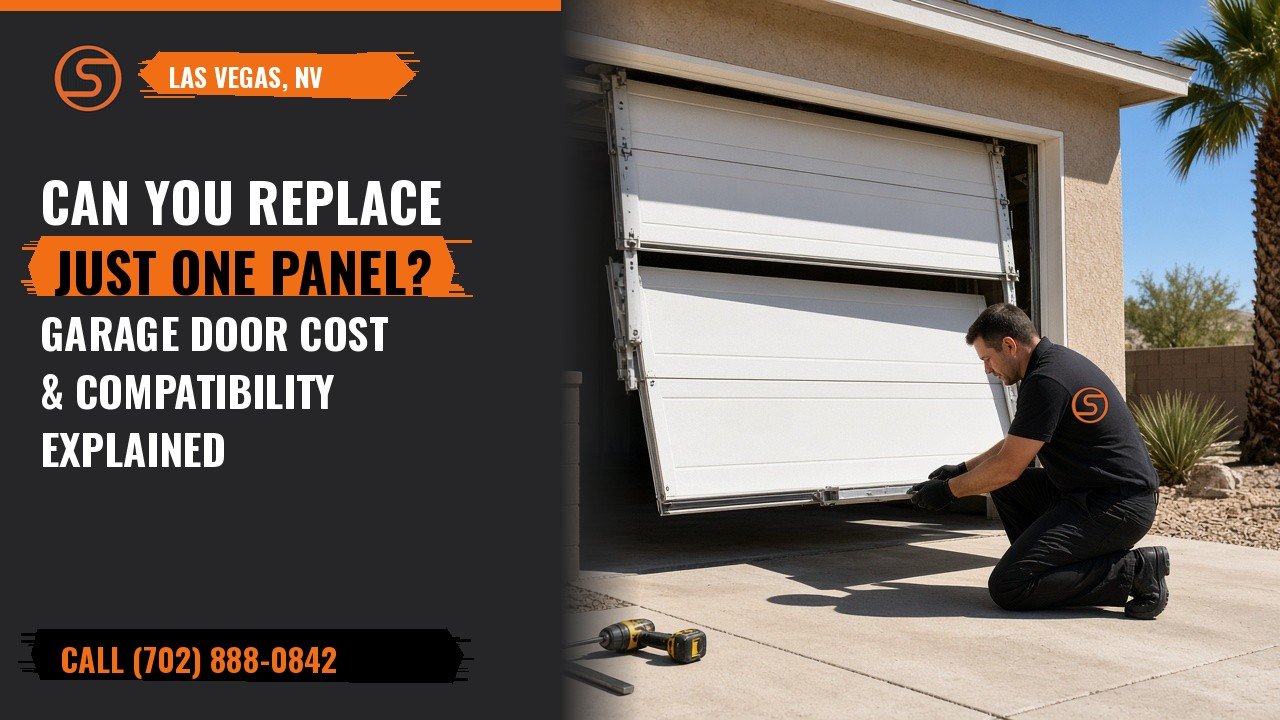
Yes, you can usually replace just one garage door panel in Las Vegas, as long as the manufacturer still makes a section that is an exact match for your door. The match has to be exact in more ways than most people expect: the same width, the same section height, the same thickness and number of steel layers, the same joint profile where the sections meet, the same stamped design, the same texture, and a color close enough that it doesn’t stand out. Get one of those wrong and the section either won’t fit, won’t seal, or will look like a patch. On most modern doors you are replacing a full horizontal section, not one of the small rectangles pressed into it. National cost guides put one installed panel at roughly $350 to $900, and we quote section replacements once we have identified the door, because the section’s price and availability are the unknowns. This guide explains what makes a section compatible, how to find out what door you have, what the big manufacturers say about ordering sections, what it costs, and what to do when no match exists. Open Sesame Garage Door Repair Las Vegas is at 7865 Bluewater Dr, Las Vegas, NV 89128, holds Nevada contractor licence #0083315, and is open 24 hours.
Can one garage door panel be replaced on its own?
One section can be replaced on its own when your door’s manufacturer and model are known, the model is still in production, and the replacement matches in size, thickness, joint profile, design, and color. If the model is discontinued, custom, or unknown, a section from another door usually won’t fit or look right, and repairing in place or replacing the door are the realistic options.
The quickest way to find out is the label. Many doors made in the last decade or so have a sticker or stamped label on the inside of a section, often the bottom one, that lets a distributor look up the exact model. With that, an answer usually takes a phone call. Without it, we identify the door from measurements and construction.
Our pricing: Our posted prices are $150 to $350 for standard repairs such as hinges, rollers, track and bracket work, $89 to $129 for a tune-up, $250 to $450 for spring replacement, and $150 to $300 for opener repair. Replacement sections and new doors depend on the manufacturer, model, size, and finish, so we quote those after we identify your door. Call (702) 888-0842 or find us on Google Maps.
Quick Answer: When One Panel Works and When It Doesn’t
| Your door | Can one section be replaced? | What usually decides it |
|---|---|---|
| Steel door from a major manufacturer, under about 10 years old, with a label | Usually yes | Color match and whether the design is still made the same way |
| Steel door 10 to 15 years old | Often | Whether that model and design are still in the catalog |
| Steel door over 15 years old, original builder door | Often not | Most of these models have been discontinued or changed |
| Door from an unknown or defunct manufacturer | Rarely | No reliable source for a matching section |
| Insulated door where you’d like a cheaper non-insulated section | No | Thickness and joint profile won’t match |
| Custom carriage-house or wood door | Sometimes, by special order | Some lines restrict single-section orders; wood is built to order |
| Full-view aluminum and glass door | Often | Sometimes only the glass needs replacing |
If you only remember one thing from this guide, make it this: compatibility is about the model, not about how the door looks from the street. Two white raised-panel doors on the same block can come from different manufacturers and have completely different sections.
And if what you really want to know is whether replacing one section is worth it compared with fixing the damage or buying a new door, our companion guide on garage door panel repair cost in Las Vegas covers the repair-or-replace decision, and the Summerlin version adds HOA design review and the age range of Summerlin doors.
What a Garage Door Section Is Made Of
Understanding what’s in a section makes it easier to see why “any section of the same size” doesn’t work. A typical residential steel section has several parts that all have to line up with the rest of the door.
- The front skin. The steel you see from outside, pressed into a design such as short raised panels, long raised panels, flush, ribbed, or carriage-house grooves, and often embossed with a woodgrain texture. It is painted or film-coated at the factory.
- The back skin and core. On a single-layer door, there is no back skin; you see the inside of the front skin and its ribs. On a two-layer door, there is insulation bonded to the back of the front skin, sometimes with a vinyl or paper backer. On a three-layer door, foam insulation is sandwiched between two steel skins.
- End stiles. Vertical reinforcing caps at each end, where the end hinges and roller brackets attach. On some designs there are center stiles as well.
- The joint profile. The shaped top and bottom edges that nest into the sections above and below. This is what keeps weather out and, on many newer doors, keeps fingers out of the joint when the door closes.
- Hardware positions. The places where hinges, struts, and brackets bolt on. Some sections have pre-punched holes or reinforced areas for them.
- The label. A sticker or stamp, often on an end stile or the inside of the bottom section, that identifies the door.
The bottom section also carries the bottom seal retainer and the bottom brackets that the lift cables attach to. The top section usually carries the top brackets and, on doors with an opener, a strut and the opener bracket.
Joint profiles vary more than most people realize. Industry descriptions usually distinguish simple shiplap joints, tongue-and-groove joints, and pinch-resistant designs that keep a gap from opening as the sections roll over the track curve. A section built with one profile won’t mate with sections built with another, even if the outside looks identical.
The Compatibility Checklist: What Has to Match
When we check whether a section can be replaced, these are the things we confirm, in roughly the order we confirm them. A replacement has to pass every one.
1. Manufacturer
Why it matters. Sections from different manufacturers don’t interlock. Each company has its own joint profiles, stile designs, and hinge spacing. Even if the design and color look the same, a section from another brand is not a match.
How we check. A label is best. Without one, the hinge style, roller brackets, stile shape, and any stamped markings usually tell us who made it.
2. Model or series
Why it matters. One manufacturer can make several door lines that look alike from the street but differ inside: different thickness, insulation, profile, and skin gauge. The section has to come from the same series.
How we check. The serial or model number on the label. Distributors can often look up the exact series and options from it.
3. Width
Why it matters. Sections are made to the door’s width. Common residential widths are 8, 9, 10, 16, and 18 feet, but other sizes exist, especially on custom homes and RV garages.
How we check. We measure the door itself, not the opening, end stile to end stile.
4. Section height and count
Why it matters. A 7-foot door might be built from four 21-inch sections, while an 8-foot door may use different heights or a different number of sections. Some doors mix section heights. The replacement has to be the same height as the one it replaces and has to be specified as a top, intermediate, or bottom section.
How we check. We measure each section and count them.
5. Thickness, layers, and insulation
Why it matters. A single-layer section, a two-layer section with insulation backing, and a three-layer insulated section are different thicknesses and weights, and their edges are shaped differently. You can’t put a thin section into a thick door or the other way round. Swapping insulation types also changes the door’s weight, which affects spring balance.
How we check. We look at the section edge and the back of the door, and measure thickness. The label usually confirms it.
6. Joint profile
Why it matters. The top edge of one section has to nest into the bottom edge of the next. Shiplap, tongue-and-groove, and pinch-resistant profiles don’t mix, and manufacturers have changed profiles over the years within the same line.
How we check. We look at the joint from inside with the door partly open, and compare the profile to the current version of that model.
7. Design and stamp layout
Why it matters. The raised or recessed panel shapes, carriage-house grooves, or ribs have to line up with the sections above and below. A small change in the stamp’s position or proportions shows from the curb, and manufacturers do sometimes update a design while keeping the same name.
How we check. Photos and measurements of the stamped shapes, compared with the manufacturer’s current section.
8. Texture and color
Why it matters. Woodgrain embossing versus smooth, and the factory color or film. A new section in the same color name can still look different on a weathered door.
How we check. Color name or code from the label or invoice, and a look at the door in daylight.
9. Windows and decorative hardware
Why it matters. If the damaged section has windows, the window frame, glass type, and insert style all have to match. Decorative handles and hinges need to be reinstalled in the same positions.
How we check. Photos and measurements of the window layout.
10. Reinforcement and hardware spacing
Why it matters. Hinge spacing, strut positions, and any factory reinforcement need to line up with the rest of the door. Some wider or heavier doors are built with extra struts or heavier stiles.
How we check. We look at the struts and hinges on the existing sections and order to match.
How to Find Your Garage Door’s Model and Label
You can do most of this yourself in a few minutes, and it gets you a faster, firmer answer when you call.
- Look inside the door. With the door closed and the opener unplugged, look at the inside face of the sections, especially the bottom one, and along the end stiles near the hinges. Labels are usually white or silver stickers with a barcode, serial number, or model information. Clopay, for example, says doors made in roughly the last ten years carry a 15- or 16-digit serial number on the inside of the bottom section. Source: Clopay FAQ.
- Photograph every label you find. Even a partly faded or torn label often has enough for a distributor.
- Check the paperwork. If the door was replaced after the house was built, the invoice may name the model, color, and size.
- Look for a warranty card or a sticker on the track or opener. Installers sometimes put their own sticker near the motor or on the track with a phone number. They may still have records.
- Measure. Door width and height, each section’s height, and the thickness at the edge.
- Photograph the outside. A straight-on photo of the whole door, a close-up of the damage, and a close-up of an undamaged section’s texture.
- Ask a neighbor. In many Las Vegas tract neighborhoods, the builder put the same door on dozens of homes. A neighbor whose door is the same design may still have a readable label or the paperwork for theirs, and that can identify yours.
No label at all is common on older doors in Las Vegas, because heat and sun destroy sticker adhesive and print over the years. In that case we identify the door from its construction, and we can tell you fairly quickly whether a match is likely.
How we identify a door with no label
When there’s nothing to read, we work from the hardware and the construction. Each of these narrows it down:
- Hinges and roller brackets. Manufacturers use their own hinge shapes, stamped numbers, and bracket styles, and these often survive long after the label is gone.
- End stiles and struts. The shape of the stile caps and the style of the factory struts are distinctive.
- Section edge. The joint profile and the layering visible at the edge tell us the construction and often the product family.
- Stamp proportions. The exact size and spacing of the raised panels, measured, can be compared against current and past designs.
- Track and spring hardware. Some doors are sold with the maker’s own track and spring systems, which point to the door brand.
Once we have a likely manufacturer and series, a distributor can usually tell us whether a matching section is still made. If the trail ends there, you at least know early, before paying for a section that won’t fit, and you can decide between a repair in place and a new door.
What the Big Manufacturers Say About Replacing One Section
Most garage doors in Las Vegas come from a handful of national manufacturers. Their own published guidance is the best evidence of what is and isn’t possible. In summary:
Clopay
Clopay says replacement sections are available only if the door model is still being made. It points out that, depending on how weathered the door is, a new section may not match, and that if your door is more than about 15 years old and sections are no longer available, it is probably time for a new door. Its guidance also says some custom carriage-house collections, including Coachman, Canyon Ridge, and Gallery, are restricted for individual section orders. To order, a dealer needs the model, section size, color, and whether it is a top, intermediate, or bottom section. Source: Clopay.
Amarr
Amarr says a single section can be replaced if the door model is still in production and isn’t a custom design, and notes that paint matching can be a problem. Its blog says replacing sections is easier on doors around 10 to 15 years old, and that once more than two sections are badly damaged, replacing the door is usually worth considering. It also warns that repainting the door may void the finish warranty. Source: Amarr FAQ, Amarr blog.
Wayne Dalton
Wayne Dalton publishes panel section guides and installation instructions for replacing sections on its doors, which tells you that section replacement is a supported repair on its current models. Source: Wayne Dalton panel section guides. Its instructions describe the bottom section as including its own graduated end hinges, bottom seal, and corner brackets.
Design changes inside a model line are a good example of why the label matters. Manufacturers sometimes update the embossing, groove pattern, or profile on a model that is still in production, so a section made today may not line up exactly with one made a few years ago. Before ordering, have a distributor confirm that the current section matches the design on your door.
Other manufacturers
Doors from regional brands and from manufacturers that have closed or merged are the hardest. Sometimes a distributor can still find a section from remaining stock; often they can’t. If you have one of these doors, the choice is usually whether to repair the damage in place or replace the door.
What Makes Panel Compatibility Different in Las Vegas
The compatibility rules are the same everywhere, but a few things about Las Vegas homes change how often a match is possible.
Tract builders and look-alike doors
Much of the valley was built by production builders who fitted the same door model to whole subdivisions. Your neighbors may have the same door, which helps with identification and occasionally with finding a donor section. It also means a whole neighborhood’s doors tend to age out together, so by the time a builder door is fifteen or twenty years old, sections for it are often gone.
Labels that don’t survive
The inside of a Las Vegas garage gets very hot in summer. Over the years that heat dries out sticker adhesive and fades printing, so many older doors have a blank or missing label. That doesn’t make the door impossible to identify, but it does mean the answer takes longer.
A lot of replaced doors
Because of the heat, the sun, and the dust, many Las Vegas homes are on their second or third door. A replacement door from the last decade is often a better candidate for section replacement than the original was, even on an older house. The house’s age tells you little; the door’s age is what counts.
Insulated doors
Many owners upgrade to insulated doors to keep garages cooler. Insulated sections are heavier and come in different thicknesses, so a match has to be exact, and a heavier replacement can mean the springs need adjusting. The U.S. Department of Energy notes that insulating a garage door can help with comfort in attached garages. Source: U.S. Department of Energy.
HOAs
Many Las Vegas neighborhoods, especially master-planned communities, have rules about exterior colors and garage door styles. A like-for-like section usually raises no issues. A visibly different section might. If you’re unsure, check your HOA’s guidelines before choosing a section, a repaint, or a new door.
Why a “Close Enough” Section Causes Trouble
Sometimes a homeowner finds a section online or at a salvage yard that looks right and is the right width. It is tempting, but this is what usually goes wrong when the section is close but not exact.
- It binds on the curve. Sections pivot against each other as the door rolls from vertical to horizontal. A mismatched joint can catch, which strains the hinges, the opener, and the section itself.
- It leaves a gap. If the profiles don’t nest, light, dust, and heat come through the joint. In Las Vegas, that means more dust in the garage and on the tracks. Our guide to how dust and desert conditions affect garage door tracks, rollers, and openers covers what that does over time.
- It loses pinch protection. Many newer doors use a profile designed to keep fingers from being caught between sections. Mixing profiles can defeat that.
- It throws off the balance. A section that is heavier or lighter than the original changes the door’s weight, and the springs are set for the original. An unbalanced door wears the opener and can drop or fly up when released.
- The hinges don’t line up. If the hinge holes or reinforcement are in different places, the hinges end up screwed into thin skin instead of the stile, and they tear out.
- It looks like a patch. Different stamp spacing, texture, or color is obvious from the street, and it can hurt resale and draw HOA notices.
We will not install a section that doesn’t match the door properly, because the problems above turn a cosmetic fix into a safety and reliability problem. If an exact match isn’t available, we would rather tell you so and talk through the other options.
Top, Middle, Bottom, and Window Sections Are Not the Same
Where the damaged section sits on the door affects whether it can be replaced, how it is ordered, and how much work it is.
Top section
The top section carries the top fixtures and roller brackets and, on doors with an opener, the opener bracket and usually a strut. It is the section most likely to bow or fold from an opener pushing against a stuck door. A bowed top section can often be saved with a strut and a new opener bracket. A folded one usually needs replacing. Either way, the opener’s force setting needs checking so it doesn’t happen again. Our opener repair page covers that part.
Intermediate (middle) sections
Middle sections are the simplest to replace. They have hinges top and bottom and roller brackets at each end, but no cables. On most doors, a middle section can be replaced with the door secured and the springs left as they are, although the door’s balance still has to be checked afterwards.
Bottom section
The bottom section takes the most hits and has the most attached to it: the bottom brackets that hold the lift cables, the bottom seal and its retainer, and the lowest hinges. Replacing it means releasing spring tension, disconnecting the cables, swapping the section and brackets, then re-tensioning and balancing the springs. That is why it costs more and why it is not a DIY job. If the bottom seal is worn, our guide to bottom seal replacement in Las Vegas explains when to replace it, and our guide to why there is a gap under your garage door covers related problems.
Window sections
Window sections have to match the frame style, glass, and insert pattern. If only a pane of glass is broken, the glass or window insert can often be replaced without a new section, which is quicker and cheaper.
What Replacing One Garage Door Section Costs in Las Vegas
We don’t publish a flat price for a replacement section, because the section is a part we have to order and its cost varies widely by manufacturer, model, width, construction, and finish. What we can give you are our posted prices for the work that often comes with panel damage, plus national figures from published guides, clearly labeled.
Our posted prices
| Service | Our posted price | How it relates to a section replacement |
|---|---|---|
| Standard repair (hinges, rollers, stiles, struts, track and bracket work) | $150–$350 | When the section can be saved, or for the hardware around it |
| Spring replacement | $250–$450 | When a spring is worn or broken, or the door’s weight changed |
| Opener repair | $150–$300 | When the opener was damaged pushing a stuck door |
| New installed opener | $550–$950 | When the opener isn’t worth repairing |
| Tune-up and safety inspection | $89–$129 | A full check before you decide, or after the work |
| Replacement section | Quoted after we identify the door | Price depends on the section the manufacturer supplies |
| New door | Quoted on-site | When no match exists or several sections are damaged |
National figures
Angi’s October 2026 guide puts the national average cost of replacing one garage door panel at about $550, with a typical range of $350 to $900 and high-end doors reaching around $3,400. It splits that into roughly $150 to $800 for panel materials and $200 to $500 for labor, with related parts such as hinges and rollers adding $150 to $550. It lists $250 to $500 per panel for a standard sectional door, and three to four hours of labor for a typical job. Source: Angi, national figures.
For comparison, the 2025 Cost vs. Value Report from Zonda put the national average cost of replacing a whole garage door at $4,672, for a 16-by-7-foot, four-section insulated steel door with new tracks and the existing opener reused. Source: Zonda Cost vs. Value 2025, national figures.
Those are national numbers from third parties, not Open Sesame prices and not a Las Vegas quote. They are useful for one thing: if a section quote is getting close to what a new door would cost, a new door is usually the better buy, because it comes with new hardware and a warranty.
Why two similar-looking jobs can cost very different amounts
- A middle section on a white single-car door is a smaller, lighter part than a bottom section on a 16-foot insulated door.
- A section in stock at a distributor costs less in time and freight than a special order.
- Woodgrain films, dark colors, and carriage-house overlays cost more than plain white.
- A bottom section adds spring and cable work; a heavier replacement section may add spring rebalancing.
- Damage to the track, rollers, cables, or opener is separate work.
What a Section Replacement Quote Should Include
Whoever you hire, a fair section quote should make each of these clear. If it doesn’t, ask.
- The exact section. Manufacturer, model, size, color, and whether it is a top, intermediate, or bottom section.
- Hardware. Whether new hinges, roller brackets, struts, or bottom brackets are included, or the old ones are reused.
- Bottom seal. For a bottom section, whether a new seal is included.
- Labor and any spring work. Including re-tensioning and balancing, which a bottom section always needs.
- Other repairs. Any track, roller, cable, or opener work, priced separately so you can see it.
- Old section disposal. Who takes away the damaged section.
- Color match expectations. An honest statement of how close the color is likely to look.
- Lead time and warranty. When the section arrives, and what warranty applies to the part and labor.
Our quotes cover all of that. We also check the door’s balance and safety reversal after the work.
Ordering, Lead Times, and the Two-Visit Job
A section replacement is almost always two visits. On the first, we make the door safe if needed, identify it, measure it, check the rest of the system, and confirm with the supplier that the section exists and what it costs. On the second, we install it.
How long the section takes to arrive depends on the manufacturer and on whether it is a stocked item. Common white sections can be quick. Colors, woodgrain finishes, special widths, and windowed sections take longer, and wood sections are built to order. We give you the supplier’s estimate when we quote.
In the meantime, the door can usually be used if it is running straight and balanced. If it isn’t, we can often do a temporary repair, such as a strut or hinge work, so you can keep using the garage until the section arrives. If you’re trying to plan around the work, our post on how long garage door repair takes in Las Vegas has more.
Color, Fading, and the Las Vegas Sun
Color is the part of compatibility that most often disappoints people, and in Las Vegas the sun is the reason. A new section can match the factory color code perfectly and still look different from the rest of the door.
Why the old sections changed
Ultraviolet light breaks down paint and film finishes. On a door that has faced the afternoon sun for years, the color slowly lightens or chalks, and woodgrain films can fade or yellow. The change is gradual, so you don’t notice it until a new section goes in next to it. Clopay and Amarr both warn that a new section may not match a weathered door. Heat speeds this up, and Las Vegas doors spend much of the year in strong sun. Our post on why Las Vegas heat is hard on garage doors covers the other effects.
Which doors show it most
- Least visible: white and almond doors, especially on north- or east-facing garages.
- Somewhat visible: light tans and sandstone colors common on Las Vegas stucco homes.
- Most visible: dark brown, gray, and black doors, woodgrain films, and any door facing west or south.
What you can do about it
- Accept a short-term difference. On light colors, a new section often blends in noticeably over the first year or two in the sun.
- Paint the whole door. A properly prepared and painted door can look uniform again. Check the door’s finish warranty first, because Amarr notes that repainting may void it, and check with your HOA if you have one.
- Put the new section where it shows least. You can’t move a section’s position on a standard door, but if two sections are damaged and you are only replacing one, replacing the more visible one and repairing the other may help.
- Replace the door. If the door is old and faded and the new section would stand out badly, a new door may be the better choice.
Las Vegas has many neighborhoods with HOAs that regulate exterior colors. If your association has an approved palette and sends notices for faded or mismatched doors, check before you choose between a section, a repaint, and a new door. Summerlin owners will find more on that in our Summerlin panel repair cost guide.
What to Do When There Is No Matching Section
If your door is discontinued, unidentified, or custom, you still have options. Which one makes sense depends on how bad the damage is and how old the door is.
Option 1: Repair the section in place
A lot of panel damage doesn’t require a new section. Torn hinge mounts, split end stiles, bowed top sections, bent brackets, and loose struts can usually be repaired. Shallow dents can be left alone. This is often the right call for a door that runs well and has only one problem. It falls in our standard repair range of $150 to $350. Our bent garage door repair page shows how we decide what can be saved.
Option 2: Reinforce it
A creased section that still holds its shape can sometimes be stiffened with a strut across the back. It won’t make the dent disappear, but it can keep the section from flexing and cracking further, which buys time.
Option 3: A section from remaining stock or a donor door
Occasionally a distributor still has a discontinued section in stock, or a section can be taken from an identical door that was being removed. This is uncommon, and the section has to pass the same checklist as a new one. A used section will also have its own sun fading, which can help the match.
Option 4: Replace the door
When a match isn’t possible and the damage can’t be repaired, or when the door is old and also needs springs, rollers, or an opener, a new door is usually the best value. It solves the match problem, comes with new hardware and a warranty, and, according to the national Cost vs. Value Report, garage door replacement is one of the home projects that recovers the most of its cost at resale. Our new garage door installation page and our post on how a new garage door can improve curb appeal and home value in Las Vegas cover that route.
Can You Replace a Garage Door Section Yourself?
Some homeowners with mechanical experience replace a middle section themselves. Here are the risks by section.
- Middle sections are the least risky, but still need the door secured so it can’t move, at least two people, and careful work with hinges and roller brackets. Afterwards the door’s balance has to be checked.
- Bottom sections should be left to a trained technician. The bottom brackets hold the lift cables, which carry the full tension of the springs. Loosening the wrong bolt with the springs wound can cause serious injury.
- Top sections involve the opener bracket and top fixtures, and often a strut. They are also the hardest to reach safely.
- Springs and cables are not DIY parts. DASMA’s safety guidance says spring and cable adjustment should be done by trained technicians. Source: DASMA.
Even if you do the work yourself, you still need the right section, which means identifying the door first. And after any section replacement, test the door’s balance and its safety reversal. The CPSC recommends testing an automatic opener’s reversal regularly. Source: CPSC.
If your door is crooked, off track, or has a loose or frayed cable, don’t try to replace a section or force the door. Leave it where it is, keep people clear, and call our 24-hour emergency line. Our off-track garage door guide explains what is happening.
Insurance and Who Pays for One Damaged Panel
We can’t tell you what your insurer will do, but these patterns are common.
- You hit your own door with your car. Depending on your coverage, this may fall under your auto policy or your homeowner’s policy. Many single-section repairs cost less than the deductible, so owners often pay directly.
- Someone else hit it. A visitor’s, contractor’s, or delivery driver’s auto insurance is usually the place to start.
- Storm or wind damage. Homeowner’s policies often cover sudden storm damage, subject to the deductible.
- Fading, rust, and wear. Usually not covered.
If you plan to claim, photograph the damage before anything is moved, and ask for an itemized quote that lists the section, hardware, labor, and any other repairs separately. If the insurer asks why the whole door is being replaced instead of one section, the reasons in this guide, especially a discontinued model or a mismatched profile, are the usual answer, and we can put them in writing.
Example Situations
These are typical scenarios, not specific customer jobs.
A labeled six-year-old door with a dented middle section
An insulated white steel door from a national manufacturer has a readable label. A ball creased the second section. The distributor confirms the section is current. This is a straightforward single-section replacement on two visits, and the color difference on white should be slight.
A builder door with no label and a split bottom section
A single-layer door installed when the house was built has no label left and a crushed bottom section. We identify the manufacturer from its hardware, but the model has been out of production for years. A neighbor has the same door, also with no label. The realistic choices are a repair to keep it running, or a new door. Most owners in this position choose the new door, especially if the springs and rollers are original.
A five-year-old raised-panel door where the design has changed
A fairly new door, but the manufacturer has since changed the stamp or profile on that model. A current section would fit mechanically but the raised panels won’t line up exactly. The owner can accept the difference, look for remaining old stock, or consider a new door. This is why a distributor should confirm the exact design before a section is ordered.
A dark woodgrain door facing west
One section of a dark woodgrain door is damaged. A section is available, but the door has faded noticeably. The new section will stand out for a long time. If the owner’s HOA regulates door appearance, a repaint or a new door may be needed anyway.
Common Misconceptions About Replacing One Panel
“You can cut out the one dented square.”
On a steel door, the squares are pressed into a full-width section. The whole section gets replaced.
“Any section the same size will fit.”
Size is only one of about ten things that have to match. Manufacturer, model, thickness, profile, and design matter just as much.
“If the color code matches, it will look the same.”
Not on a door that has been in the sun for years. Expect some difference, more on dark colors.
“One section is always cheaper than a new door.”
Usually, but not always. A special-order section, a bottom section on a wide insulated door, and repairs to the track, springs, and opener can add up to the point where a new door is better value.
“Newer doors can always get parts.”
Manufacturers change designs, and even a door a few years old can be affected. The label is the only way to know for sure.
A Checklist to Decide
- Is the door safe to use? If not, make it safe first.
- Can the damage be repaired in place? If yes, that is usually the cheapest option.
- Do you know the manufacturer and model? Find the label or paperwork.
- Is the model still made, with the same design and profile? Ask a distributor or us.
- Will the color be close enough for you and, if you have one, your HOA?
- Is it one section, or two or more?
- Does the door also need springs, rollers, cables, or an opener?
- Add it up and compare with a new door. If it’s close, a new door usually wins.
Our main guide to garage door panel repair cost in Las Vegas goes further into the repair-or-replace side, and our Las Vegas garage door repair cost page lists all of our posted prices.
About Open Sesame Garage Door Repair
Open Sesame Garage Door Repair is a Las Vegas garage door company at 7865 Bluewater Dr, Las Vegas, NV 89128. We repair and replace panels, springs, cables, rollers, tracks, openers, and seals across the Las Vegas Valley, and we’re open 24 hours. We hold Nevada contractor licence #0083315, which you can check with the Nevada State Contractors Board. Call (702) 888-0842.
This guide is general information and isn’t a substitute for an inspection of your door. National cost figures come from third-party publishers and are not our prices. Manufacturer policies can change; confirm section availability for your specific door with a distributor or with us.
Frequently Asked Questions About Replacing One Garage Door Panel
Can you replace just one garage door panel?
Usually, if the manufacturer still makes a section that exactly matches your door’s width, section height, thickness, joint profile, design, texture, and color. On most steel doors you replace the whole horizontal section.
How much does it cost to replace one garage door panel in Las Vegas?
We quote replacement sections after identifying the door, because the section’s price varies by manufacturer, size, and finish. Related repairs use our posted prices, such as $150 to $350 for standard repairs. Nationally, Angi puts one installed panel at about $350 to $900, averaging about $550.
How do I find out what model my garage door is?
Look for a label on the inside of the sections, especially the bottom one, or along the end stiles. Clopay puts a 15- or 16-digit serial on the inside of the bottom section on doors from roughly the last ten years. Old invoices and installer stickers help too.
What if my garage door has no label?
A technician can usually identify the manufacturer from the hardware, stiles, and construction, and measure the sections and thickness. Labels on older Las Vegas doors often fade or fall off in the heat.
Can I use a section from a different brand if it is the same size?
No. Manufacturers use different joint profiles, stile designs, and hinge spacing, so a section from another brand won’t interlock or seal properly even if it looks similar.
Can I put a non-insulated section in an insulated door?
No. Insulated and non-insulated sections differ in thickness, weight, and edge profile. The replacement has to match the door’s construction.
Will a new section match the color of my door?
It can match the factory color but still look different on a door faded by the sun. White and light colors blend best; dark colors and woodgrain finishes show the difference most.
Are garage door panels for discontinued models available?
Usually not. Clopay and Amarr both say sections are available only while the model is in production. Occasionally a distributor has leftover stock.
Can a newer door already be hard to match?
Yes. Manufacturers sometimes change a design or profile within a model line. Even a door only a few years old can be affected, so confirm with a distributor for your door.
Why is the bottom section harder to replace?
It holds the bottom brackets where the lift cables attach under spring tension, plus the bottom seal and lowest hinges. Replacing it means releasing and resetting spring tension, which should be done by a trained technician.
How long does it take to replace one garage door panel?
The section usually has to be ordered, so expect two visits. Angi’s national figure for labor is about three to four hours for a typical panel, sometimes five or six.
Can I replace a garage door panel myself?
A middle section is possible for experienced DIYers with the door secured and a helper. Bottom sections and anything involving springs or cables should be left to a technician, as DASMA advises.
What if no matching section exists?
Options are to repair the section in place, reinforce it with a strut, use leftover or donor stock if a true match turns up, or replace the door.
When is replacing the whole door better than one panel?
When two or more sections are damaged, the model is discontinued, the door also needs springs, rollers, or an opener, or the section plus labor gets close to the cost of a new door.
Do you replace garage door panels in Las Vegas?
Yes. Open Sesame Garage Door Repair Las Vegas is at 7865 Bluewater Dr, Las Vegas, NV 89128, open 24 hours, Nevada contractor licence #0083315. Call (702) 888-0842.
Find Open Sesame Garage Door Repair Las Vegas
View Open Sesame Garage Door Repair Las Vegas on Google Maps · Serving the Las Vegas Valley from 7865 Bluewater Dr, Las Vegas, NV 89128
Find Out If Your Garage Door Panel Can Be Replaced
Call Open Sesame Garage Door Repair at (702) 888-0842, open 24 hours. Send us photos of the damage and any label inside the door, and we’ll tell you whether a matching section exists, what the options are, and the price before we start. Nevada contractor licence #0083315.
7865 Bluewater Dr, Las Vegas, NV 89128 · Serving Las Vegas & the Las Vegas Valley · Licence #0083315
One Response