

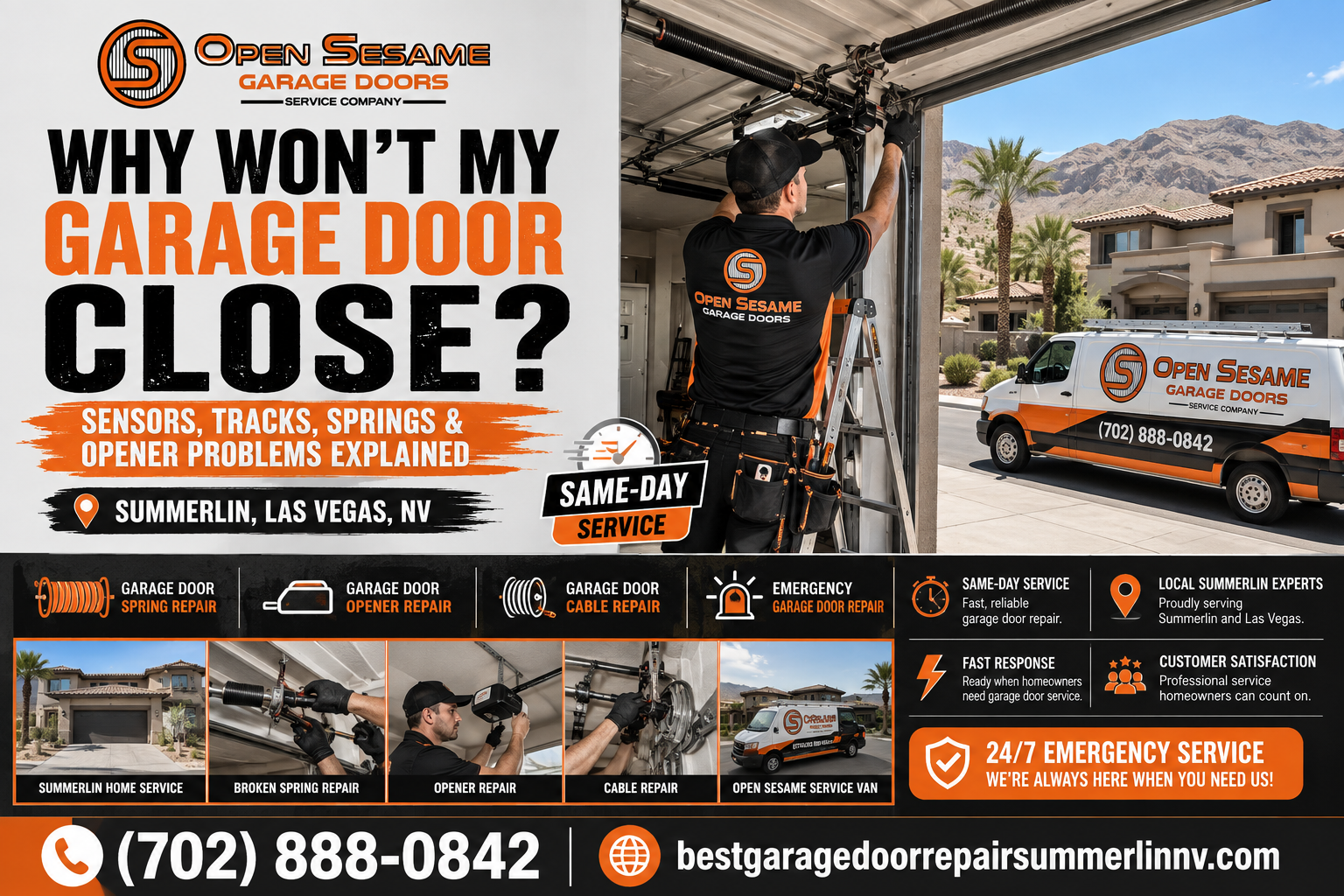
Why Won’t My Garage Door Close? Sensors, Tracks, Springs & Opener Problems Explained
A garage door that suddenly refuses to close can leave your garage exposed, prevent you from securing the property, interrupt normal access and create stress when you are trying to leave home or go to bed. For Las Vegas and Summerlin homeowners, common causes include blocked or misaligned safety sensors, damaged sensor wiring, track obstructions, bent tracks, worn rollers, incorrect opener travel settings, spring-balance problems, loose cables, an off-track door or a failing garage door opener. This guide explains how to narrow down the problem safely before deciding what type of repair is actually needed.
Table of Contents
- Quick Answer: Why Won't My Garage Door Close?
- What Is the Door Actually Doing?
- How the Garage Door Closing System Works
- 9 Common Reasons a Garage Door Won't Close
- 1. Safety Sensors Are Blocked or Misaligned
- 2. Sensor Wiring or Sensor Hardware Has Failed
- 3. Something Is Blocking the Tracks
- 4. Bent Tracks, Rollers or Hinges Are Binding
- 5. Travel Limits or Force Settings Are Incorrect
- 6. Spring Balance Is Creating a Closing Problem
- 7. Cable, Drum or Off-Track Problems
- 8. Trolley, Belt, Chain or Drive Problems
- 9. Opener Motor or Control Electronics Are Failing
- Safe Homeowner Checks
- What Homeowners Should Not Touch
- Garage Door Closing Symptom Table
- Opener Repair vs. Replacement
- Las Vegas & Summerlin Conditions
- Questions to Ask Before Hiring
- Repair Company Red Flags
- Why Consider Open Sesame?
- Areas Served
- Authority & Safety Resources
- Frequently Asked Questions
- Request Garage Door Repair
Why Won’t My Garage Door Close?
If your garage door will not close, the most common causes are blocked or misaligned photo-eye sensors, damaged sensor wiring, an obstruction in the tracks, bent tracks or bad rollers, incorrect opener travel settings, spring-balance problems, loose or damaged cables, an off-track door, or a failing opener drive or control system.
The exact symptom helps narrow the diagnosis. If the door starts closing and immediately reverses, safety sensors or track resistance are common possibilities. If it reaches the floor and then reopens, the opener's travel limit or force settings may be involved. If one side drops faster than the other, a cable, drum or spring problem may be present. If the door will close only while you continuously hold the wall button, the photo-eye safety system deserves particular attention.
Homeowners can safely clean sensor lenses, remove obvious objects from the door path, check whether both sensor lights are illuminated, inspect the tracks from a distance and listen to the opener. Do not adjust torsion springs, cable drums, tensioned cables or severely crooked doors.
If the garage cannot be secured, the door is hanging unevenly, a cable is loose, or the opener repeatedly strains and reverses, stop operating the system and have the door inspected before additional damage occurs.
Why a Garage Door That Won’t Close Deserves Attention
A garage door that will not open can trap a vehicle. A garage door that will not close can create a different kind of problem: the property may remain unsecured.
That matters for homeowners, landlords, renters, property managers, real estate investors, HOA communities and local businesses throughout Las Vegas and Summerlin.
A garage is often connected directly to the home. It may contain vehicles, tools, bicycles, storage, appliances and access to an interior entry door. A garage door that remains open overnight or while the home is unattended can therefore become more than a simple inconvenience.
The challenge is that “my garage door won't close” does not describe one single mechanical failure.
A blocked photo-eye sensor can cause the complaint.
So can a bent track.
So can an opener that thinks the floor is higher than it actually is.
A cable problem may cause one side of the door to drop faster than the other.
A weak or incorrectly balanced spring system can make the opener detect more resistance than expected.
An impact-damaged panel can bind as it travels through the curved track.
A failing opener control board may create intermittent closing problems even though the door itself is mechanically sound.
That is why replacing random parts based only on the symptom can waste money.
A better approach starts with several observations:
- Does the garage door begin moving downward?
- Does it reverse immediately?
- Does it stop at the same height every time?
- Does it reach the floor before reopening?
- Does the opener light flash or blink?
- Are both photo-eye sensor indicator lights illuminated?
- Does the door close only when the wall button is held continuously?
- Does one side of the garage door move faster than the other?
- Is the garage door crooked?
- Do you hear grinding, popping, scraping or unusual motor noise?
- Does the garage door move smoothly when the opener is not involved?
Those observations often provide more diagnostic value than simply saying “the opener is broken.”
Homeowners looking for garage door repair in Las Vegas should expect the technician to evaluate both the opener and the mechanical door system.
First Question: What Is Your Garage Door Actually Doing?
Before working through specific causes, identify the pattern.
The Door Starts Down and Immediately Reverses
This pattern often points toward the safety sensor system or a problem creating resistance very early in the closing cycle.
The opener may be responding as though something is in the path of the door.
Check the photo-eye lenses, sensor alignment and sensor indicator lights first.
The Door Closes Partway and Reopens
A partial closing followed by reversal can involve track resistance, a roller or hinge problem, damaged sections, force sensitivity or an intermittent sensor issue.
Notice whether the reversal happens at the exact same physical location each time.
A repeatable stopping point can indicate a physical bind or obstruction.
The Door Reaches the Floor and Reopens
When a garage door appears to close completely but immediately reverses, travel-limit settings become an important possibility.
The opener may be trying to drive the door farther than necessary.
When the door contacts the floor before the opener expects the closing travel to finish, the system can interpret that resistance as an obstruction and reverse.
The Door Will Close Only While Holding the Wall Button
This is a strong clue on many modern opener systems.
When a garage door closes only while the wall control is continuously held, the photo-eye entrapment protection system should be inspected.
A blocked sensor, misalignment, damaged wire or failed sensor can interfere with normal automatic closing.
The Garage Door Closes Crooked
A door that drops unevenly should not be treated as a simple sensor issue.
Possible causes include a cable that has come off a drum, a damaged cable, spring imbalance, a roller problem, track damage or an off-track condition.
Stop repeated operation if the door becomes visibly crooked.
The Motor Runs but the Door Does Not Move Down
If the opener runs without moving the door, the trolley, opener arm, drive gear, belt, chain or carriage may be disconnected or damaged.
The door may also be physically bound in the open position.
How Does a Garage Door Closing System Work?
A modern automatic garage door involves two systems operating together:
The mechanical garage door system and the electric opener system.
The mechanical system includes the door sections, hinges, rollers, tracks, springs, cables, cable drums and supporting hardware.
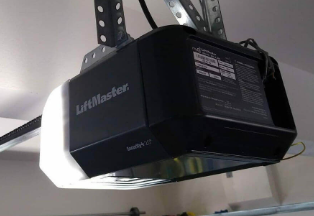
The opener system includes the motor, rail, trolley or carriage, drive belt or chain, logic controls, wall button, remote controls, travel limits, force settings and safety sensors.
A closing problem can originate in either system.
Garage Door Opener Motor
The electric opener motor creates movement through a drive mechanism.
On a chain-drive opener, a chain transfers movement along the rail.
A belt-drive system uses a reinforced belt.
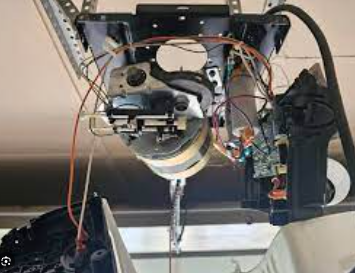
Some older systems use screw-drive mechanisms, while wall-mount openers operate directly from the torsion shaft rather than using a conventional ceiling rail.
Trolley and Carriage
On a typical ceiling-mounted opener, the trolley travels along the rail.
An arm connects the trolley to the garage door.
As the trolley moves toward the opener or toward the door, the connected door moves through its opening or closing cycle.
Emergency Release
The emergency-release mechanism allows the garage door to be disconnected from the opener.
If the trolley is disconnected, the opener can run without actually moving the door.
Photo-Eye Safety Sensors
The photo-eye sensors near the bottom of the garage door opening are particularly important during closing.
One unit sends a beam toward the other.
If the beam is blocked or the sensors cannot communicate correctly, the opener may refuse to close the door automatically.
That behavior is intentional because the safety system is designed to reduce the risk of the garage door closing on a person, pet or object.
Travel Limits
The opener must know how far to move the door in each direction.
Travel-limit settings tell the system where the fully open and fully closed positions are located.
If the closing travel is set too far, the opener may continue pushing after the door reaches the floor and then reverse.
If travel is set too short, the garage door may stop before reaching the floor.
Force Settings
Force settings or electronic force detection help the opener recognize abnormal resistance.
If the door binds because of tracks, rollers, hinges or poor balance, the opener may stop or reverse.
Increasing force should not be used as a shortcut for correcting a mechanically binding door.
Spring Balance
The spring system counterbalances the weight of the garage door.
Even though gravity helps the door travel downward, incorrect spring balance can still affect the closing cycle.
A door that is poorly balanced may move too aggressively, resist movement through part of its travel, place unusual load on the opener or create inconsistent closing behavior.
Garage Door Cables
Cables connect the lower portion of the garage door to the lifting system.
On torsion systems, the cables wind around drums on the torsion shaft.
Both sides should work together so the door remains level.
A damaged cable or cable that comes off the drum can cause one side to move differently from the other.
9 Common Reasons Your Garage Door Won’t Close
The following causes cover many of the closing problems Las Vegas and Summerlin homeowners encounter.
Not every door uses identical opener technology, so the final diagnosis still depends on the actual equipment installed at your property.
The Safety Sensors Are Blocked, Dirty or Misaligned
This is one of the first things to inspect when an automatic garage door will open normally but refuses to close.
The photo-eye sensors are normally positioned near the floor on opposite sides of the garage door opening.
The sensors must maintain a clear line of sight.
A cardboard box, bicycle tire, garden tool, trash container, children's toy or other object can interrupt the beam.
The obstruction can also be much smaller.
Dust, spider webs, leaves or debris near the lens can interfere with operation.
Las Vegas homeowners should pay particular attention to dust because fine desert debris can accumulate around garage floors, tracks and sensor housings.
The sensors may also become physically misaligned when they are bumped by a storage bin, broom, bicycle or vehicle tire.
What You May Notice
- The garage door starts closing and reverses.
- The door refuses to move downward from the fully open position.
- The opener light flashes or produces an error indication.
- One photo-eye indicator light is off or blinking.
- The door closes only while the wall button is held.
Safe Homeowner Check
Remove obvious objects from the opening.
Gently clean the sensor lenses with a soft dry cloth.
Look at the indicator lights on both sensors.
Make sure the sensor brackets have not obviously been knocked out of alignment.
Avoid bending or forcing the brackets aggressively.
The Safety Sensor Wiring or Sensor Hardware Has Failed
Cleaning and alignment do not solve every sensor problem.
The photo-eye system depends on electrical wiring between the sensors and garage door opener.
A wire may become damaged, loose, pinched or disconnected.
The sensor housing or internal electronics can also fail.
Because low-voltage sensor wiring often runs along garage walls, it can be damaged by storage, tools, pets, remodeling work or accidental contact.
What You May Notice
- One sensor never illuminates even after alignment.
- The sensor light flickers when the wire moves.
- Visible wiring is cut or damaged.
- The door closes intermittently rather than consistently.
- The opener reports a sensor-related diagnostic code.
Repair Approach
The technician may test sensor alignment, wiring continuity, connections and the sensors themselves.
A failed sensor does not automatically mean the entire opener needs replacement.
Sensor repair or replacement may be the more appropriate solution when the rest of the opener is functioning correctly.
An Object or Debris Is Blocking the Garage Door Tracks
The photo-eye path is not the only place an obstruction can cause a closing problem.
The rollers must travel through the vertical and horizontal tracks.
An object lodged in the track can physically prevent normal movement.
Gravel, screws, tools, accumulated debris or damaged hardware can create resistance.
A garage door opener may detect that increased resistance and reverse.
What You May Notice
- The door stops at the same height every time.
- A scraping or grinding sound occurs near one side.
- A roller appears to contact an object or damaged area.
- The door shakes immediately before reversing.
Safe Homeowner Check
With the garage door stopped and controls untouched, visually inspect the tracks for loose objects or obvious debris.
Do not place fingers near rollers or hinges while the system may move.
If the obstruction is a simple loose item sitting in the track and can be removed without touching loaded hardware, remove it while the door is stationary.
Bent Tracks, Worn Rollers, Damaged Hinges or Door Sections Are Binding
Sometimes nothing is visibly blocking the track.
Instead, the garage door itself is creating excessive mechanical resistance.
A bent track can pinch a roller.
A worn roller can stop turning smoothly.
A damaged hinge may change the way two door sections articulate through the curved portion of the track.
An impact-damaged panel can distort the door enough to create binding.
The opener may reverse because it detects resistance rather than because the photo-eye beam is blocked.
What You May Notice
- The garage door jerks while closing.
- The same roller catches at the same point.
- The door rubs against the track.
- A hinge is cracked or loose.
- A garage door panel is visibly bent.
- The door produces metal-on-metal scraping sounds.
- The door closes manually with unusual resistance.
Why Force Adjustment Is Not the First Solution
Increasing the opener force to overpower a binding garage door can mask the symptom rather than correct the cause.
If a track is bent or roller is failing, the mechanical problem should be addressed.
The Opener Travel Limits or Closing Settings Are Incorrect
Garage door openers need to know where the fully closed position is.
Depending on the opener, that position may be set mechanically, electronically or through programming controls.
If the downward travel is set too far, the opener can keep pushing after the door reaches the floor.
The system may interpret that resistance as an obstruction and reverse.
If downward travel is set too short, the garage door may stop before the bottom seal reaches the floor.
What You May Notice
- The garage door touches the floor and immediately reopens.
- The door stops an inch or two above the floor.
- No sensor obstruction is visible.
- The problem appeared after opener service, programming or installation.
What to Do
Check the opener manufacturer's manual for the appropriate travel-setting procedure.
If you are uncertain or if the door also binds mechanically, have the opener and door inspected together.
Open Sesame provides garage door opener repair in Las Vegas for opener-control and operating problems.
The Garage Door Spring System Is Poorly Balanced or Damaged
Broken springs are often associated with garage doors that will not open, but spring condition can also contribute to abnormal closing behavior.
The spring system manages the garage door's weight throughout the entire travel cycle.
If the spring balance is incorrect, the garage door may move too aggressively in one direction or resist movement in another.
A damaged spring system can also contribute to uneven movement.
The opener may stop or reverse because the door is not moving within the expected resistance range.
What You May Notice
- The garage door feels unusually heavy.
- The door closes faster than it used to.
- The door does not remain balanced when disconnected.
- A torsion spring has a visible gap.
- The opener strains during part of the travel.
- The garage door moves unevenly.
Do Not Adjust Springs Yourself
Garage door torsion springs and related cable hardware operate under substantial mechanical tension.
Spring winding, unwinding and bracket adjustments are not appropriate homeowner troubleshooting steps.
When a spring problem is confirmed, Open Sesame provides garage door spring replacement.
A Garage Door Cable, Drum or Off-Track Problem Is Making the Door Close Unevenly
Garage door cables help keep both sides of the door moving together.
If a cable becomes frayed, loose, damaged or comes off the drum, one side of the garage door may move differently from the other.
The result can be a crooked door that binds before it reaches the floor.
A roller may also come out of the track as the door becomes misaligned.
What You May Notice
- One side of the garage door drops faster.
- A cable hangs loosely near a track.
- The door appears crooked.
- A roller is outside the track.
- The opener stops because the door is binding.
- The garage door shakes or twists as it closes.
Why This Deserves Prompt Attention
A severely crooked or partially off-track garage door can become increasingly unstable if automatic operation continues.
Do not attempt to rewind the cable onto the drum.
Do not loosen drum set screws.
Open Sesame provides garage door cable replacement when damaged cable hardware is part of the failure.
The Trolley, Belt, Chain, Gear or Drive System Is Damaged
The opener motor may be running correctly while the mechanical drive system fails to transfer that movement to the door.
A stripped gear can allow the motor to run while the trolley does not travel correctly.
A damaged trolley or carriage can lose its connection to the opener arm.
A broken or excessively loose belt or chain can prevent reliable closing movement.
Depending on the opener design, worn sprockets or other drive components can produce similar symptoms.
What You May Notice
- The opener motor runs but the trolley does not move normally.
- The trolley moves inconsistently.
- The belt or chain hangs unusually loose.
- Grinding noise comes from the opener housing.
- The door sometimes closes and sometimes does not.
- The opener rail vibrates excessively.
Repair or Replacement?
Many opener drive problems can be repaired without replacing the entire opener.
Whether repair makes sense depends on the opener's age, condition, part availability and the cost of the specific failed component.
The Garage Door Opener Motor, Capacitor, Logic Board or Controls Are Failing
Once sensor, track, spring, cable and drive-system problems have been considered, the opener electronics or motor may be responsible.
Modern garage door openers include control electronics that monitor remote commands, safety sensors, travel position and motor operation.
Electrical failures can create intermittent behavior rather than a complete loss of operation.
An opener may work in the morning and fail later.
The motor may hum but not produce useful movement.
A control board may fail to respond consistently to safety inputs.
A capacitor or related electrical component may affect motor startup on certain opener designs.
What You May Notice
- The opener is completely unresponsive despite confirmed power.
- The motor hums without normal rail movement.
- The unit stops randomly during travel.
- Controls behave inconsistently.
- Sensor lights appear normal but the opener still refuses to close.
- The opener produces abnormal electrical or mechanical sounds.
Do Not Replace the Opener Before Checking the Door
An opener can appear weak when the real problem is mechanical resistance from the garage door.
The technician should consider door balance, tracks, rollers, cables and spring condition before deciding that a motor or complete opener is the root cause.
Why Are Garage Door Sensors So Important When a Door Won’t Close?
For a garage door that opens normally but will not close, the photo-eye system deserves more attention than it does when troubleshooting a door that will not open.
The safety sensors are part of the entrapment-protection system.
Their purpose is to help stop the door from automatically closing when the opening is obstructed.
A properly functioning opener therefore treats a sensor problem as a safety problem.
That means a failed sensor can make the opener behave as though something is physically underneath the door.
This can frustrate homeowners because nothing obvious may be blocking the doorway.
The actual problem may be:
- A sensor was bumped slightly out of alignment.
- Dust or a spider web is covering the lens.
- A storage item is partially crossing the beam.
- A sensor bracket has moved.
- Low-voltage wiring is loose or damaged.
- A sensor itself has failed.
- Strong sunlight or environmental conditions are affecting an already marginal alignment.
The homeowner's safest role is inspection and cleaning.
If the sensor LEDs do not return to normal after obvious obstruction and alignment issues are corrected, further diagnosis may be necessary.
Why Does My Garage Door Close When I Hold the Wall Button?
This is a particularly useful symptom to report.
On many opener systems, continuously holding the interior wall control can allow a controlled closing procedure when the photo-eye safety circuit is not satisfied.
That does not mean the sensors should be bypassed permanently.
Instead, it is evidence that the photo-eye system, sensor wiring or related safety circuit deserves inspection.
Do not disable, remove, tape over or intentionally defeat safety sensors to make the garage door close automatically.
Safe Checks You Can Make Before Calling for Garage Door Repair
You do not need to take the garage door apart to gather useful information.
Several simple checks can help distinguish a sensor problem from a mechanical failure.
1. Clear the Garage Door Opening
Move vehicles, storage containers, tools, toys and other objects away from the door path.
Pay particular attention to small objects close to the floor where the safety-sensor beam crosses the opening.
2. Clean Both Photo-Eye Lenses
Use a soft dry cloth.
Do not spray harsh chemicals into the sensor housing.
Remove dust, spider webs or visible debris.
3. Look at Both Sensor Indicator Lights
Many garage door sensor systems use small indicator LEDs.
A missing, blinking or inconsistent indicator can provide useful troubleshooting information.
The exact LED meaning depends on the opener brand and model, so check the manufacturer's manual when available.
4. Check Sensor Alignment Visually
Both sensors should face one another across the garage opening.
If one bracket has obviously been bumped and is pointing toward the floor or wall, misalignment is a strong possibility.
5. Look for Damaged Sensor Wiring
Without opening electrical housings, look for obvious cuts, loose wires or crushed low-voltage cable.
6. Inspect the Tracks for Obstructions
Look for screws, gravel, tools, broken hardware or other material in the roller path.
7. Watch the Rollers
From a safe distance, observe whether each roller remains inside its track as the garage door begins moving.
Stop operation if a roller leaves the track or the door begins twisting.
8. Listen for Unusual Sounds
Grinding can suggest opener drive problems.
Scraping can suggest mechanical binding.
Popping may involve rollers, hinges or spring-related movement.
The sound alone does not provide a complete diagnosis, but it helps narrow the possibilities.
9. Notice Exactly Where the Door Reverses
A door that reverses six inches from the floor provides different diagnostic information from a door that touches the concrete and reopens.
Tell the technician the approximate position where the problem occurs.
10. Try the Interior Wall Control
If the remote fails but the wall control works normally, the remote or its programming may be the issue.
If the door closes only when the wall button is continuously held, mention that symptom when scheduling service because it may point toward the safety-sensor circuit.
11. Look for a Broken Spring
From a safe distance, inspect the torsion spring above the garage door for an obvious gap.
Do not touch or adjust the spring.
12. Observe the Cables
Look for obvious slack or a cable hanging outside its normal position.
Do not attempt to rewind or reconnect it.
What Homeowners Should Not Adjust
Garage door troubleshooting has a clear boundary.
Cleaning a sensor is different from adjusting a torsion spring.
Removing a loose cardboard box from the track area is different from putting a cable back on a loaded cable drum.
Do not attempt the following high-risk repairs:
- Do not wind or unwind torsion springs.
- Do not loosen spring set screws.
- Do not remove spring brackets.
- Do not adjust garage door cable drums.
- Do not reconnect cables under tension.
- Do not remove bottom brackets connected to lifting cables.
- Do not force an off-track garage door.
- Do not repeatedly operate a severely crooked door.
- Do not increase opener force simply to overpower a binding door.
- Do not intentionally defeat or bypass photo-eye safety sensors.
- Do not stand underneath a garage door that appears unstable.
- Do not continue running an opener that is clearly straining against a jammed door.
Garage Door Won’t Close: Symptom Comparison Table
| Symptom | Possible Cause | What You May Notice | Safe Initial Check | Likely Repair | Urgency |
|---|---|---|---|---|---|
| Door starts down and immediately reverses | Blocked or misaligned sensors | Sensor LED may blink or be off | Clean lenses and clear beam path | Sensor alignment or repair | Moderate |
| Door closes only while wall button is held | Safety sensor circuit problem | Normal automatic close is disabled | Inspect sensor lights and alignment | Sensor/wiring diagnosis | Moderate |
| Door closes halfway and reverses | Track obstruction, roller bind, force issue | Stops near same location repeatedly | Look for visible obstruction | Track/roller/opener diagnosis | Moderate to High |
| Door reaches floor and reopens | Down-travel limit set too far | Door appears closed before reversing | Observe exact reversal point | Travel-setting correction | Moderate |
| Door stops above floor | Travel limit too short or physical resistance | Gap remains below bottom seal | Look for obstruction or binding | Travel or mechanical repair | Moderate |
| One side closes faster | Cable, drum, spring or track issue | Door becomes crooked | Stop operation | Cable/spring/track repair | High |
| Loose cable visible | Cable off drum or cable failure | Cable hangs near track | Visual inspection only | Cable replacement or reset | High |
| Roller outside track | Off-track garage door | Door may lean or twist | Stop opener operation | Off-track door repair | High |
| Grinding from opener | Drive gear, sprocket or trolley problem | Motor runs with poor movement | Stop repeated cycles | Opener drive repair | Moderate |
| Motor hums but door does not close | Motor, capacitor, drive or jammed door | Humming without normal movement | Look for mechanical obstruction | Door/opener diagnosis | Moderate |
| Door closes very quickly | Spring balance or cable problem | Door drops more aggressively than normal | Stop operation if abnormal | Spring/balance inspection | High |
| Door shakes and reverses | Rollers, tracks, hinges or panels binding | Jerky movement | Observe roller travel | Mechanical garage door repair | Moderate to High |
| Remote fails but wall button works | Remote battery, programming or remote problem | Interior control operates normally | Replace battery and test controls | Remote programming or replacement | Low |
| Door intermittently refuses to close | Sensor wiring, control board, heat or intermittent mechanical issue | Problem appears and disappears | Record when and how failure occurs | Electrical/mechanical diagnosis | Moderate |
Should You Repair or Replace the Garage Door Opener?
A garage door that will not close does not automatically need a new opener.
In fact, many closing problems are caused by components outside the opener motor.
A sensor alignment problem may be repairable.
A damaged sensor wire can often be corrected without replacing the entire opener.
A stripped gear may be replaceable on certain models.
A trolley can sometimes be repaired or replaced.
Travel settings may simply require correction.
The garage door itself may need track, cable, roller or spring service while the opener remains functional.
Opener Repair May Make Sense When:
- The safety sensors are misaligned.
- A sensor or sensor wire has failed.
- The wall control or remote has failed.
- The trolley or carriage is repairable.
- A gear or sprocket can be replaced.
- The belt or chain needs service.
- Travel limits need adjustment.
- A small electrical component has failed.
- The opener is otherwise in serviceable condition.
Opener Replacement May Be More Practical When:
- The opener is older and multiple systems are failing.
- Replacement parts are obsolete.
- The motor has failed and repair economics are poor.
- The rail is badly damaged.
- Repeated repairs are becoming common.
- The opener lacks important modern safety features.
- The opener is improperly sized or incompatible with the garage door.
- The repair cost approaches the cost of a suitable replacement opener.
Do not make the repair-versus-replacement decision before checking the mechanical door.
Installing a new opener will not fix a cable that has come off the drum.
It will not straighten a bent track.
It will not fix a severely unbalanced spring system.
It will not return an off-track roller to the correct operating position.
The root cause should come first.
What Affects Garage Door Opener Repair Cost?
There is no responsible way to assign one fixed repair price to every opener that will not close.
Cost can depend on:
- The opener brand and model.
- The failed component.
- Whether replacement parts are available.
- Belt-drive, chain-drive, screw-drive or wall-mount design.
- Whether sensors or wiring need replacement.
- Whether the door itself is binding.
- Whether spring repair is also necessary.
- Whether garage door cables are damaged.
- Track and roller condition.
- Labor required.
- Accessibility.
- Emergency scheduling policies.
Ask for a diagnosis-based estimate before approving a complete opener replacement.
Why Las Vegas and Summerlin Conditions Matter
Garage doors in Las Vegas operate in a desert environment with intense summer heat, dry air, dust, strong sun exposure and frequent daily garage use.
Those factors do not create every garage door closing problem, but they can influence how components age and how often maintenance becomes necessary.
Extreme Summer Heat
Las Vegas summers place garage equipment in unusually hot environments.
Attached garages can become significantly hotter than the outdoor shaded temperature, particularly when they face afternoon sun.
Electronics, capacitors, batteries, plastic components and lubricants can behave differently as temperatures rise.
That does not mean a garage door opener that fails on a hot day automatically needs a motor or control board.
The door's mechanical resistance should still be evaluated.
Dust Around Safety Sensors
Las Vegas dust can accumulate near the garage floor where photo-eye sensors are mounted.
A thin layer of dust may not always disable a properly aligned sensor, but dirty lenses can make an already marginal alignment less reliable.
Keeping the sensor area clean is a simple maintenance habit.
Dust and Debris in Tracks
Fine debris can also collect near tracks and garage door hardware.
Tracks should remain free of objects that can interfere with roller movement.
Do not pack grease into tracks as a substitute for correcting a mechanical problem.
Dry Climate and Moving Components
Rollers, hinges and bearings need to move smoothly.
If the garage door becomes increasingly noisy, rough or difficult to move, the opener may eventually encounter enough resistance to stop or reverse.
Heavy Insulated Garage Doors
Insulated doors can help homeowners manage heat transfer, but they may also be heavier than basic non-insulated doors.
Heavy doors require correct spring balance.
A poorly balanced heavy door can place unnecessary load on the opener during both opening and closing.
Frequent Daily Use
Many Las Vegas homeowners use the garage as the main household entrance.
Multiple vehicles and frequent trips can create thousands of operating cycles over time.
That repeated use affects springs, rollers, hinges, cables and opener drive components.
Summerlin Homes and HOA Communities
Summerlin, Summerlin South, Sun City Summerlin, The Lakes, Desert Shores, Peccole Ranch, Queensridge and Canyon Gate include a wide range of garage door styles.
Some homes use standard steel sectional doors.
Others use heavier insulated, modern glass or decorative systems.
The visible style does not determine the cause of a closing problem.
The mechanical system still needs to be diagnosed based on the actual symptoms.
Open Sesame provides garage door repair in Summerlin for sensor, opener, spring, cable, track and other garage door problems.
Rental and Investment Properties
Landlords and property managers often need a practical written explanation of why the garage door would not close.
A tenant may report simply that “the opener is broken.”
The actual cause could be a dirty sensor, damaged wire, cable problem or track obstruction.
A clear diagnosis helps distinguish necessary repair from optional equipment replacement.
Security Concerns
A door that cannot close is especially frustrating because the garage may remain exposed.
When the issue cannot be resolved safely through simple sensor cleaning or removal of an obvious obstruction, homeowners may want same-day repair availability.
Open Sesame offers local garage door repair options in Las Vegas and Summerlin. Call (702) 888-0842 to ask about the current schedule.
What If the Garage Door Won’t Open Either?
A door that refuses to close and a door that refuses to open can share some mechanical causes, but the troubleshooting priorities are different.
For example, safety sensors are especially important when a door will not close.
A broken torsion spring becomes a more obvious suspect when a door will not open or opens only a few inches.
If your symptom is on the opening side rather than the closing side, read:
Why Won’t My Garage Door Open? 9 Common Problems Las Vegas Homeowners Face .
Looking at both symptoms separately helps prevent unnecessary parts replacement.
Questions to Ask Before Hiring a Garage Door Repair Company
A garage door repair company should be able to explain the cause of the closing problem in understandable terms.
You do not need to know every technical detail before calling.
However, asking a few specific questions can help you compare diagnoses and avoid unnecessary replacement work.
- Why exactly is the garage door refusing to close?
- Are the photo-eye sensors blocked, misaligned or failed?
- Is the sensor wiring damaged?
- Are both sensor indicator lights operating correctly?
- Is there a track obstruction?
- Are the tracks bent or misaligned?
- Are any rollers damaged or outside the track?
- Are any hinges or panels binding?
- Are the opener travel limits set correctly?
- Is the opener force setting part of the problem?
- Is the garage door spring system balanced correctly?
- Is a garage door spring broken?
- Are the cables loose, frayed, damaged or off the drum?
- Is the garage door off track?
- Is the opener trolley connected?
- Is the drive gear stripped?
- Is the belt or chain damaged?
- Is the opener motor actually failing?
- Has the control board been tested?
- Can the existing opener be repaired?
- Would opener replacement be more practical?
- What parts are included in the estimate?
- Is labor included?
- Are service-call charges included?
- Are there emergency or after-hours charges?
- What parts warranty applies?
- What labor warranty applies?
- Can you show me the failed component?
- Will you inspect the springs, cables, rollers, tracks and opener together?
- Will I receive a written estimate before work begins?
Why the Diagnosis Matters More Than the Sales Pitch
Imagine that a homeowner says:
“My garage door starts going down and then immediately comes back up.”
One possible cause is a sensor problem.
Another is mechanical resistance.
If the door reverses only when a particular roller reaches a bent section of track, replacing the photo-eye sensors would not solve the problem.
If the door reaches the floor and reopens, replacing the motor would not be the first logical repair when the travel limit is incorrect.
If one side of the door drops faster and a cable is off the drum, changing opener settings does not correct the lifting system.
Good troubleshooting follows the evidence.
Garage Door Repair Red Flags
Be cautious if a garage door company:
- Cannot clearly explain why the garage door will not close.
- Immediately claims the complete opener must be replaced without testing it.
- Does not inspect the photo-eye safety sensors.
- Does not inspect visible sensor wiring.
- Ignores tracks and rollers.
- Fails to inspect spring balance.
- Does not look at cables when the door closes unevenly.
- Suggests simply increasing opener force to overcome a binding door.
- Recommends bypassing or defeating safety sensors.
- Provides vague explanations such as “everything is bad.”
- Adds major repairs without showing why they are necessary.
- Changes the quote substantially without explaining newly discovered conditions.
- Uses aggressive pressure before allowing you to understand the diagnosis.
- Provides unsafe do-it-yourself instructions involving spring or cable tension.
- Cannot explain what parts and labor are included.
- Has no clear local business identity.
- Has no clear service area or business information.
- Will not explain warranty terms.
- Refuses to provide a written estimate when requested.
Why Consider Open Sesame Garage Door?
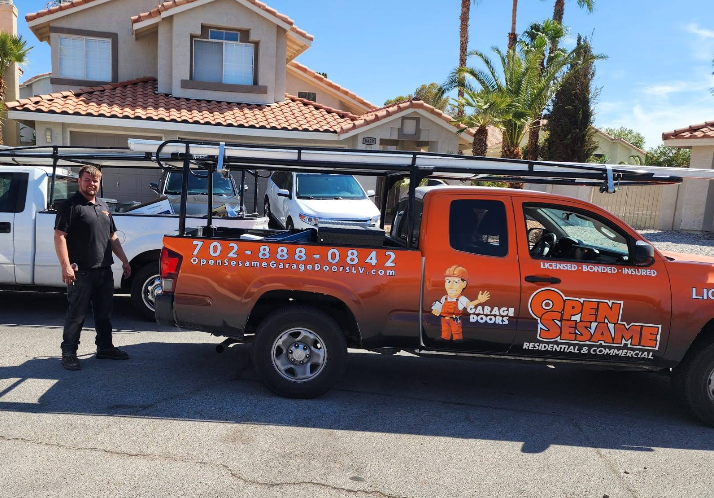
Open Sesame Garage Door is a local garage door repair company serving Las Vegas, Summerlin and nearby Clark County communities.
A garage door that will not close can involve multiple systems, which makes broad garage door repair capability useful.
Open Sesame works with common problems including garage door opener issues, sensor problems, broken springs, cable failures, off-track doors, noisy doors, rollers, tracks and general garage door maintenance.
Sensor & Closing Problems
Diagnosis of doors that reverse, refuse to close, close only while the wall button is held, or behave as though the safety beam is blocked.
Garage Door Opener Repair
Repair for opener drive components, controls, trolleys and related opener failures when the automatic system is responsible.
Mechanical Garage Door Repair
Spring, cable, roller, track and off-track door diagnosis when mechanical resistance or imbalance is preventing normal closing.
Support for Las Vegas Homeowners
Homeowners can call when the garage door cannot secure the property, reverses unexpectedly, becomes crooked or develops unusual noises.
Support for Summerlin Homeowners
Open Sesame serves Summerlin and nearby West Valley communities with garage door opener, spring, cable and general repair services.
Support for Landlords and Property Managers
When a tenant reports that a garage door will not close, the company can help identify whether the failure is electrical, sensor-related or mechanical.
Support for Renters
Renters should normally coordinate major mechanical garage door repairs with the property owner or management company unless their rental agreement says otherwise.
Support for Real Estate Investors
A diagnosis can help distinguish a relatively small sensor or adjustment problem from a larger opener or mechanical repair before decisions are made about replacement.
Contact Options
- Call (702) 888-0842.
- Request garage door repair .
- View Open Sesame Garage Door on Google Maps .
- Review garage door opener repair services .
- Review garage door cable replacement .
- Review garage door spring replacement .
When Is a Garage Door That Won’t Close an Urgent Repair?
Not every sensor problem requires emergency service.
If the garage door remains open and cannot secure the property, however, the situation can become more time-sensitive.
Prompt professional service may be useful when:
- The garage door is stuck fully open overnight.
- The property cannot be secured.
- The garage door is hanging crooked.
- A cable has come loose or off a drum.
- A roller has left the track.
- The door is stuck partially open.
- The opener repeatedly reverses while the door visibly binds.
- A landlord needs to secure a rental property.
- A property manager has an access or security issue.
- A local business cannot secure a garage or overhead opening.
Open Sesame's live site includes information about emergency garage door repair in Las Vegas .
Call (702) 888-0842 to ask about current scheduling and technician availability.
Garage Door Repair Service Areas
Open Sesame Garage Door serves customers throughout Las Vegas, Summerlin and nearby Clark County communities.
The locations below describe areas served and should not be interpreted as separate physical offices in every neighborhood.
Closing problems can look very different from one property to another.
A Summerlin homeowner may have a safety-sensor alignment problem.
A home in The Lakes may have an older opener with worn drive components.
A Spring Valley property may have track resistance or dirty sensors.
A Centennial Hills home may have a cable problem causing the door to close unevenly.
A Henderson or North Las Vegas property may have an opener travel-setting issue.
The location changes the service area, but the diagnosis still depends on the actual mechanical and electrical symptoms.
Open Sesame Garage Door — Las Vegas Location
Open Sesame Garage Door is located at 7865 Bluewater Dr, Las Vegas, NV 89128 and serves Las Vegas, Summerlin and nearby Clark County communities.
Open Sesame Garage Door
7865 Bluewater Dr
Las Vegas, NV 89128
Phone: (702) 888-0842
Garage Door Safety and Consumer Authority Resources
Frequently Asked Questions: Garage Door Won’t Close in Las Vegas
Why won’t my garage door close in Las Vegas?
Common causes include blocked or misaligned safety sensors, damaged sensor wiring, track obstructions, worn rollers, bent tracks, incorrect opener travel settings, spring-balance problems, loose cables, an off-track door or a failing opener drive or control system. The exact symptom—such as immediate reversal, closing only while holding the wall button, or reopening after touching the floor—helps narrow the diagnosis.
Why does my garage door start closing and then go back up?
The opener may be responding to a blocked or misaligned safety sensor, excessive mechanical resistance, a track or roller problem, or an incorrect force or travel setting. Start by clearing the door path and checking the photo-eye sensor lights. If the door is crooked or binding, stop operation and have the mechanical system inspected.
Why will my garage door close only when I hold the wall button?
On many opener systems, this symptom points toward the photo-eye safety system. A blocked sensor, misalignment, damaged wire or failed sensor may be preventing normal automatic closing. Do not permanently bypass or disable the safety sensors.
Can dirty garage door sensors stop the door from closing?
Yes. Dust, spider webs or debris on the sensor lenses can interfere with reliable operation, especially when the sensors are already slightly misaligned. Gently clean both lenses with a soft dry cloth and check whether the sensor indicator lights return to normal.
Why does my garage door touch the floor and then reopen?
One possible cause is an incorrect down-travel setting. If the opener is programmed to move farther than necessary, the door can contact the floor before the opener expects the closing cycle to finish. The resulting resistance may cause the opener to reverse. Mechanical binding should also be ruled out.
Can a broken spring cause a garage door not to close correctly?
Yes. The spring system counterbalances the door throughout its travel. A broken, damaged or poorly balanced spring system can create abnormal weight distribution, uneven movement or excessive speed. Homeowners should not adjust torsion springs or loaded spring hardware themselves.
Why is one side of my garage door closing faster than the other?
Uneven closing can indicate a cable, drum, spring, roller, track or off-track problem. If the door becomes visibly crooked, stop automatic operation. Do not attempt to rewind a loose cable onto the drum while the system is under tension.
Can garage door sensors be bypassed?
Safety sensors are an important part of the opener's entrapment-protection system and should not be permanently bypassed or disabled to make the door close. If the sensor system is malfunctioning, repair the alignment, wiring or failed component instead.
Should I repair or replace my garage door opener if the door won’t close?
Repair may make sense when the problem involves sensors, wiring, a trolley, gear, sprocket, belt, chain, wall control or travel setting. Replacement may be more practical when the opener is older, major parts are obsolete, the motor or rail has failed, or repeated repair costs approach the price of an appropriate replacement system.
Does Las Vegas heat affect garage door opener performance?
Las Vegas heat can contribute to a demanding operating environment for electronics, capacitors, batteries, seals and lubricated components. However, a closing failure should still be diagnosed rather than automatically blamed on temperature because sensor, track, spring, cable and mechanical problems can produce similar symptoms.
Is same-day garage door repair available in Las Vegas?
Open Sesame Garage Door offers same-day garage door repair options in Las Vegas and Summerlin. Current scheduling and parts availability can change, so call (702) 888-0842 to ask about availability for your specific garage door closing problem.
Related Garage Door Troubleshooting Topics
Garage Door Won’t Close in Las Vegas or Summerlin?
If your garage door reverses, remains stuck open, closes unevenly, has a loose cable, comes off track or continues showing a sensor problem after simple cleaning and alignment checks, avoid forcing the system.
Call Open Sesame Garage Door at (702) 888-0842 for garage door opener repair and garage door repair in Las Vegas, Summerlin and nearby Clark County communities.
Safety reminder: Do not wind springs, adjust cable drums, reconnect tensioned cables, force an off-track door or permanently bypass garage door safety sensors.